Design Philosophy: Naoto Fukasawa — Without Thought

The Principle
“Thinking needs time. Feeling can be done in a moment.” – Naoto Fukasawa1
Most product design wants to be noticed. Fukasawa’s wants to be used before you notice it. His term for this is “Without Thought”: design addressed to the body rather than the mind, built on gestures people already perform without deciding to. You do not learn to pull a hanging cord – your hand already knows. A design that borrows an existing behavior needs no manual, no onboarding, no moment where the user stops and thinks. As he put it in a designboom interview, “the design of an object corresponds to our unconscious movements and the environment that surrounds us.”1
This is a different reduction from the two the series has already mapped. Dieter Rams removes to clarify: the reduced object declares its function. Kenya Hara removes to invite: the empty object waits for your interpretation. Fukasawa removes the need for interpretation altogether. The object slots into a behavior that was already there, and the interaction happens before conscious attention arrives. Rams declares. Hara invites. Fukasawa dissolves.
Context
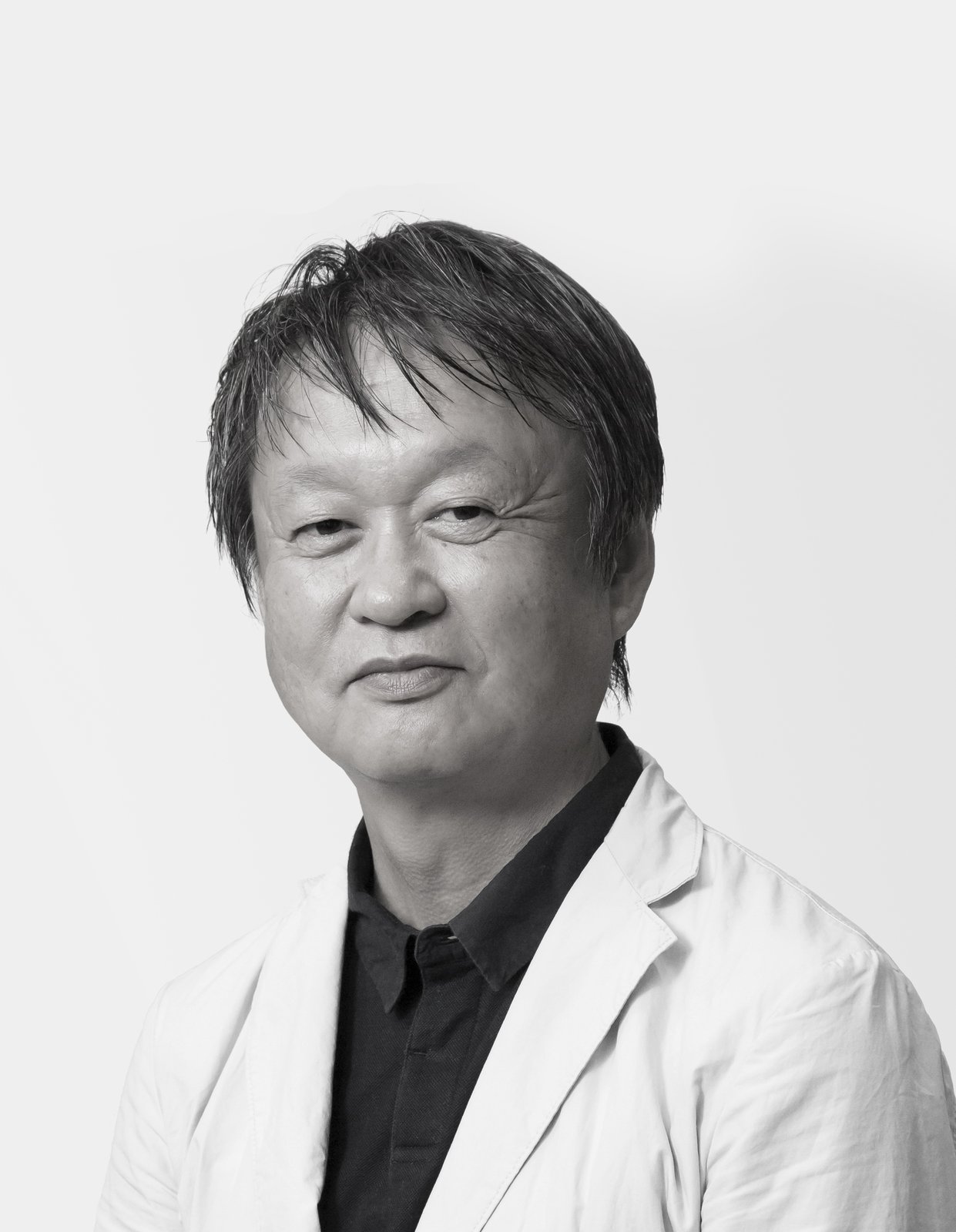
Fukasawa was born in Yamanashi Prefecture in 1956 and graduated from Tama Art University’s product design department in 1980. He spent his first eight years at Seiko Epson as an advanced development designer, then moved to San Francisco in 1989 to join ID Two – the consultancy that became IDEO – designing for Silicon Valley industries. In 1996 he returned to Japan to establish and lead IDEO’s Tokyo office.23
The consultancy years matter because they trained the method. Human-centered design as IDEO practiced it runs on observation – watching what people actually do rather than what they say they do. Fukasawa sharpened that into something more radical: watching what people do without noticing they are doing it. People lean umbrellas against walls, hang bags on doorknobs, find the light switch without looking – a whole vocabulary of behavior that runs below conscious attention. In 1999 he began running annual workshops around this idea, which he named Without Thought. The first commercial proof came out of that same year’s work: a CD player for MUJI that would end up in MoMA.24
In 2003 he went independent, founding Naoto Fukasawa Design in Tokyo and launching ±0 (Plus Minus Zero), a housewares brand built on goods that feel “just right.”3 The institutional roles accumulated: member of MUJI’s design advisory board, art director of the furniture maker Maruni, chairman of the Good Design Award jury from 2010 to 2014, professor at Tama Art University, and, from 2012, director of the Japan Folk Crafts Museum – the Mingeikan, the Tokyo museum Yanagi Sōetsu built to honor anonymous everyday craft.23 That last appointment is the least surprising of all of them. Fukasawa’s whole career is an argument that the best design, like the best folk craft, does not need an author’s signature to work.
The Work
MUJI Wall-Mounted CD Player (1999): A Fan That Plays Music
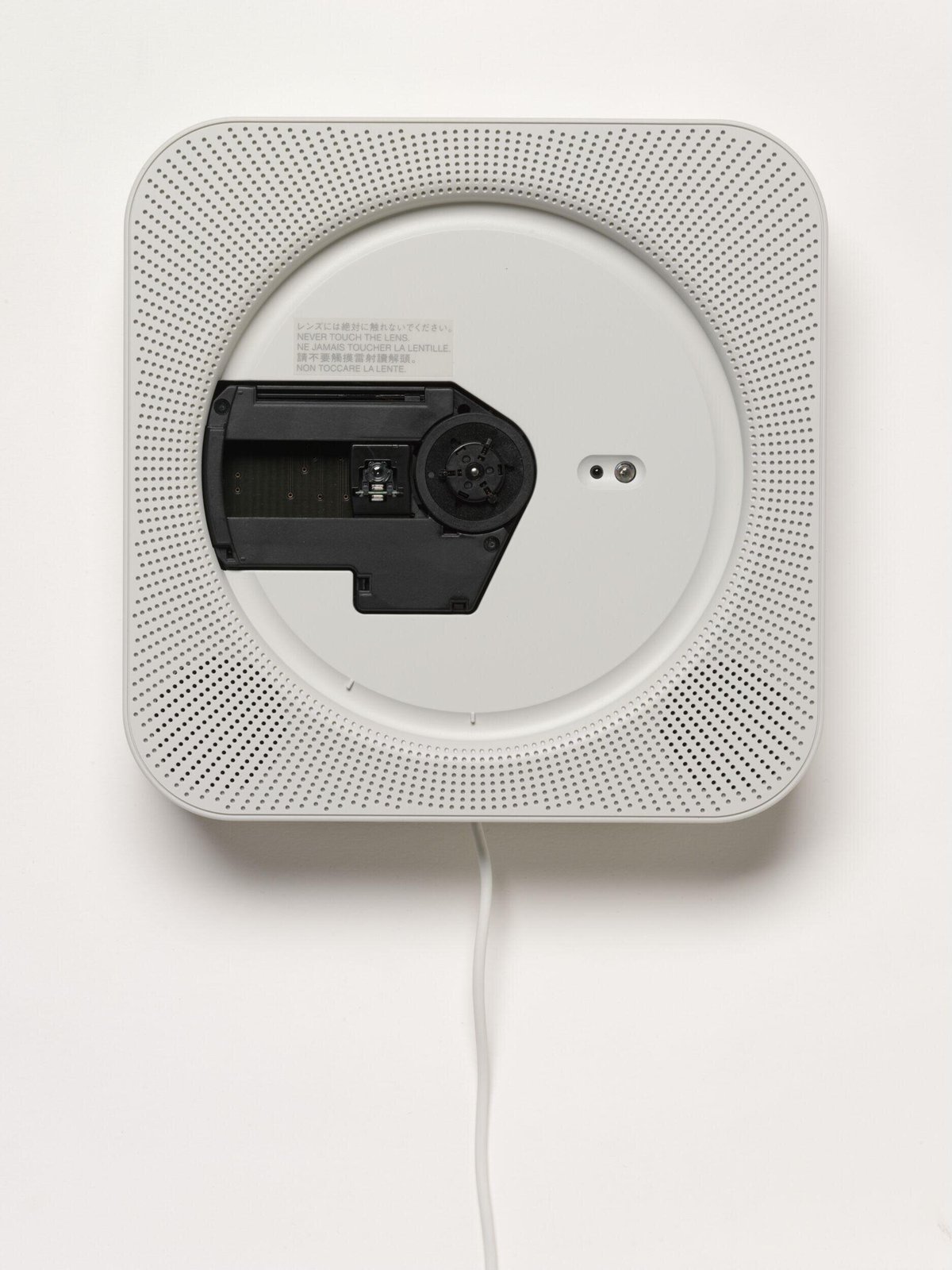
The idea started with a resemblance: a CD spinning in a player looks like the rotating blades of a kitchen ventilation fan. Fukasawa followed the resemblance to its conclusion and borrowed the fan’s interface too – a hanging pull cord. The result, produced by MUJI from 1999, is a square of injection-molded ABS plastic, 17.1 centimeters on a side and 3.8 deep, that mounts on the wall like an extractor fan. The hanging power cord is the switch: pull it and the exposed disc spins and plays.4
The interaction is the design. Nobody reads instructions for a pull cord; the gesture belongs to bathroom fans and closet lights, and the hand executes it before the mind weighs in. What Fukasawa engineered was a small misdirection with a reward inside – the gesture that should produce moving air produces music instead. The V&A’s catalog entry states the doctrine plainly: products should not need an instruction manual; their functionality should be evident instinctively.4
MoMA acquired the player for its permanent collection, and MUJI has kept it in production for decades.5 For an electronics product, whose category logic is planned obsolescence, that longevity is the quiet half of the argument: an object that attaches to a human behavior rather than a technology cycle outlives the technology.
±0 Humidifier (2003): A Drop of Water on the Floor
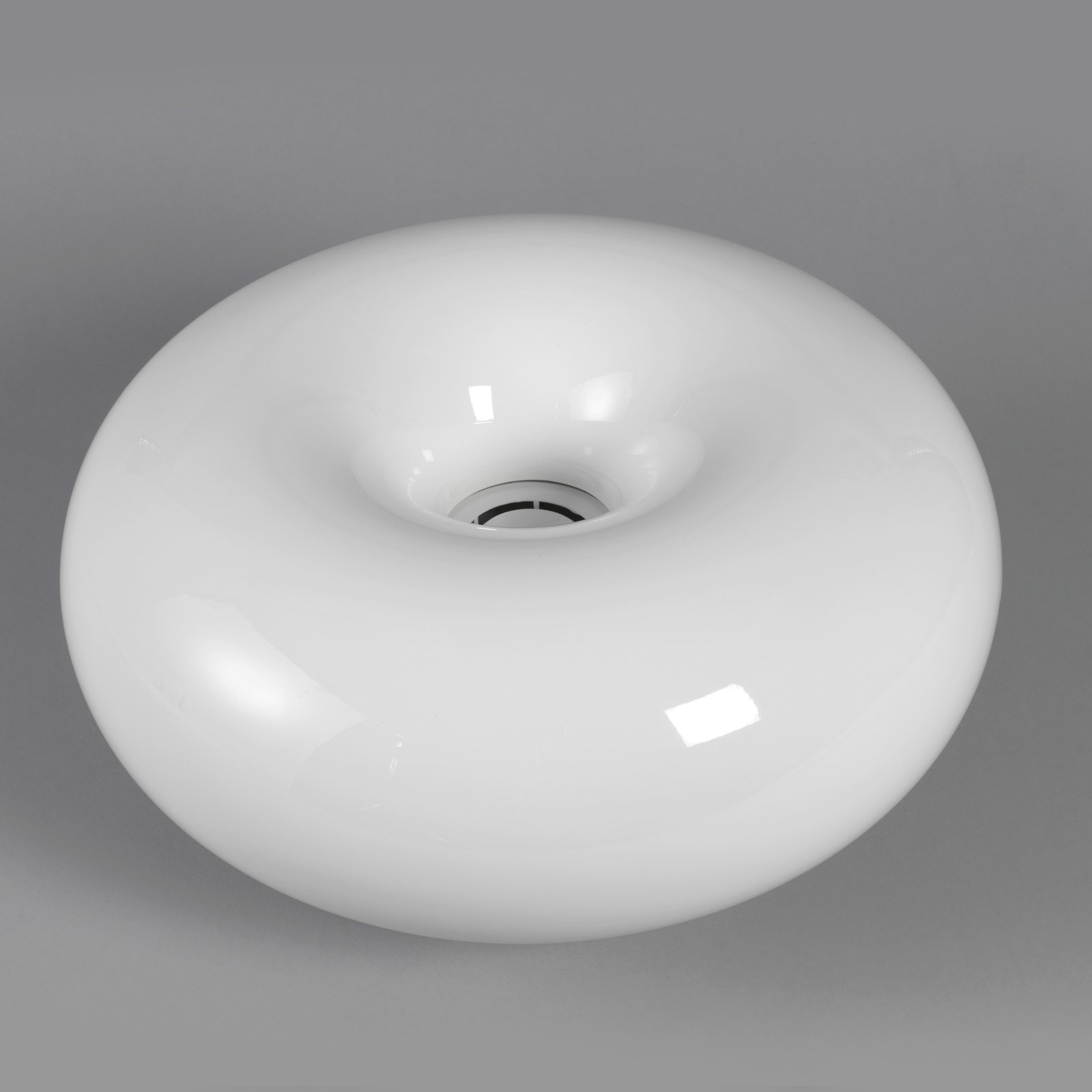
The humidifier was the launch statement for ±0, the brand Fukasawa started the same year as his studio. It is a glossy doughnut about 30 centimeters across, molded in polycarbonate and polypropylene – a form Cooper Hewitt’s record describes as a shiny bulblike shape inspired by a water droplet.6 A humidifier’s job is to put water into the air; Fukasawa gave the object the form of the water itself, sitting on the floor like something spilled and perfected.
The finish carries the philosophy. The seam where the molded halves meet is smoothed, minimized, bonded, painted, and hand-polished until the object reads as one continuous form.6 Mass production plus hand finishing, deployed to erase the evidence of manufacture – the same obsession with the unseen seam that runs through Jony Ive’s work at Apple. The user never consciously registers the absent seam. That is the point. A visible joint is a small demand for attention, and Without Thought design spends attention nowhere.
Like the CD player, the humidifier entered MoMA’s collection.7 Two for two: a museum validating objects designed to be unremarkable.
Hiroshima Chair for Maruni (2008): Craft at Industrial Scale
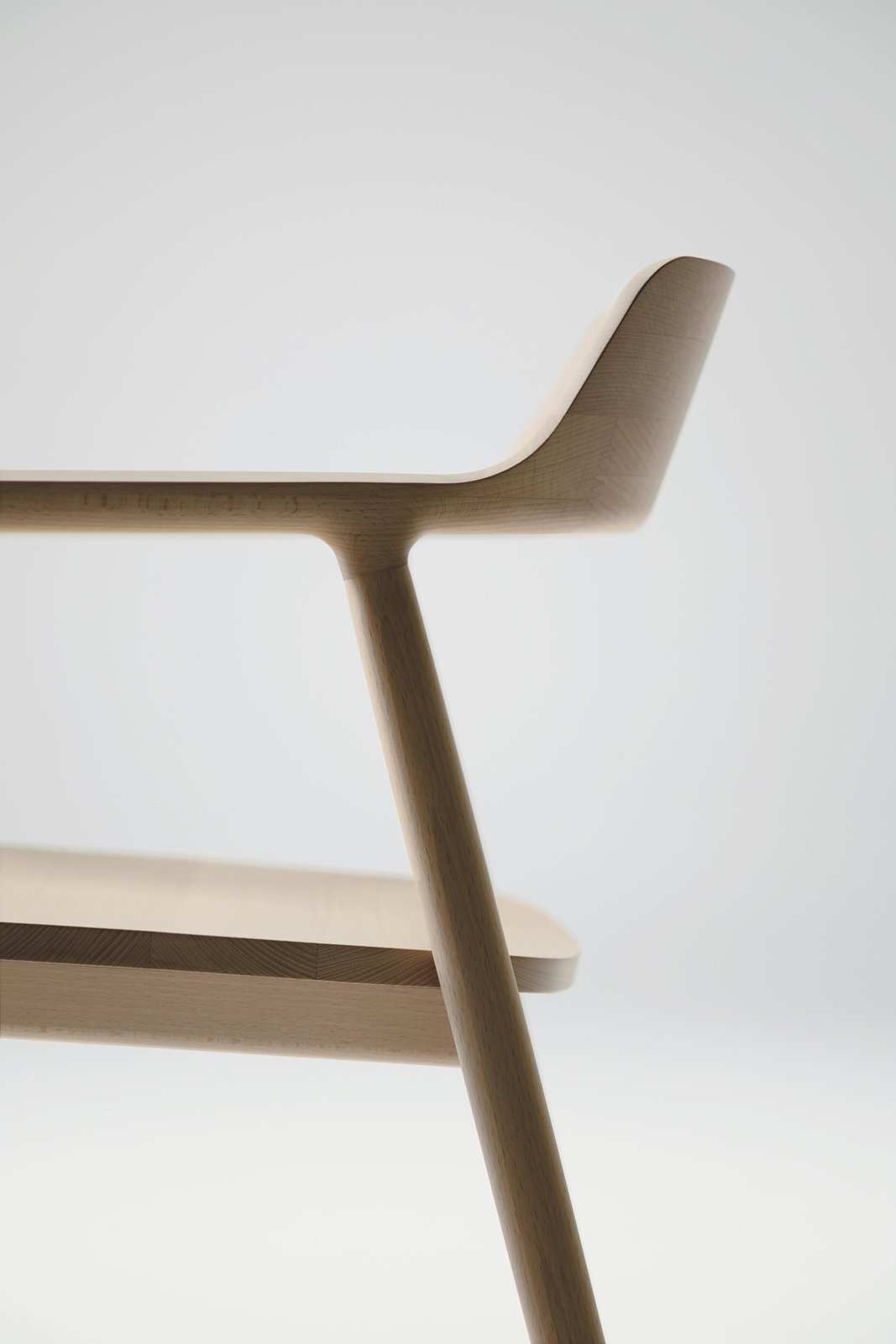
In 2008, Maruni Wood Industry – the furniture maker in the city the chair is named for – launched its Maruni Collection with Fukasawa, who became the company’s art director.38 The Hiroshima armchair is the flagship: beech or oak, the arms and low backrest resolved into a single continuous line, with nothing that reads as styling.9 The parts are cut on five-axis CNC milling machines, then assembled and finished by hand – the ±0 humidifier’s production logic translated into wood.8
The chair does not photograph as spectacular, and that is deliberate. Its qualities are the ones you find at minute thirty of sitting in it, not second one of seeing it – Fukasawa’s stated essence of design, the thing “you’ve missed initially” that only use reveals.1
The most consequential endorsement came from Cupertino: when Apple built Apple Park, it ordered thousands of Hiroshima chairs for the campus’s terrace dining areas and visitor center, with finishes customized to match the building.8 The company that obsesses over unseen details furnished its headquarters with a chair designed on exactly that principle.
The Method
The Without Thought workshops have run annually since 1999: designers photograph and catalog unconscious behaviors, then design objects that attach to them.3 The raw material is never a form or a technology; it is a behavior that already exists. Fukasawa’s official biography compresses the method into one phrase – finding the impetus for design in people’s unconscious behavior – and his working shorthand for the goal is “design dissolving in behavior.”3
The discipline this requires is mostly renunciation. A designer’s instincts push toward novelty, signature, the recognizable hand. Fukasawa treats those as defects: “I like when a project doesn’t sell my name or my characteristic, when it is just an object that happens to be there.”1 His advice to young designers is not a technique but a posture: design means observing objectively, being aware of ourselves as “a simple element in the larger environment.”1
In June 2006 he and Jasper Morrison gave the philosophy a canon. Their exhibition Super Normal, at Axis Gallery in Tokyo, gathered around 200 objects – anonymous everyday items like a shopping basket alongside design classics by Rams, Jacobsen, Bill, and Noguchi – that share one quality: they outperform their flashier counterparts in long-term everyday use.10 The companion book, published by Lars Müller, documents 204 of them.11 Super Normal is Without Thought turned into a curatorial argument: the best objects are the ones that became invisible through use, whether a famous designer made them or nobody remembers who did.
Influence Chain
Who Shaped Him
Dieter Rams provided the reduction lineage. The Super Normal canon includes Rams’ Braun work as a benchmark of the ordinary-done-perfectly, and Fukasawa’s MUJI products are the clearest contemporary descendants of Braun’s white, silent functionalism.10 The inheritance comes with a mutation: Rams removed the unnecessary from the object; Fukasawa also removes the unnecessary from the interaction. (Direct influence)
The Mingei tradition – Japan’s folk craft movement, institutionalized in the museum Fukasawa now directs – supplied the deeper premise: that anonymous, unselfconscious making produces objects of the highest quality precisely because no one was trying to be original.2 Super Normal is Mingei’s argument restated for the industrial product. (Cultural foundation)
The consultancy years at ID Two and IDEO built the observational method. Fourteen years inside human-centered design practice, from Silicon Valley to Tokyo, turned watching users into his native instrument – he then pointed it below the threshold of the users’ own awareness.23 (Formative practice)
Who He Shaped
MUJI’s product identity. The wall-mounted CD player became the definitive MUJI object: unbranded, behavior-first, indifferent to trend. As a member of the design advisory board alongside art director Kenya Hara, Fukasawa builds the objects that Hara’s philosophy of emptiness describes – Hara articulates the void; Fukasawa manufactures things that disappear into it. Hara included Fukasawa’s redesigned tea bag in his 2000 RE-DESIGN exhibition, and the two have anchored MUJI’s design thinking for two decades. (Peer collaboration)
Jony Ive and Apple share the lineage rather than copying the work: both routes lead back to Rams. But the regard is concrete – thousands of Hiroshima chairs in Apple Park’s dining terraces and visitor center, hand-finished to match the campus.8 When the most detail-obsessed company in consumer technology needed chairs worthy of its headquarters, it chose the designer whose chairs refuse to perform. (Convergent lineage, documented endorsement)
The Throughline
Put the three MUJI-adjacent reducers side by side and the series’ map of “less” completes itself. Rams’ object says: here is my function, nothing else. Hara’s object says: the space is yours. Fukasawa’s object says nothing at all – your hand has already used it. Don Norman gave interaction design the vocabulary of affordances, the properties of an object that signal how to use it; Fukasawa builds objects that are nearly all affordance and no signal, because the behavior they afford is one you already had. The design guide traces how these positions relate across the series. (Series bridge)
What I Take From This
The pull cord is the perfect interface because it borrows a behavior instead of teaching one. That is the standard I hold software to: HTMX works because a click that swaps HTML is the web’s oldest gesture, and a good CLI flag works because it matches the muscle memory of every CLI before it. The moment someone has to read the manual, I have made them think – and thinking, as Fukasawa says, needs time.
FAQ
What is Naoto Fukasawa’s design philosophy?
Fukasawa’s philosophy is “Without Thought”: design that attaches to people’s unconscious behavior so that using an object requires no deliberation, no instructions, and no learning. He describes the goal as “design dissolving in behavior” – the object disappears into the gesture it serves. He has developed the idea through annual workshops since 1999 and through his product work for MUJI, ±0, and Maruni.13
What did Naoto Fukasawa design?
His best-known works are the MUJI wall-mounted CD player (1999, in MoMA’s collection), the ±0 humidifier (2003, in MoMA and Cooper Hewitt), the INFOBAR mobile phone for KDDI (2003), and the Hiroshima chair for Maruni (2008), thousands of which furnish Apple Park. His studio has designed for more than 70 brands, including Herman Miller, Alessi, and Samsung.235
What is Super Normal?
Super Normal is a concept and exhibition created by Fukasawa and Jasper Morrison in June 2006 at Axis Gallery, Tokyo, celebrating around 200 objects – many anonymous, some by designers like Rams and Jacobsen – that prove their value through long-term everyday use rather than visual novelty. The companion book, published by Lars Müller, documents 204 objects.1011
What can designers learn from Naoto Fukasawa?
Observe what people do without noticing they are doing it, and design for that. Borrow existing gestures instead of inventing new ones – an interface built on learned behavior needs no manual. Judge objects by their thirtieth day of use, not their first impression. And treat your own signature as a cost: the object that “happens to be there” outlasts the object that performs.1
Sources
Images: portrait and Hiroshima chair photography courtesy Naoto Fukasawa Design; CD player © Victoria and Albert Museum, London; humidifier courtesy Cooper Hewitt, Smithsonian Design Museum.
-
Naoto Fukasawa, interview with designboom. “Thinking needs time. Feeling can be done in a moment,” “the design of an object corresponds to our unconscious movements,” “what you’ve missed initially is the essence,” “I like when a project doesn’t sell my name.” ↩↩↩↩↩↩↩
-
Wikipedia, “Naoto Fukasawa.” Born 1956 in Kōfu, Yamanashi; Tama Art University 1980; Seiko Epson until 1988; ID Two/IDEO and Tokyo office 1996; ±0 founded 2003; INFOBAR (2003); Hiroshima chair (2008); director of the Japan Folk Crafts Museum since 2012. ↩↩↩↩↩↩
-
Naoto Fukasawa Design, About. Official biography: career timeline, Without Thought workshops annually since 1999, “design dissolving in behavior,” MUJI advisory board, Maruni art directorship, Good Design Award chairmanship 2010–2014, 70+ client brands. ↩↩↩↩↩↩↩↩↩
-
Victoria and Albert Museum, “CD Player, Fukasawa, Naoto.” 1999 design for MUJI (Ryohin Keikaku); ventilation-fan inspiration; pull-cord power switch; ABS plastic; 17.1 x 17.1 x 3.8 cm; instruction-manual doctrine. ↩↩↩
-
MoMA, “Naoto Fukasawa. Wall-mounted Compact Disc Player. 1999.” Permanent collection record. ↩↩
-
Cooper Hewitt, Smithsonian Design Museum, “Humidifier (Japan), 2003.” Plus Minus Zero Company; polycarbonate and polypropylene; 15.6 x 30.5 cm; water-droplet form; seam smoothed, bonded, painted, and hand-polished. ↩↩
-
MoMA, “Naoto Fukasawa. Plus Minus Zero Humidifier. 2003.” Permanent collection record. ↩
-
The Peak, “Why Apple wanted this Japanese chair – and why you will, too.” Five-axis CNC milling with hand assembly and finishing; thousands of Hiroshima chairs ordered for Apple Park’s terrace dining areas and visitor centre with customized finishes. ↩↩↩↩
-
Maruni Wood Industry, “HIROSHIMA.” Official series page: beech and oak, design intent. Release year 2008 per twentytwentyone and the V&A’s Hiroshima chair record. ↩
-
Jasper Morrison, “Super Normal” exhibition page. June 2006, Axis Gallery, Tokyo; the “gradual noticing” that discrete objects outperform in long-term everyday use; inclusion of Rams, Jacobsen, Bill, and Noguchi. ↩↩↩
-
Lars Müller Publishers, Super Normal: Sensations of the Ordinary by Naoto Fukasawa and Jasper Morrison. 204 objects; published on the occasion of the 2006 Tokyo exhibition. ↩↩











