Design Philosophy: Daniel Arsham — Everything Becomes a Relic

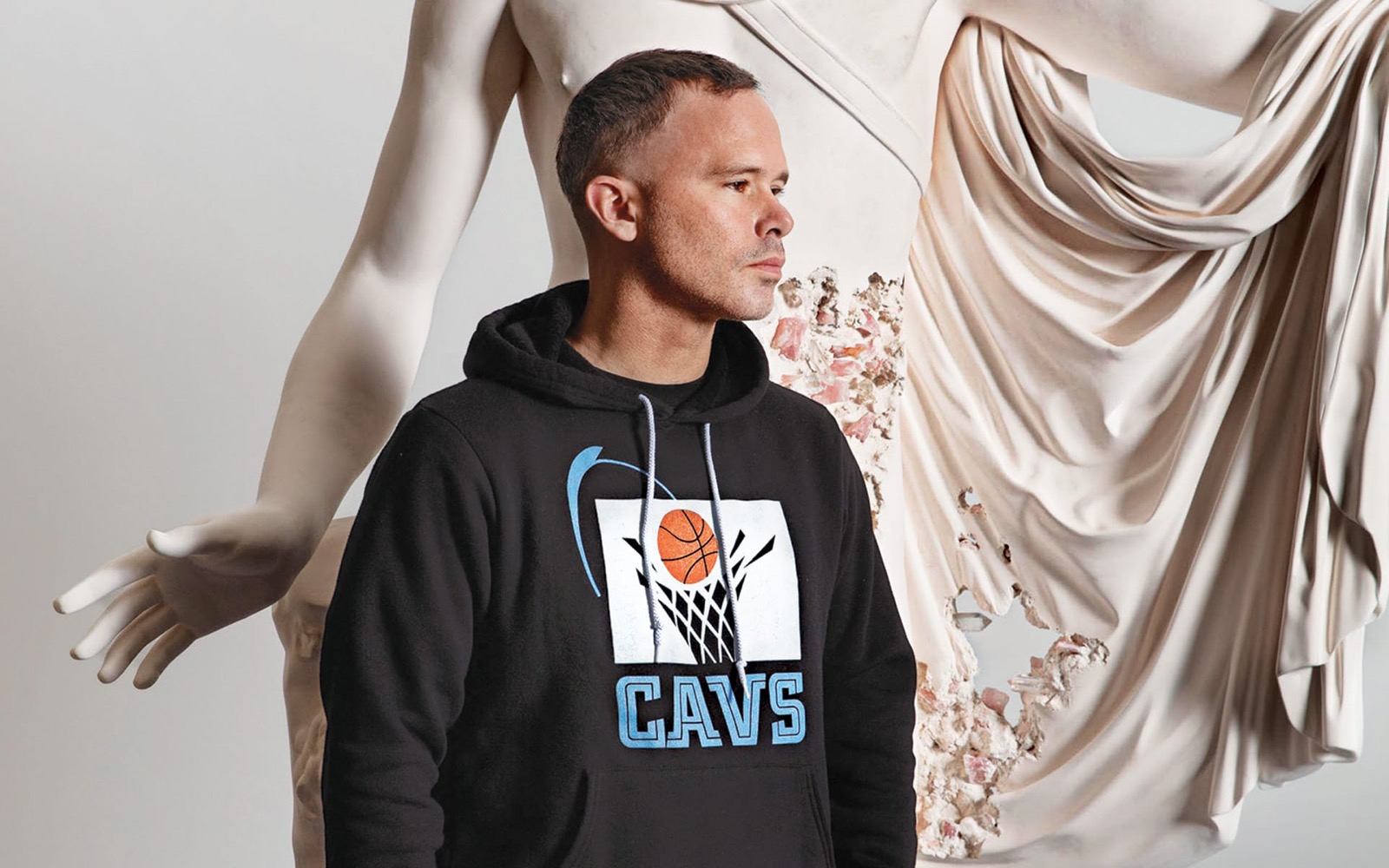
The Principle
“Everything that exists today will become a relic – an archeological object – in the future. The idea of fictional archeology allows us to view those things with a perspective of time, to view them from some future era.” – Daniel Arsham1
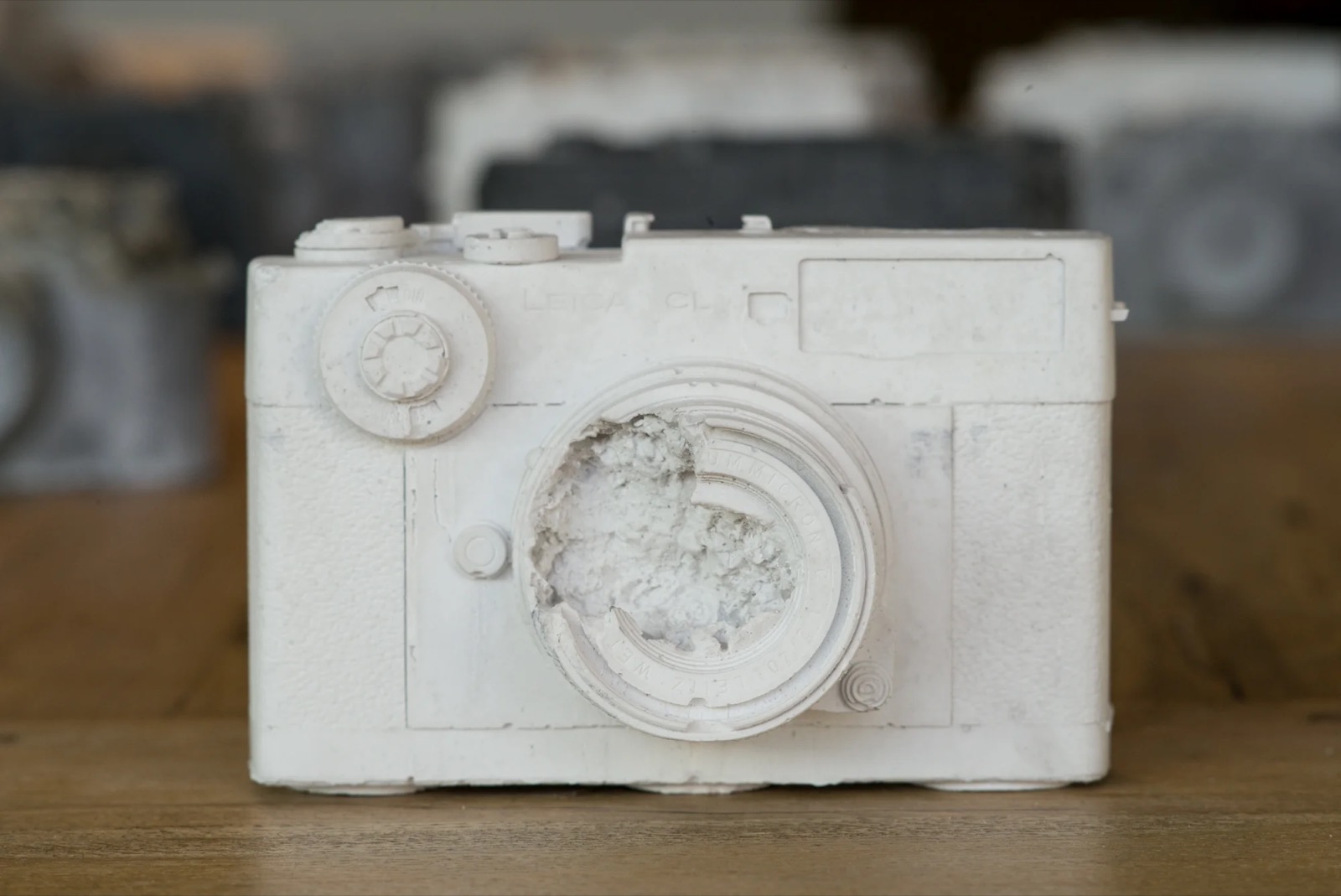
Arsham’s method is temporal displacement. He takes objects from the present – cameras, Porsches, basketballs, keyboards – and casts them in volcanic ash, selenite, quartz, and crystal. The resulting sculptures look like they were excavated from a dig site a thousand years from now. They are simultaneously familiar and alien: you recognize the object, but the material tells you it has been through deep time.
The critical insight is the dual reading. “Although my versions appear to be in a state of decay, they are made with materials that feature embedded elements, such as crystals and volcanic ash, which are components that we associate with a long geological time frame,” Arsham explains. “Thus, there are two potential readings of the work: one is that they are falling apart and the other is that they’re growing together to a state of completion.”1
Decay and formation are the same process viewed from different positions in time. This is not pessimism about impermanence. It is a design method that uses time as a material.
Context
Daniel Arsham was born in Cleveland in 1980 and grew up in Miami. In 1992, Hurricane Andrew destroyed his family home. He was twelve. He hid in a reinforced closet, and when he emerged, walls were ripped apart, family possessions scattered into useless piles. The experience appears in every eroded sculpture he has made since – objects in states of destruction and reconfiguration, structures revealing their interiors.2
Arsham is severely color blind, distinguishing approximately 20% of what a normal eye perceives. This explains his signature near-monochromatic palette – the whites, grays, and soft mineral tones that dominate his work. When he received corrective EnChroma glasses, the adjustment was not entirely welcome: “The more I wear these glasses, the more difficult it seems to imagine wearing them all the time. There were consequences that I hadn’t anticipated. It was almost like color fatigue.”3
He attended Cooper Union on a full scholarship and in 2004, at age 24, began designing stages for Merce Cunningham – the youngest artist to work with Cunningham’s company and the last to collaborate before Cunningham’s death in 2009. The relationship was foundational. “I learned a lot from him in using techniques where you could generate a scenario in which different people would work together but all of them were just implementing the best things that they could do.”4
In 2007, he co-founded Snarkitecture with Alex Mustonen, a fellow Cooper Union graduate. The firm operates “in the territory between art and architecture, emphasising the transformation of the familiar into the extraordinary.”5
The Work
Fictional Archaeology (2011-present): The Easter Island Revelation
The method crystallized on Easter Island in 2011. Arsham watched archaeologists excavating the famous statues and discovered that tools left by previous archaeologists a century earlier were embedded in the same ground. “Looking at this, I had this idea about the collapse of time within those two separate objects – the sculpture from 1,000 years ago and a more contemporary tool.”1
He returned and began casting present-day objects in geological materials – volcanic ash, crystal, blue calcite, glacial rock dust – as if they had been unearthed in the distant future. The objects he selects are deliberately universal. “When I was considering a body of work around fictional archeology, I looked for markers of universal meaning. I picked things that could be found here, in Japan, South America, or really anywhere in the world.”1
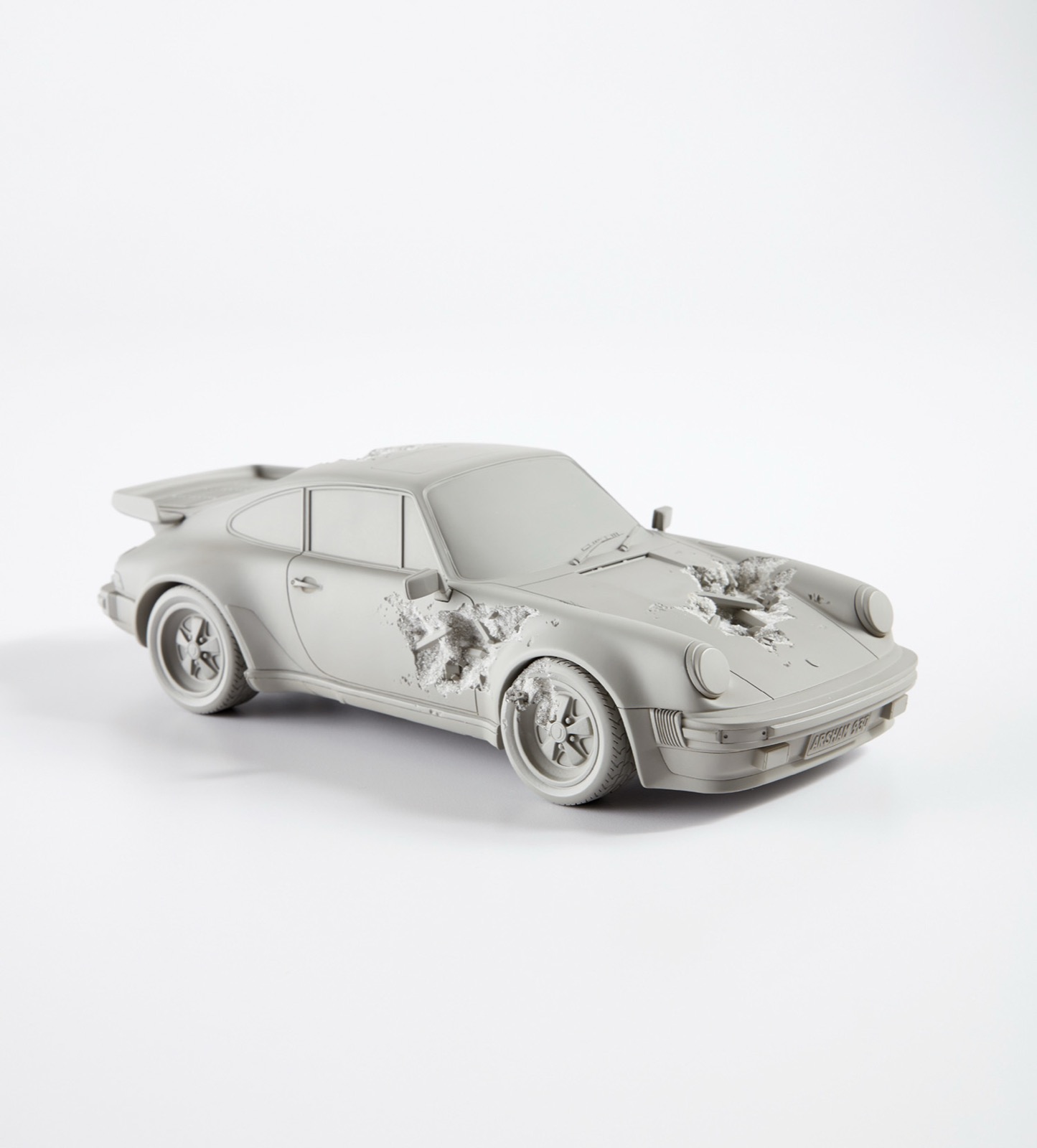
A crystal basketball. An eroded Porsche 911. A volcanic ash camera. Each object is recognizable but displaced in time. The viewer understands what it was. The material tells them it is no longer that thing – or not yet.
Snarkitecture — The Beach (2015): Space as Experience
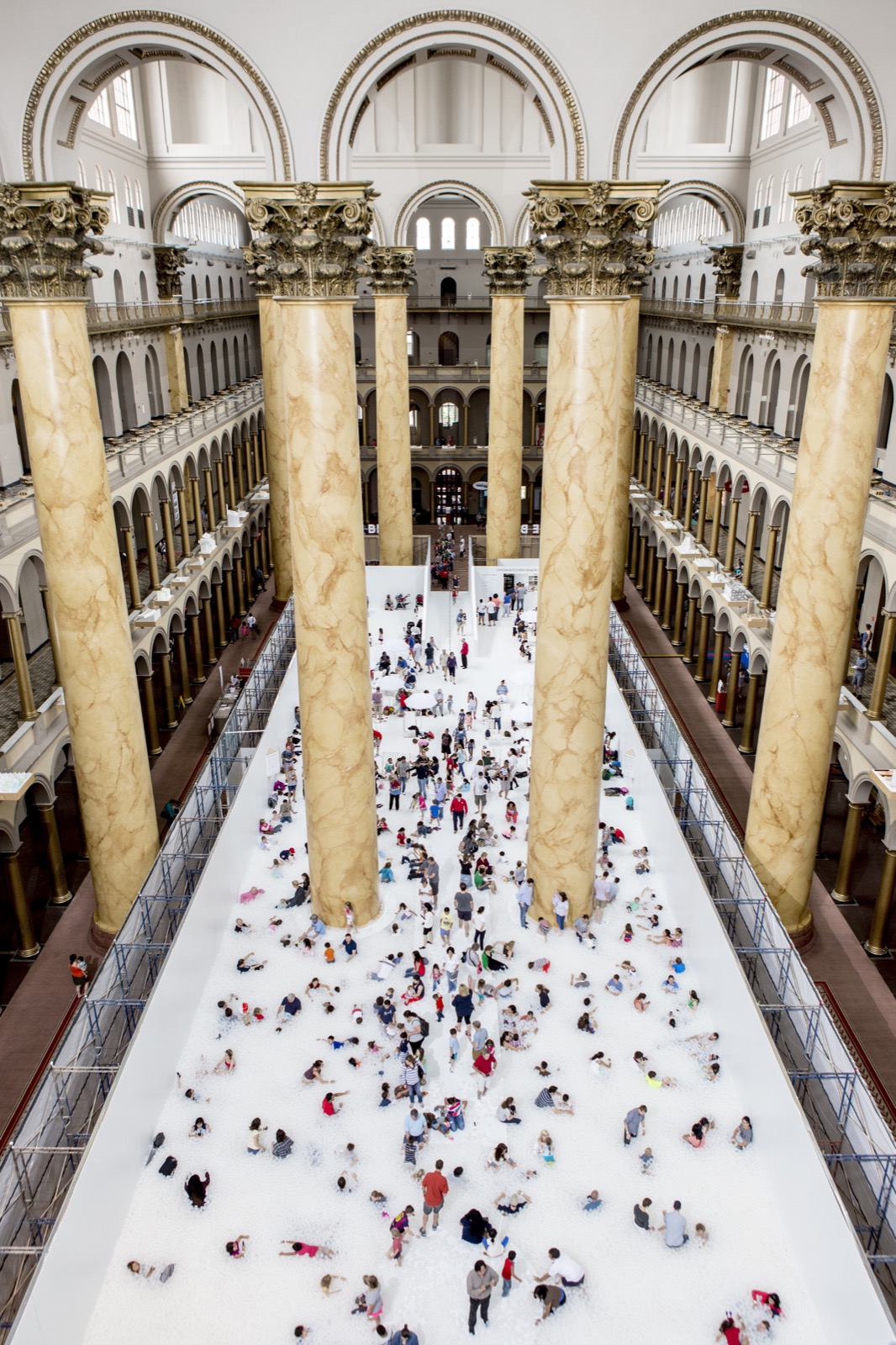
Snarkitecture’s most celebrated installation filled the National Building Museum in Washington, D.C., with nearly one million translucent recyclable balls across 10,000 square feet, creating a 50-foot “shoreline” with beach chairs and umbrellas reflected in a mirrored wall to infinity. Over 50,000 people visited. The installation toured to Sydney, Paris, Tampa, and Bangkok.5
The Beach demonstrated Arsham’s spatial thinking: architecture is not a container for experience. Architecture is the experience. The balls are not decoration. They are the medium – the way the building feels changes completely when the ground becomes unstable, translucent, and ankle-deep. The familiar (a beach) becomes extraordinary (inside a neoclassical museum) through material substitution.
Cleveland Cavaliers Creative Director (2020-present): Design at Institutional Scale
Arsham became the first artist to hold a creative director position in professional sports. He redesigned the Cavaliers logo (a 1990s-inspired simplification), created the 2022 NBA All-Star Game logo based on Cleveland’s Terminal Tower, redesigned the court, and renovated the walk-in tunnel at Rocket Mortgage FieldHouse.6
“My family’s Cleveland roots go back to 1908,” Arsham said. “If Warhol was around today, he’d be the creative director of the Knicks. He would’ve known what to do there.”6 The statement is not grandiosity. It is a position: the boundary between art and commercial design is a fiction maintained by people who benefit from keeping artists in galleries and away from the institutions where most people actually encounter visual identity.
Collaborations: Dior, Adidas, Porsche, Pharrell
Arsham’s commercial collaborations apply the fictional archaeology method to products. The Adidas Futurecraft 4D (2018) is a sneaker designed as an eroded future artifact. The Dior SS20 collaboration with Kim Jones placed crystal-encrusted sculptures alongside runway fashion. The Porsche partnership produced eroded 911s in blue calcite and volcanic ash.7
Virgil Abloh wrote the foreword to Arsham’s Rizzoli monograph. Both share the conviction that art and commerce are not opposed – that a white T-shirt can be transformed by art “in the same way as a canvas.”8 Arsham has also collaborated directly with Pharrell Williams, recreating Pharrell’s first keyboard in volcanic ash.
The Method
“Probably 50 percent of my new ideas come from finding something that didn’t work,” Arsham told The Talks. “A lot of my work comes about through accidents or failure: finding something that didn’t work, and then thinking about it in a new way.”2
The failure rate is not a confession. It is the method. Arsham’s studio practice is experimental in the scientific sense: try a material combination, observe the result, keep what works, discard what doesn’t, and revisit the discards later because “it can take years to get there.”2
“Everything is hand made. All of the molds are hand made,” he told Autre Magazine.9 He uses 3D printing for precision – “I’m 3D printing components so that once they’re cast, they’re going to interlock perfectly” – but the fabrication is physical.2 The hand is in the work. The geological materials are real, not simulated. The crystals grow. The volcanic ash was ejected from an actual volcano.
“I tend to think about everything as a kind of architecture,” Arsham has said. “An exhibition, a sculpture, or a book all require structure and rhythm.”1 The architectural thinking – inherited from Cooper Union and the Cunningham stage collaborations – means that even a single sculpture is designed as a spatial experience, not an isolated object.
“Most people just don’t have the willingness to fail for ten years,” he observed.10 The patience is the method’s cost. The payoff is a body of work that spans sculpture, architecture, fashion, film, and professional sports without treating any medium as primary.
Influence Chain
Who Shaped Him
Merce Cunningham gave Arsham his collaborative methodology – the idea that multiple practitioners can work independently toward a shared vision without compromising their individual excellence. The Cunningham stage designs (2004-2009) were Arsham’s first major work and established his approach to spatial thinking. (Direct influence)4
Hurricane Andrew gave him the visual vocabulary – structures revealing their interiors, objects scattered and reconfigured, the domestic made unfamiliar through destruction. Every eroded sculpture is a controlled version of what the hurricane did uncontrollably. (Formative experience)2
Who He Shaped
The art/commerce boundary. Arsham operates simultaneously in galleries (Perrotin), professional sports (Cleveland Cavaliers), fashion (Dior, Adidas), luxury goods (Porsche, Tiffany, Rimowa), and film – without treating any medium as more legitimate than another. “There is no reason that a white T-shirt can’t be transformed by art, in the same way as a canvas.”1
Virgil Abloh and Arsham shared the “everything is design” conviction. Abloh wrote Arsham’s Rizzoli monograph foreword. Both refused to distinguish between gallery objects and commercial products. (Mutual influence)8
The Throughline
Arsham occupies the position in this series where art meets product and neither apologizes. Futura moved from subway trains to galleries to Supreme collaborations – the graffiti-to-commerce pipeline. Arsham starts in galleries and moves outward to NBA courts, sneakers, and Porsche partnerships without treating the outward movement as a compromise. Fujiwara curates across media. Pharrell arranges across media. Arsham erodes across media – applying the same temporal displacement method to a basketball, a building, and a runway show. The medium changes. The method does not. (Series bridge)
What I Take From This
“Probably 50 percent of my new ideas come from finding something that didn’t work.” That is the debugger’s mindset. The failed experiment is data, not waste. The thing that didn’t work last year might be the solution to this year’s problem, if you kept it.
FAQ
What is Daniel Arsham’s design philosophy?
Arsham practices “fictional archaeology” – casting present-day objects in geological materials (volcanic ash, crystal, quartz) to create sculptures that appear to have been excavated from the distant future. His work uses time as a design material, offering dual readings: objects that are simultaneously decaying and forming. He treats art and commerce as inseparable and works across sculpture, architecture, fashion, film, and professional sports.1
What did Daniel Arsham create?
Arsham co-founded Snarkitecture (2007), created the fictional archaeology body of work (2011-present), installed The Beach at the National Building Museum (2015), and serves as creative director of the Cleveland Cavaliers (2020-present). He has collaborated with Dior, Adidas, Porsche, Pharrell Williams, and Tiffany & Co. His retrospective “Wherever You Go, There You Are” was shown at the Orange County Museum of Art (2023).567
How does Daniel Arsham’s work relate to streetwear and fashion?
Arsham bridges fine art and commercial design without distinguishing between them. His collaborations with Dior, Adidas, and Porsche apply the same fictional archaeology method he uses in gallery sculpture. Virgil Abloh wrote the foreword to his monograph. Both share the conviction that consumer objects are as valid a canvas as gallery walls.78
What can designers learn from Daniel Arsham?
Failure is 50% of the method. The thing that didn’t work is data for the next attempt. Think in terms of time – everything you design will eventually become a relic, and designing with that awareness changes what you prioritize. And the boundary between art and commerce is a fiction: the quality of attention you bring to a sculpture should be the same quality you bring to a logo, a court design, or a sneaker.
Sources
-
Daniel Arsham, “Fictional Archeology Interview,” Art & Object. Easter Island origin, dual reading of decay/growth, universal markers, “everything as architecture.” Also: “How He Builds a Creative Life.” ↩↩↩↩↩↩↩
-
Daniel Arsham, The Talks interview. “50 percent of new ideas from failure,” 3D printing process, “it can take years.” ↩↩↩↩↩
-
Highsnobiety, “Daniel Arsham Color Blindness.” EnChroma glasses, “color fatigue,” 20% color perception. ↩
-
Daniel Arsham, 52 Insights interview. Cunningham collaboration, “all objects become ruins,” collaboration philosophy. ↩↩
-
Dezeen, “Snarkitecture: The Beach.” National Building Museum, one million balls, 50,000 visitors. ↩↩↩
-
Surface Magazine, “Daniel Arsham: Cleveland Cavaliers Creative Director.” Logo redesign, All-Star Game, Warhol/Knicks quote. ↩↩↩
-
Hypebeast, “Daniel Arsham Eroded 911 Turbo” and “Futurecraft 4D Interview.” Porsche and Adidas collaborations. ↩↩↩
-
Rizzoli, Daniel Arsham monograph. Foreword by Virgil Abloh. “White T-shirt transformed by art” from Art & Object interview. ↩↩↩
-
Daniel Arsham, Autre Magazine interview. “Everything is hand made,” Future Relic film series, “a lot of failure in what I do.” ↩
-
Daniel Arsham, The Creative Independent. “Most people just don’t have the willingness to fail for ten years,” “luck is manufactured.” ↩











