Kunle Adeyemi: Makoko Floating School & Water Architecture

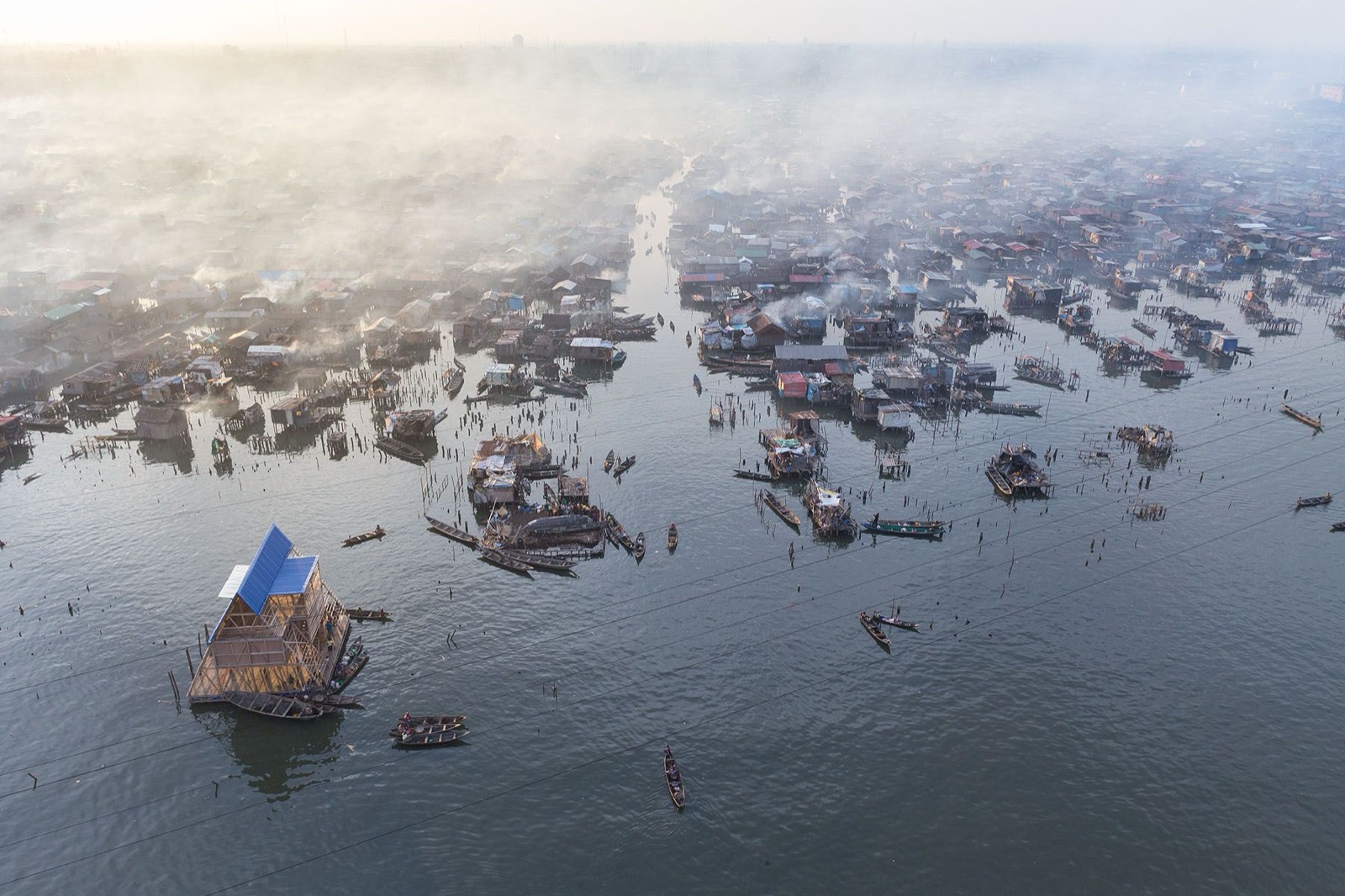
Kunle Adeyemi is a Nigerian architect who founded NLÉ after nine years at OMA with Rem Koolhaas. His most recognized work, the Makoko Floating School, is a prototype for climate-adaptive infrastructure built on the Lagos lagoon. The system has deployed in six countries across three continents, winning the Silver Lion at the Venice Biennale. Adeyemi designs for instability rather than against it, treating rising water, shifting coastlines, and informal settlements as conditions to work with. His design philosophy centers on iterative prototyping at architectural scale.
The Principle
“We’re not only invested in building on water. It’s not about ‘floating architecture,’ that’s really not what my practice is focused on. It’s really the relationship between water and the city, between water and humans.” – Kunle Adeyemi1
Adeyemi designs for instability. Not instability as a problem to solve, but instability as a permanent condition to design with. Water rises and falls. Coastlines shift. Informal settlements grow without plans. The conventional architectural response fights these conditions: build seawalls, pour foundations, impose order. Adeyemi’s response works with them: float on the water, adapt to the flooding, learn from the informality rather than replacing it.
The work produces infrastructure for environments that will not hold still, and as climate change accelerates, that description applies to more of the world every year. Where Tadao Ando sculpts concrete to frame nature as something to contemplate, Adeyemi builds structures that float on nature as something to negotiate with.
Context
Kunle Adeyemi is a Nigerian architect who studied at the University of Lagos and earned a post-professional degree from Princeton, where he worked with Peter Eisenman investigating rapid urbanization and market economies in developing cities, focusing on Lagos. He also holds a certificate in Real Estate Economics and Finance from the London School of Economics.2
He spent approximately nine years at OMA working closely with Rem Koolhaas, leading the design of major projects including the Shenzhen Stock Exchange tower, Qatar National Library, and the Prada Transformer in Seoul. Critically, OMA had an ongoing research project on the urbanization of Lagos, the same city Adeyemi grew up in. The research gave him both the analytical framework and the personal motivation to found his own practice.2
In 2010, Adeyemi founded NLÉ (“at home” in Yoruba), based in Amsterdam and Lagos. The practice describes itself as “a design and development practice for innovating cities and communities,” focused on “bridging critical gaps in infrastructure and urban development.”2
His academic work at Cornell, Columbia, Princeton, and Harvard centers on “Water & The City”: the intersections of rapid urbanization and climate change along coastlines, rivers, lagoons, and floodplains. Over 70% of Africa’s major cities and capitals sit near waterfronts.3
The Work
Makoko Floating School (2013): The Prototype
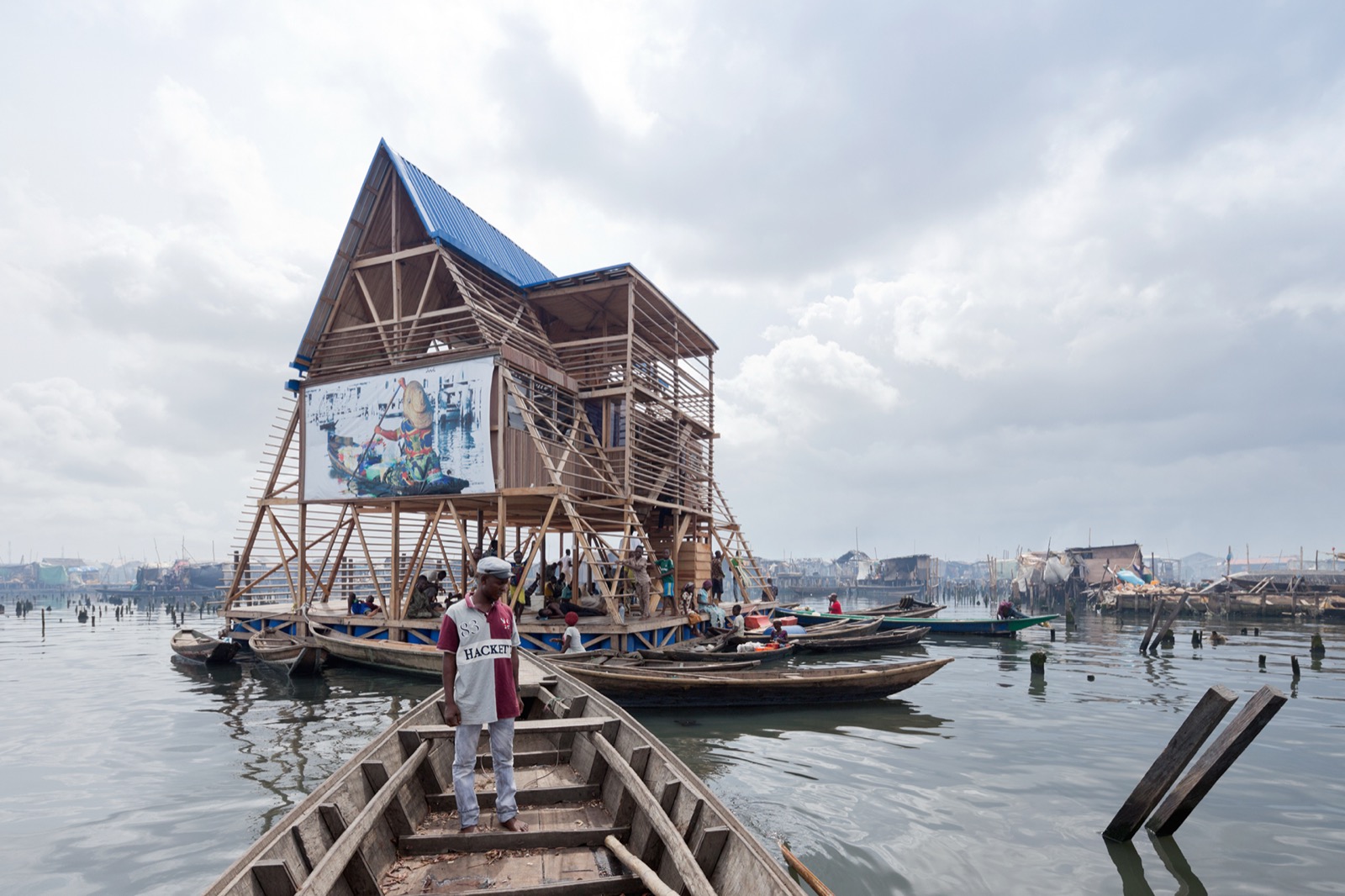
The Makoko Floating School was a prototype floating structure for the historic water community of Makoko on the Lagos lagoon, a settlement of approximately 100,000 people living in structures on stilts over the water. The school occupied 220 square meters, rode on 256 plastic drums, and served as “a pilot project taking an innovative approach to address the community’s social and physical needs in view of the impact of climate change and a rapidly urbanizing African context.”4
The school collapsed in 2016 after heavy rain. NLÉ published a detailed FAQ response rather than treating the collapse as a failure to hide. The collapse yielded data: it revealed which structural assumptions held and which did not. Subsequent iterations incorporated those findings.
“The innovation of Makoko Floating School came not only from us, but largely from the community itself,” Adeyemi said. “We were simply agents to compose those ideas into a new form or an improvement of what’s already existing.”1
MFS II (2016): Silver Lion at Venice
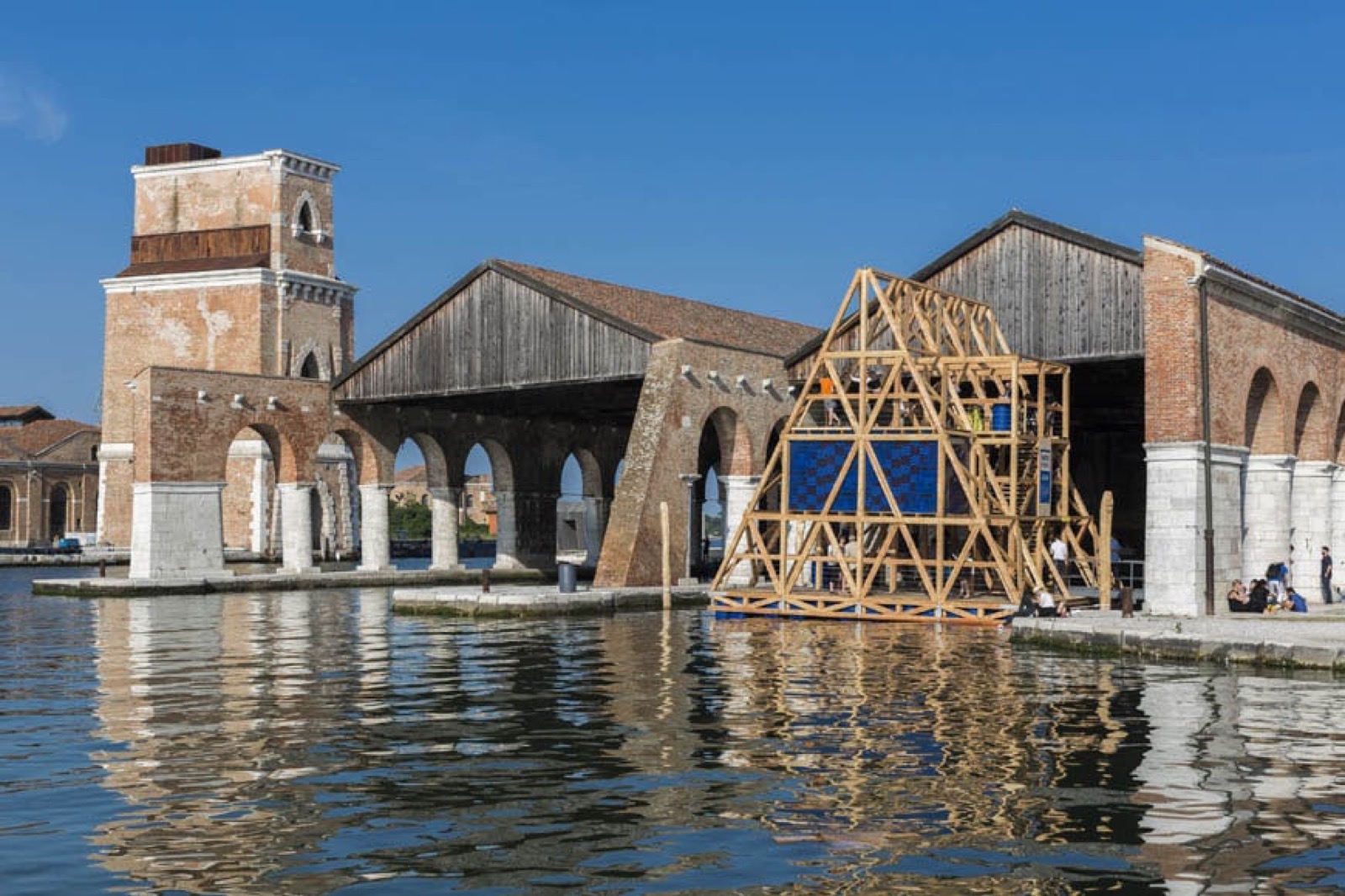
Alejandro Aravena curated the 15th Venice Architecture Biennale under the theme “Reporting from the Front,” where the second iteration of the Makoko Floating System appeared. The improved design was modular, constructed from sustainably sourced wood, and capable of hand assembly and disassembly. It won the Silver Lion Prize.4
MFS IIR (2023-2024): Six Prototypes, Three Continents
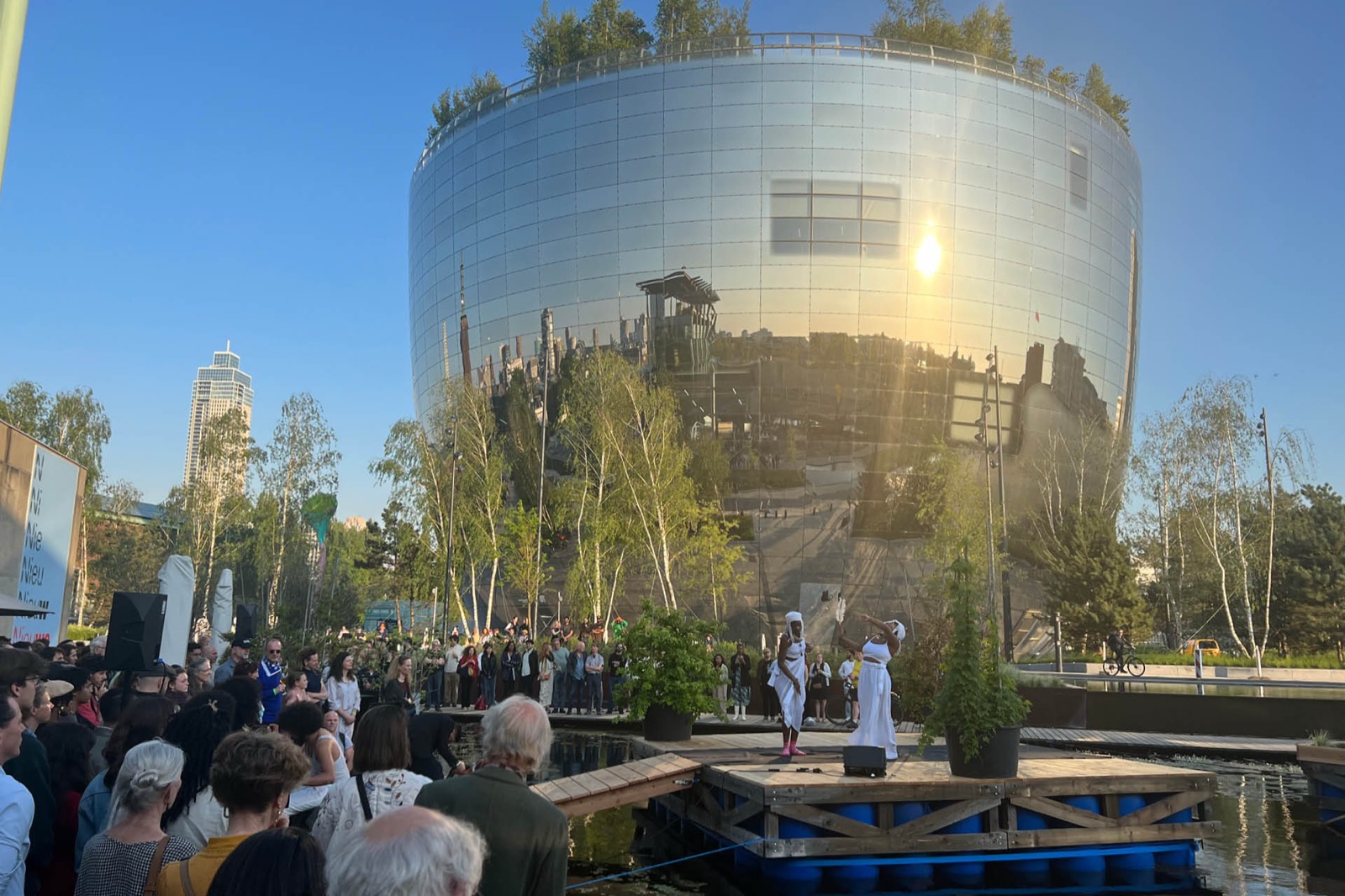
The system has now deployed in six countries across three continents, with each iteration refining the design. MFS IIR at Het Nieuwe Instituut in Rotterdam was the sixth prototype, built from reused and recycled components of MFS II, the Venice Silver Lion winner. The iteration history is the method: each deployment teaches something the previous one could not.5
“We are just starting to brace ourselves and learn to live with water as opposed to fighting it,” Adeyemi has said.1
Black Rhino Academy (2018): Learning from Indigenous Settlement
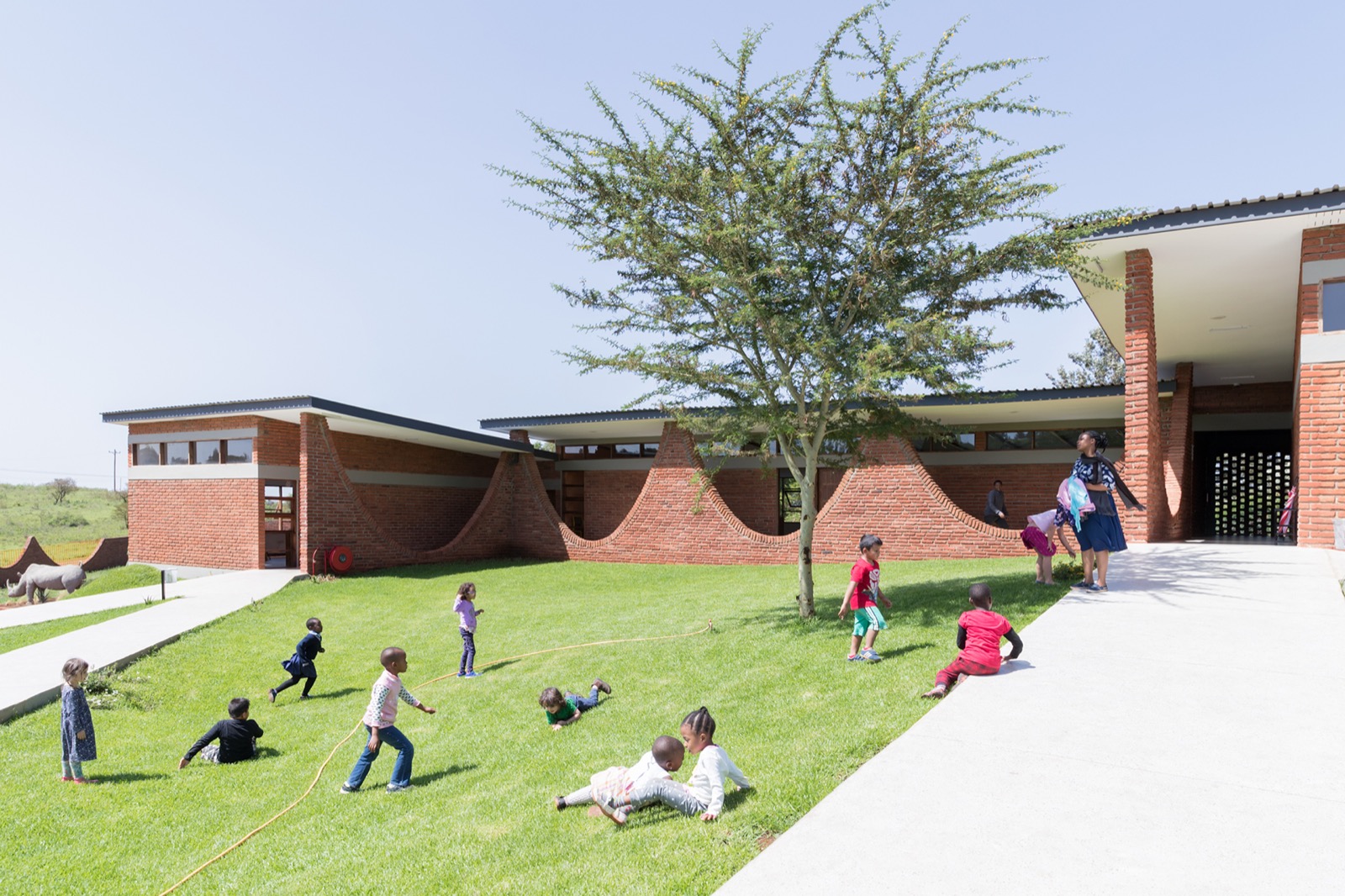
The Black Rhino Academy in Karatu, Tanzania, is a primary and secondary international boarding school whose campus masterplan draws from Iraqw and Masai Boma settlements, organized in rings of small building units rather than institutional blocks. Metropolis named the project one of its Best Buildings of 2018.6
The indigenous settlement reference is not decorative. The ring organization produces the same spatial qualities (community gathering, graduated privacy, ventilation between units) that centuries of occupation have optimized. Adeyemi’s method here mirrors Wang Shu’s salvage approach: using existing knowledge rather than imposing imported solutions.
The Method
Adeyemi’s method is prototyping at architectural scale. The Makoko Floating System evolved through six iterations across three continents: Lagos, Venice, multiple locations, Rotterdam, Chengdu. Each iteration refined the previous one, incorporating structural data from collapses, user feedback from communities, and material insights from different climates.45
The method requires treating failure as information. MFS I collapsed. The response was not to abandon the concept but to publish the failure analysis and build a better version. Architecture rarely tolerates that approach, since buildings are expected to be permanent and failures are liabilities. Adeyemi treats buildings the way software treats releases: version 1 teaches you what version 2 needs. Neri Oxman iterates through material computation; Adeyemi iterates through deployment and collapse.
His approach to informal settlements is equally specific: work with the existing patterns rather than replacing them. The Makoko community already lived on water. The question was not “how do we move them to land?” but “how do we improve the conditions under which they already live?” The reframing from replacement to improvement is the political dimension of the work.
“The architects of the future will begin to be seen more as agents of change,” Adeyemi has said.1 The statement echoes Frank Lloyd Wright’s belief that architecture shapes society, but Adeyemi locates agency in communities rather than individual genius.
Influence Chain
Who Shaped Him
Rem Koolhaas / OMA gave Adeyemi nine years of training at the highest level of institutional architecture, plus the Lagos urbanization research that seeded NLÉ. Koolhaas’s intellectual framework (architecture as cultural research, not just building) runs through everything Adeyemi does. (Direct influence)2
Peter Eisenman at Princeton supervised Adeyemi’s research on market economies in developing cities, providing the theoretical foundation for treating informal settlements as design problems rather than urban failures. (Direct influence)2
Who He Shaped
Architecture for water. The Makoko Floating System is the most internationally recognized prototype for floating community infrastructure. As climate change makes coastal flooding more frequent, Adeyemi’s research (compiled in the 2023 publication African Water Cities) provides the framework for how cities can adapt rather than resist.3
The architect as iterative prototyper. Most architects design a building, build it once, and move on. Adeyemi’s MFS system has deployed, failed, revised, and redeployed six times. The iterative method, borrowed from product design and applied to architecture, challenges the profession’s assumption that buildings are permanent, single-version artifacts.
The Throughline
Adeyemi and Diébédo Francis Kéré both design for African contexts but address different environmental conditions. Kéré designs for extreme heat on stable ground: his double roofs and compressed earth walls solve the problem of keeping cool. Adeyemi designs for water and flooding on unstable ground: his floating systems solve the problem of keeping dry. Together, they demonstrate that architecture for Africa is not one problem but many, each requiring its own method derived from its own constraints.
Fumihiko Maki designed buildings as participants in an urban field, responsive to their neighbors. Adeyemi designs buildings as participants in an environmental field, responsive to water levels, tidal patterns, and climate shifts. Both reject the building-as-monument. Both require the architect to listen to the site, but Adeyemi’s site is literally moving. (Series bridge)
What I Take From This
“We were simply agents to compose those ideas into a new form.” That is the correct posture for any system built for an existing community. The users already have the knowledge. The designer’s job is to formalize it into something that scales.
FAQ
What is Kunle Adeyemi’s design philosophy?
Adeyemi designs infrastructure for unstable environments, primarily the relationship between water and cities. His method treats instability as a permanent condition to design with rather than a problem to solve. He works with existing informal settlement patterns rather than replacing them, and iterates designs through multiple prototypes deployed across different contexts. The approach distinguishes him from architects who impose order on sites; Adeyemi listens to them.12
What is the Makoko Floating School?
The Makoko Floating School (2013) was a 220-square-meter prototype floating structure built for the water community of Makoko on the Lagos lagoon, a settlement of approximately 100,000 people living on stilts over the water. Supported by 256 plastic drums, the structure served as climate-adaptive community infrastructure. After MFS I collapsed in 2016 heavy rain, NLÉ published a full failure analysis and iterated the design into MFS II, which won the Silver Lion at the 2016 Venice Biennale.4
What is NLÉ and what does it do?
NLÉ (meaning “at home” in Yoruba) is the architecture and development practice Kunle Adeyemi founded in 2010, based in Amsterdam and Lagos. The studio focuses on bridging infrastructure gaps in rapidly urbanizing cities, with particular attention to the relationship between water and urban development. NLÉ’s work spans floating systems, community schools, and the African Water Cities research publication (2023), which documents how over 70% of African capitals sit on waterfronts.23
How does the Makoko Floating System work?
The MFS is a prefabricated timber-framed structure supported by plastic drums, designed as “a simple way to build on water by hand.” Communities can assemble and disassemble it themselves. The system has evolved through six prototypes across three continents, each incorporating lessons from the previous deployment, including the structural data from MFS I’s collapse in 2016. The sixth prototype (MFS IIR, Rotterdam 2023-2024) used entirely reused components of the Venice Silver Lion winner.45
What can designers learn from Kunle Adeyemi about climate-adaptive architecture?
Treat failure as data, not liability. When MFS I collapsed, Adeyemi published the analysis and built a better version. Design with existing conditions rather than against them: the community already had the knowledge, and the architect’s job was to formalize it. Iterate, because a building, like software, can have versions. Center the user: “We were simply agents to compose those ideas into a new form.” For more on how designers approach environmental constraints, see the full design philosophy series.
Sources
-
Kunle Adeyemi, Louisiana Channel interview “Living on Water” and ArchDaily interview summaries (2014-2015). “Not about floating architecture,” “agents to compose ideas,” “learn to live with water,” “agents of change.” ↩↩↩↩↩
-
NLÉ, Team: Kunle Adeyemi. Full biography, OMA background, Princeton/Eisenman, founding statement. Also: Princeton and Harvard GSD faculty pages. ↩↩↩↩↩↩↩
-
NLÉ, African Water Cities publication (2023). 70% of African capitals on waterfronts, five research topics, urbanization/climate intersection. ↩↩↩
-
NLÉ, Makoko Floating School. MFS I specifications, 256 plastic drums, Aga Khan shortlist, collapse and FAQ response. ↩↩↩↩↩
-
NLÉ, MFS IIR: Water Cities Rotterdam. Sixth prototype, reused MFS II components, Het Nieuwe Instituut. ↩↩↩
-
NLÉ, Black Rhino Academy. Iraqw/Masai Boma masterplan, Metropolis Best Buildings 2018. ↩











