Fumihiko Maki's Design Philosophy: Creation Is Discovery

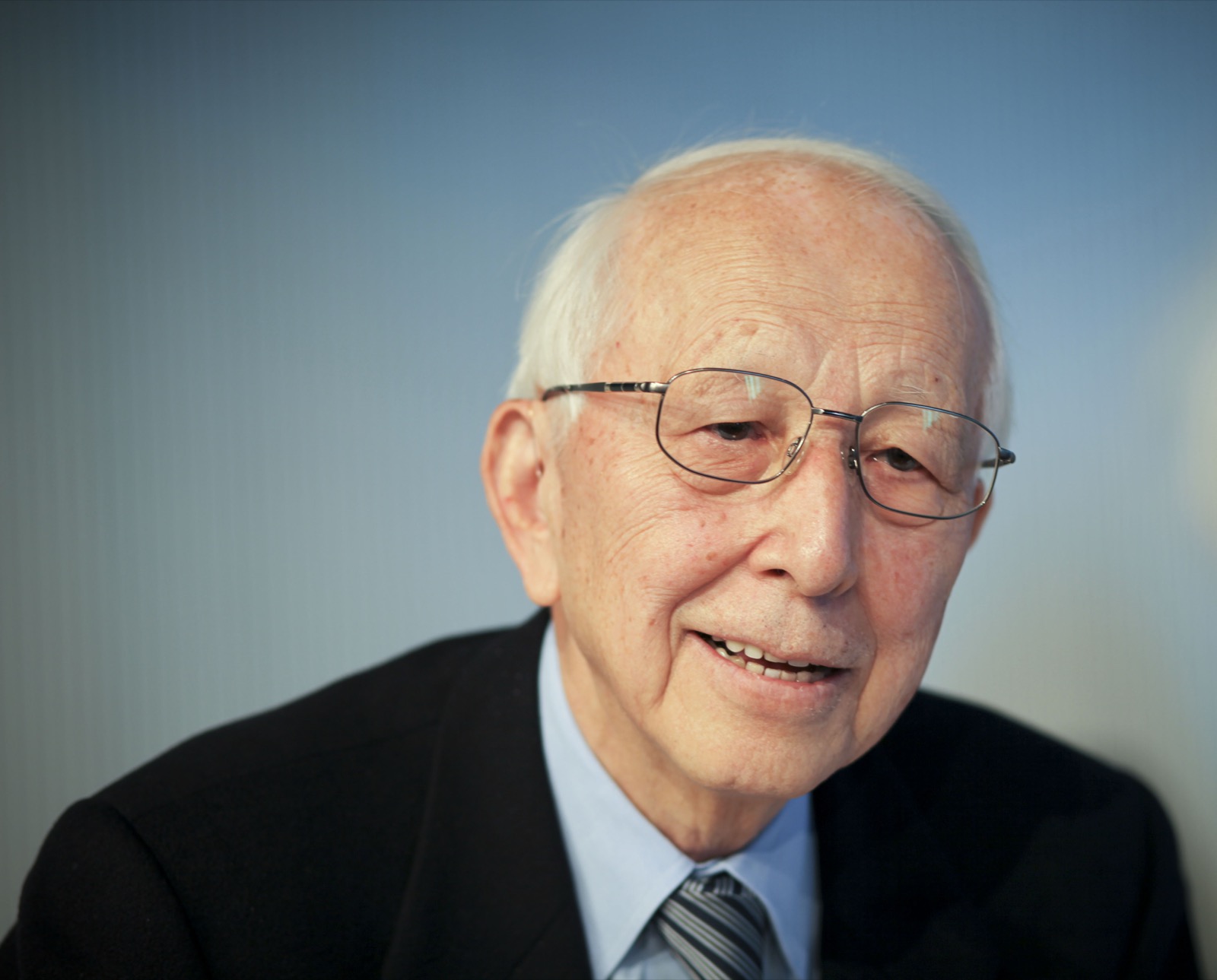
The Principle
“Creation in architecture is not invention but discovery… a cultural act in response to the common imagination or vision of the time.” – Fumihiko Maki, Pritzker Prize acceptance1
Maki’s principle separates architecture from sculpture. A sculptor invents forms. An architect discovers the forms that a site, a program, and a culture already imply. The building that feels inevitable – the one you cannot imagine the street without – was not imposed on the city. It was found in the city. The architect’s skill is not originality but perception: seeing what the site is asking for and giving it a physical form.
This is the opposite of signature architecture – and a key node in the taste infrastructure that connects architecture to broader design philosophy. Maki never built a building that screams its author’s name. His buildings are modest, precisely detailed, and calibrated to their urban surroundings with a care that approaches invisibility. He designed 4 World Trade Center in New York – a 72-story tower on the most symbolically loaded site in America – and it does not call attention to itself. It participates. That restraint is the hardest architectural achievement in this series.
Context
Fumihiko Maki was born in Tokyo on September 6, 1928. He studied architecture at the University of Tokyo under Kenzo Tange – who would become the first Japanese architect to receive the Pritzker Prize (1987). After graduating in 1952, Maki crossed the Pacific: first to Cranbrook Academy of Art in Michigan, then to the Harvard Graduate School of Design under José Luis Sert. He worked at Skidmore, Owings & Merrill in New York and Sert’s own firm before returning to academic positions at Washington University in St. Louis and Harvard.2
In 1960, Maki became a founding member of the Metabolist group alongside Tange, Kikutake, Kurokawa, and Isozaki – the Japanese architects who proposed radical urban megastructures as solutions to postwar density. But Maki rejected megastructures almost immediately. His 1964 publication Investigations in Collective Form argued that large-scale urban design should not be monolithic. It should be an aggregation of smaller buildings, each responding to the others and to the street, creating a “group form” that achieves coherence through relationship rather than through a single master plan.3
He founded Maki and Associates in Tokyo in 1965 and never scaled the practice beyond what he could personally oversee. “I was never attracted to the idea of a large organization,” he said. “My ideal is a group structure that allows people with diverse imaginations, that often contradict and are in conflict with one another, to work in a condition of flux, but that also permits the making of decisions that are as calculated and objectively weighed as necessary for the creation of something as concrete as architecture.”1
He received the Pritzker Prize in 1993. He died on June 6, 2024, at age 95.4
The Work
Hillside Terrace, Daikanyama (1969-1992): 25 Years of Group Form
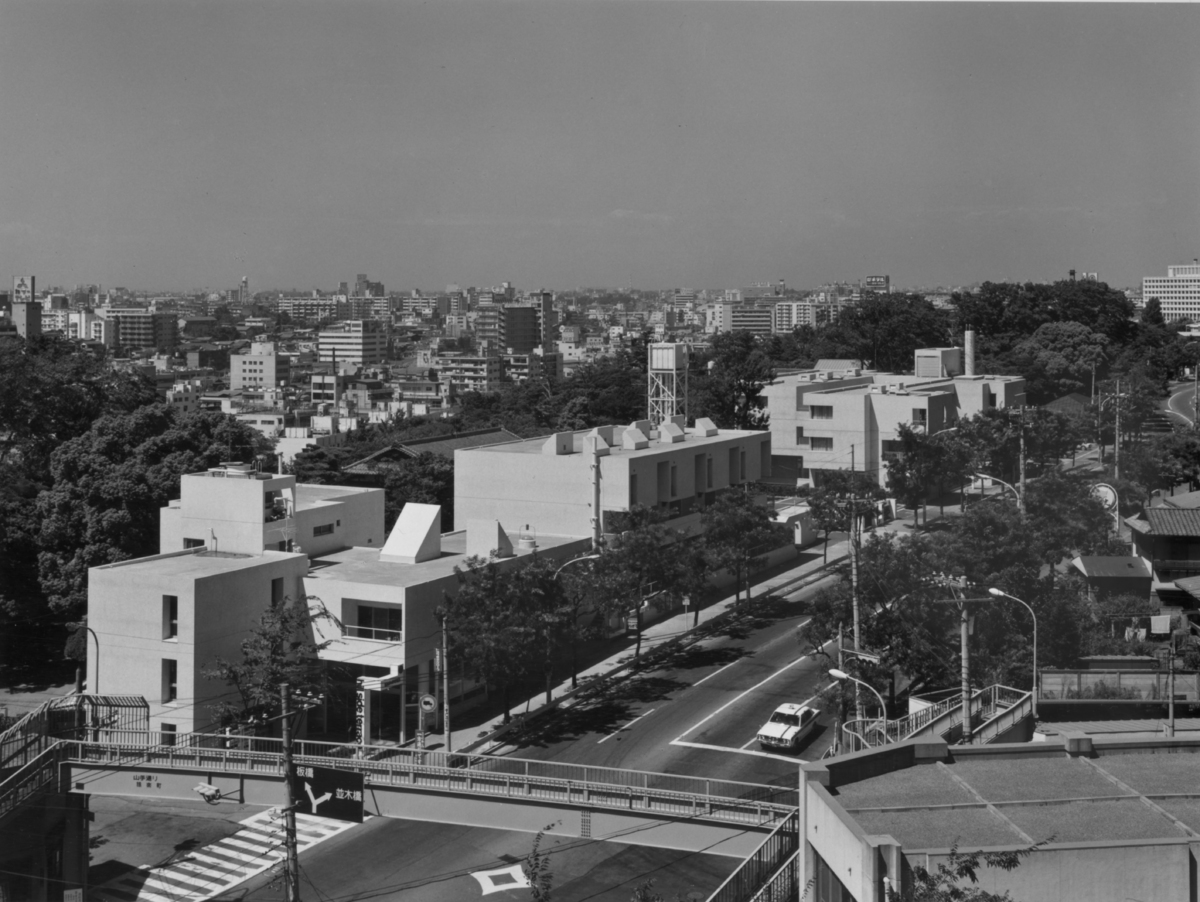
Hillside Terrace is Maki’s definitive project – and its defining quality is that it was never finished in a single gesture. Built in six phases over twenty-five years in Tokyo’s Daikanyama neighborhood, it is a housing and commercial complex that grew organically, each phase responding to the one before.1
The Pritzker biography describes it: “A strategy of transparent layering creates a series of shared scenes or landscapes within an urban context. Wandering through the complex, one encounters intimate courtyards hidden away amid greenery, linked by meandering passages and discovered only by accident of a sideways glance.”1
The 25-year timeline is not a construction delay. It is the method. Each new building was designed after the previous one had been occupied and observed. Maki could see how people actually used the first phase before designing the second. The complex is not a master plan executed over decades. It is a conversation between the architect and the occupied city, conducted in real time across a quarter century. The Pritzker announcement called it “a landmark of not only Maki’s architectural genius, but also a kind of history of modernism.”1
Fujisawa Gymnasium (1984): Dynamic Ambiguity
The Fujisawa Gymnasium marked a turning point in Maki’s career – the moment his buildings became formally daring while remaining functionally precise. The stainless steel roof “seems virtually to float above the main arena, separated from the spectator stands by a ribbon of light and supported only at four points.”1
“Many people say it looks like a helmet, or a frog, or a beetle, or a spaceship,” Maki said. “I just wanted to make a very dynamic building. I wanted to make rich interior spaces. Then to cover them, I needed certain components… the building has become complex enough to yield all kinds of images according to the people who look at it.”5
The ambiguity is deliberate. A building that looks like one thing to everyone has imposed a single reading. A building that looks different to every viewer has opened a space for interpretation. Maki’s gymnasium does not tell you what it is. It waits for you to decide.
4 World Trade Center (2013): Restraint at Ground Zero
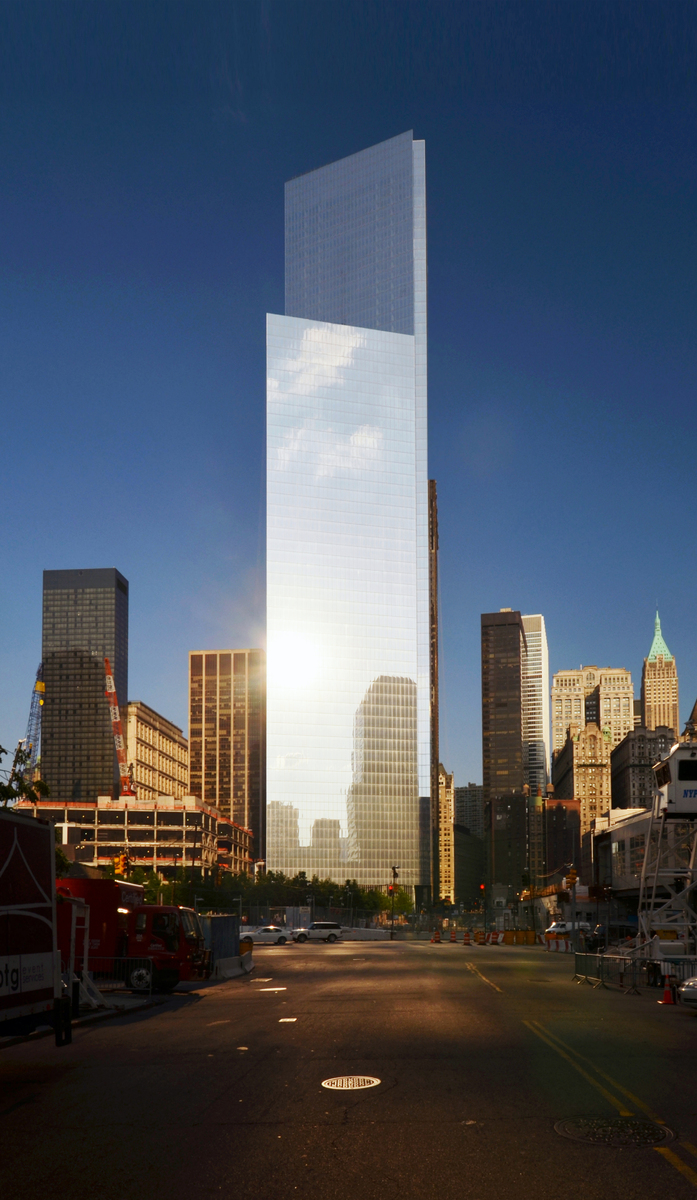
The first tower to open at the rebuilt World Trade Center site, 4 WTC is a 72-story glass tower that participates in the complex without competing with it. New York magazine called it “pretty exquisite.” The New York Times noted that Maki was almost 80 when construction began.4
Where other architects might have used the site’s symbolism as license for grand gestures, Maki built a tower that serves the urban fabric. It is transparent, reflective, and scaled to relate to its neighbors rather than to dominate them. Group form, applied at the scale of lower Manhattan.
MIT Media Lab Extension (2009): Circulation as Design
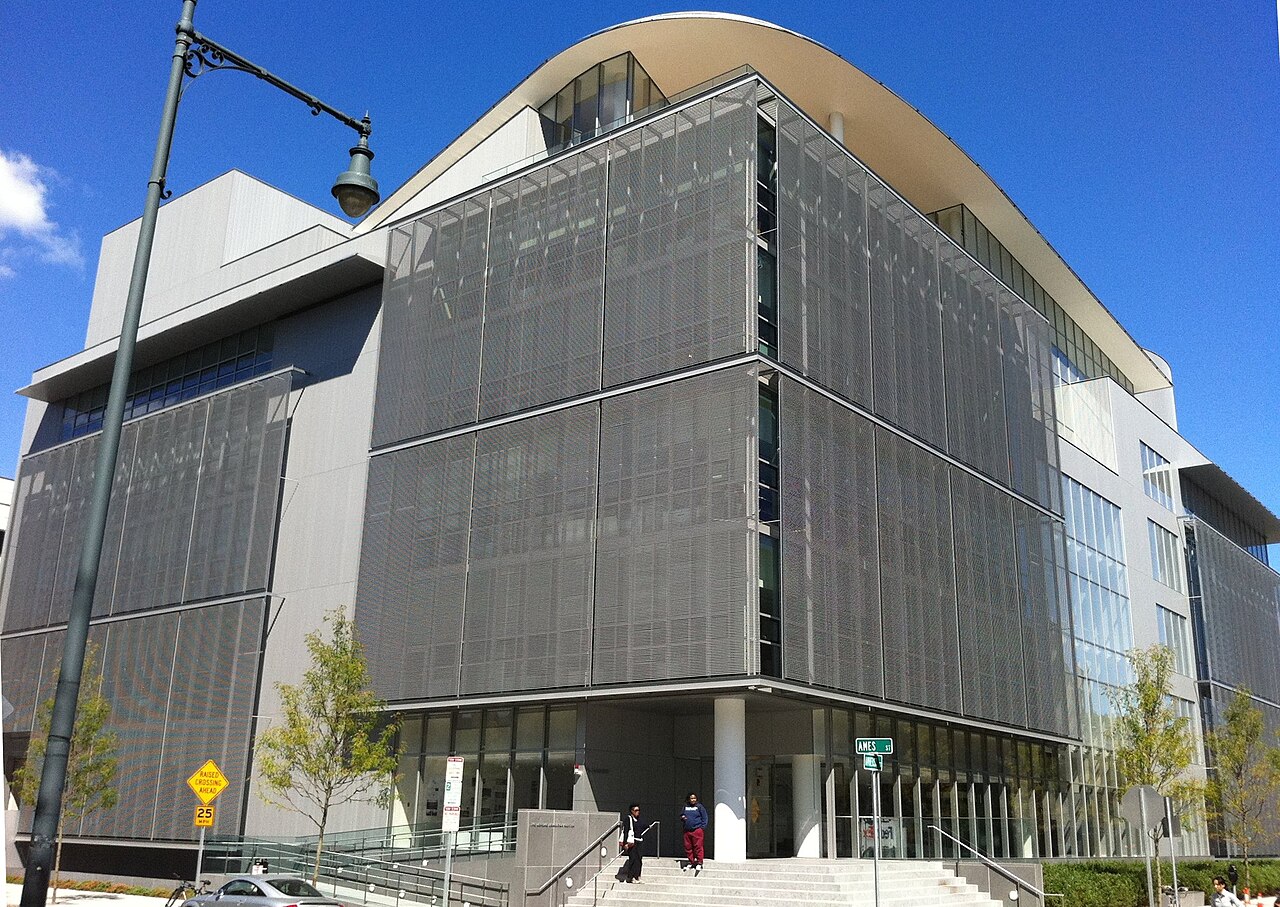
Maki’s Media Lab extension at MIT connects work areas with zigzagging stairways that are “less steep than normal flights, to encourage scientists to saunter from level to level rather than take elevators. The goal, Mr. Maki said, was to get people – and ideas – circulating through the building.”4
The design principle is spatial: if you design the circulation to be pleasant, people will use it. If people move through the building on foot rather than in elevators, they encounter each other. The encounters produce conversations. The conversations produce ideas. The building does not contain the work. It generates the conditions for the work.
The Method
Maki’s method is incremental. He does not master-plan. He builds, observes, and responds. Hillside Terrace is the proof: each phase calibrated to what the previous phase revealed about how people actually inhabit the space.
He introduced the concept of “oku” – spatial depth and layering unique to Japanese architecture – as a formal strategy. Oku means that the most significant space is not immediately visible. You discover it by moving through threshold layers, each one partially concealing and partially revealing what comes next. The Pritzker biography: “By articulating several layers of threshold spaces between the busy street edge and the densely wooded interior of the block, Maki is able to impart a sense of depth to spaces that physically are quite compact.”1
“He uses light in a masterful way,” the Pritzker jury wrote, “making it as tangible a part of every design as are the walls and roof. In each building, he searches for a way to make transparency, translucency and opacity exist in total harmony.”1
His goal, he told the New York Times in 2010, was not beauty – “an elusive quality” – but to “delight their users.”4
Influence Chain
Who Shaped Him
Kenzo Tange was his teacher at the University of Tokyo and a fellow Metabolist founder. Tange’s institutional modernism – large-scale, concrete, monumental – gave Maki the vocabulary he would then soften and fragment into human-scale group forms. (Direct influence)2
José Luis Sert at Harvard GSD gave Maki the Western modernist framework – urban design as a discipline, not just building design. Sert’s concern for the relationship between buildings and cities became Maki’s central preoccupation. (Direct influence)2
Who He Shaped
The theory of group form. Investigations in Collective Form (1964) is one of the most cited texts in urban design theory. It proposed that cities should grow through aggregation of smaller, responsive buildings rather than through master-planned megastructures – an argument that influenced decades of urban design practice. Kunle Adeyemi carries this principle into the Global South, designing floating and modular structures that respond to specific community conditions rather than imposing universal plans.3
Japanese institutional modernism. Maki demonstrated that a Japanese architect could work at international scale (4 WTC, MIT Media Lab, Aga Khan Museum in Toronto) while maintaining the spatial sensibility – oku, threshold layering, transparent materiality – that is specific to Japanese architectural tradition.1
The Throughline
Maki is the institutional counterpart to Tadao Ando in the series’ architecture branch. Both are Japanese Pritzker winners. Both care deeply about light and material. But their methods are opposite: Ando is self-taught, works in concrete, and creates enclosed spaces of spiritual intensity. Maki is Harvard-trained, works in metal and glass, and creates open spaces of urban calibration. The New York Times observed: “His buildings were, like Mr. Maki himself, soft-spoken and impeccably polite. They had none of the bravado of buildings by Frank Gehry or Zaha Hadid or even his countryman Tadao Ando.”4
Frank Lloyd Wright designed buildings that are of their sites. Maki designed buildings that are for their cities. Wright’s principle is organic integration with terrain. Maki’s principle is social integration with urban fabric. Both reject the building-as-monument. Both require the architect to listen to the site before imposing a form. (Series bridge)
What I Take From This
Maki’s 25-year Hillside Terrace method is iterative development applied to architecture. Build the first phase. Ship it. Watch how people use it. Design the next phase based on what you observed. The best systems are not master-planned. They are grown.
FAQ
What is Fumihiko Maki’s design philosophy?
Maki believed that architecture is discovery, not invention – a cultural response to the conditions of a specific site and time. His theory of “group form” proposes that buildings should participate in the urban fabric as responsive participants rather than isolated monuments. He introduced the Japanese spatial concept of oku (layered depth) into modernist practice, creating buildings where the most significant spaces are discovered through movement, not revealed at first glance.13
What did Fumihiko Maki design?
Maki founded Maki and Associates in 1965 and received the Pritzker Prize in 1993. His key works include Hillside Terrace in Daikanyama (1969-1992, built in six phases over 25 years), Fujisawa Gymnasium (1984), Spiral Building in Tokyo (1985), 4 World Trade Center in New York (2013), MIT Media Lab extension (2009), and Aga Khan Museum in Toronto (2014).124
How does Fumihiko Maki compare to Tadao Ando?
Both are Japanese Pritzker-winning architects who care deeply about light and materiality. But their methods are opposite: Ando is self-taught, works in concrete, and creates enclosed spaces of spiritual intensity. Maki is Harvard-trained, works in metal and glass, and creates open spaces calibrated to their urban surroundings. Ando’s buildings are monuments to conviction. Maki’s buildings are participants in cities.4
What can designers learn from Fumihiko Maki?
Build incrementally. Observe how the first phase is used before designing the second. Design for the urban context, not for the portfolio – a building that participates in its neighborhood serves more people than a building that dominates it. And pursue delight over beauty: beauty is elusive, but delight is observable. The design guide explores how this incremental philosophy connects to other practitioners in the series.
Sources
-
Pritzker Architecture Prize, “Biography: Fumihiko Maki” and “Jury Citation.” “Creation is discovery, not invention,” Hillside Terrace description, light and transparency, practice philosophy quote. ↩↩↩↩↩↩↩↩↩↩↩
-
Britannica, “Maki Fumihiko.” University of Tokyo under Tange, Cranbrook, Harvard GSD, career arc, “fused Modernism with Japanese traditions.” ↩↩↩↩
-
Fumihiko Maki, Investigations in Collective Form (Washington University, 1964). Group form theory. Also: JSTOR, “My Urban Design of Fifty Years.” Ekistics, vol. 73, 2006. ↩↩↩
-
New York Times, “Fumihiko Maki obituary” (June 12, 2024). 4 WTC, MIT Media Lab circulation design, “delight their users,” comparison to Ando/Gehry/Hadid. ↩↩↩↩↩↩↩
-
Fumihiko Maki, Fumihiko Maki: An Aesthetic of Fragmentation (Rizzoli, 2003). Fujisawa Gymnasium quote: “helmet, frog, beetle, spaceship.” Also cited in Pritzker Prize biography. ↩