Charles & Ray Eames' Design Philosophy: Details Are Design

The Principle
“The details are not the details. They make the design.” – Charles Eames1
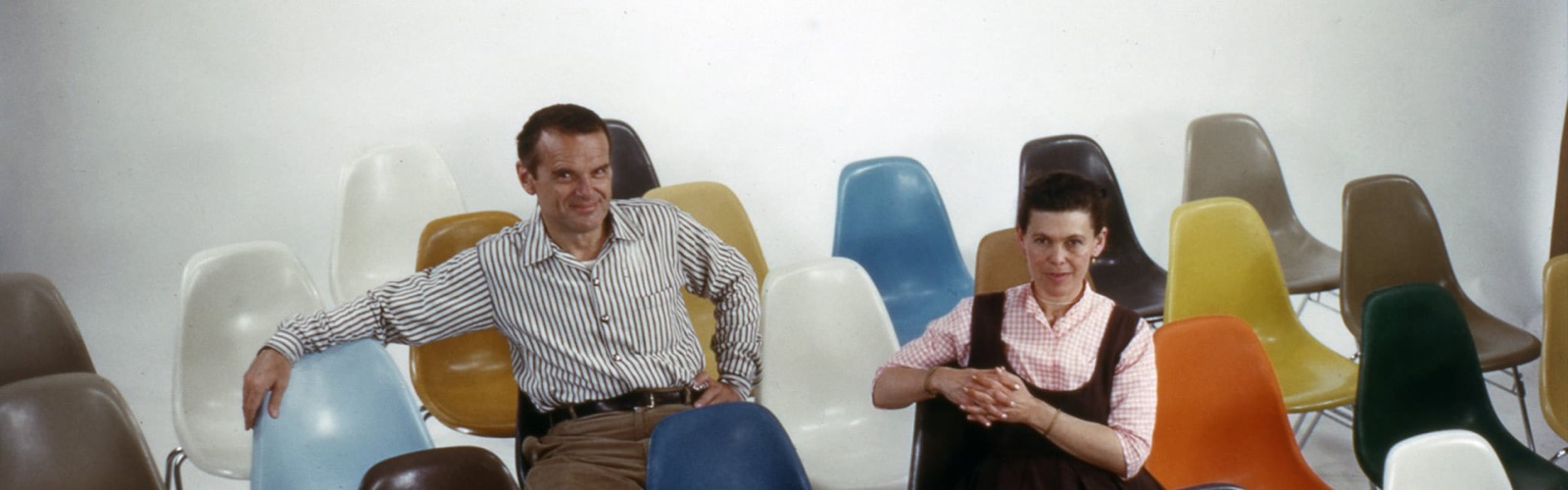
Charles and Ray Eames did not distinguish between big ideas and small decisions. Their work forms a load-bearing pillar of the taste infrastructure that connects postwar American manufacturing to the objects we still sit in today. A curve in a chair’s plywood shell was as consequential as the decision to build the chair at all. The radius determined whether the wood would crack under stress, whether the body would feel supported or suspended, whether the manufacturing process required one mold or three. Every decision at the level of millimeters propagated upward into the experience of sitting. The detail was not subordinate to the design. The detail was the design.
They worked as a pair for thirty-seven years. Charles brought architecture and structural thinking. Ray brought painting, color, and an intuitive sense of form she developed through six years studying with Hans Hofmann. Neither produced their best work alone. The Eames Office – a 20,000-square-foot former garage at 901 Washington Boulevard in Venice, California – operated as a single organism with two nervous systems.
Context
Charles Eames was asked to leave Washington University’s architecture school for championing Frank Lloyd Wright and modern architects the faculty considered too radical. He found his way to Cranbrook Academy of Art in Michigan, where Eliel Saarinen had built an educational community modeled on the medieval guild – students and masters working alongside each other, disciplines dissolving into shared problems. At Cranbrook, Charles met Eero Saarinen, Eliel’s son, and Florence Knoll – the constellation of designers who would define postwar American interiors. Together, Charles and Eero designed furniture for MoMA’s 1940 “Organic Design in Home Furnishings” competition. They won. The prize-winning chairs used molded plywood techniques that no manufacturer could reliably produce at scale. The gap between the design and its manufacture became the problem Charles would spend his career solving.2
Ray Kaiser studied abstract painting with Hans Hofmann in New York from 1933 to 1939 – six years of rigorous training in composition, color relationships, and what Hofmann called “push and pull,” the creation of spatial tension between forms. She was a founding member of American Abstract Artists alongside Lee Krasner. When she arrived at Cranbrook in 1940 to audit courses, she was not an aspiring designer. She was an established painter who chose to redirect her practice. When asked years later how it felt to give up painting, Ray answered: “I never gave up painting. I just changed my palette.”3
They married in 1941 and drove to Los Angeles on their honeymoon. They never left. The Eames Office opened in 1943 in the Bay Cities Garage in Venice – a building they filled with prototypes, toys, film equipment, a research library, and a pet octopus. They worked thirteen-hour days, six or seven days a week, for the next thirty-five years.4
The Work
Molded Plywood Leg Splint (1942): War as Prototype
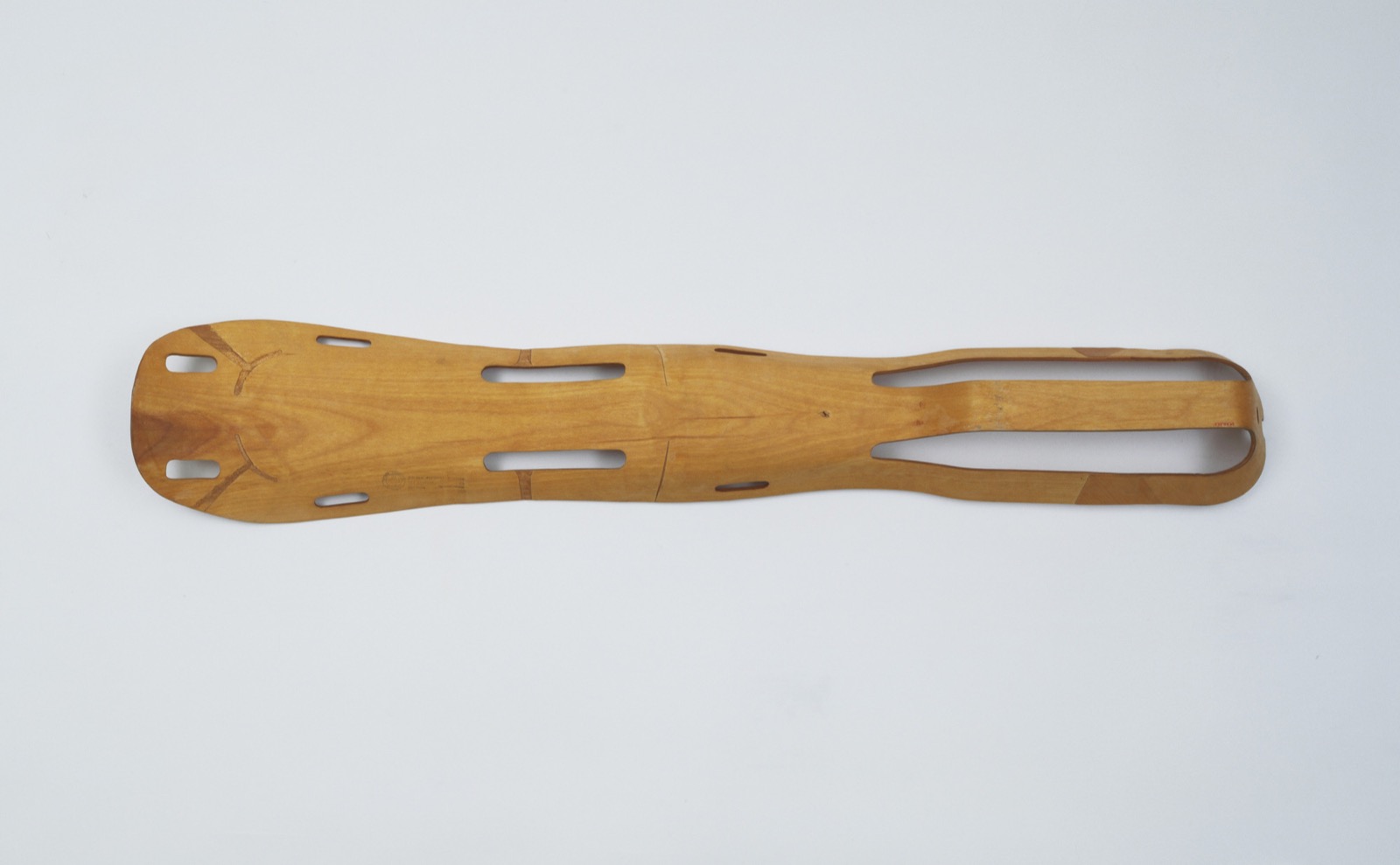
The US Navy’s standard metal leg splints caused secondary injuries during transport – the metal vibrated, shifted, and pressed against fractures. Charles and Ray built a device they called “the Kazam! machine” in their apartment and began bending plywood into compound curves using heat, pressure, and resin. The resulting splint was so light it could be lifted with one finger. Approximately 150,000 were produced during the war.5
The splint was not furniture. But the technology was the same technology that would produce the most influential chairs of the twentieth century. The Eameses did not set out to reinvent furniture design. They set out to solve a medical problem, and the solution’s manufacturing process turned out to be transferable. “Designers should only innovate as a last resort,” Charles said.2 The innovation in the splint was not the shape – it was the process. The process became the platform.
Case Study House #8 / The Eames House (1949): Living in the Work
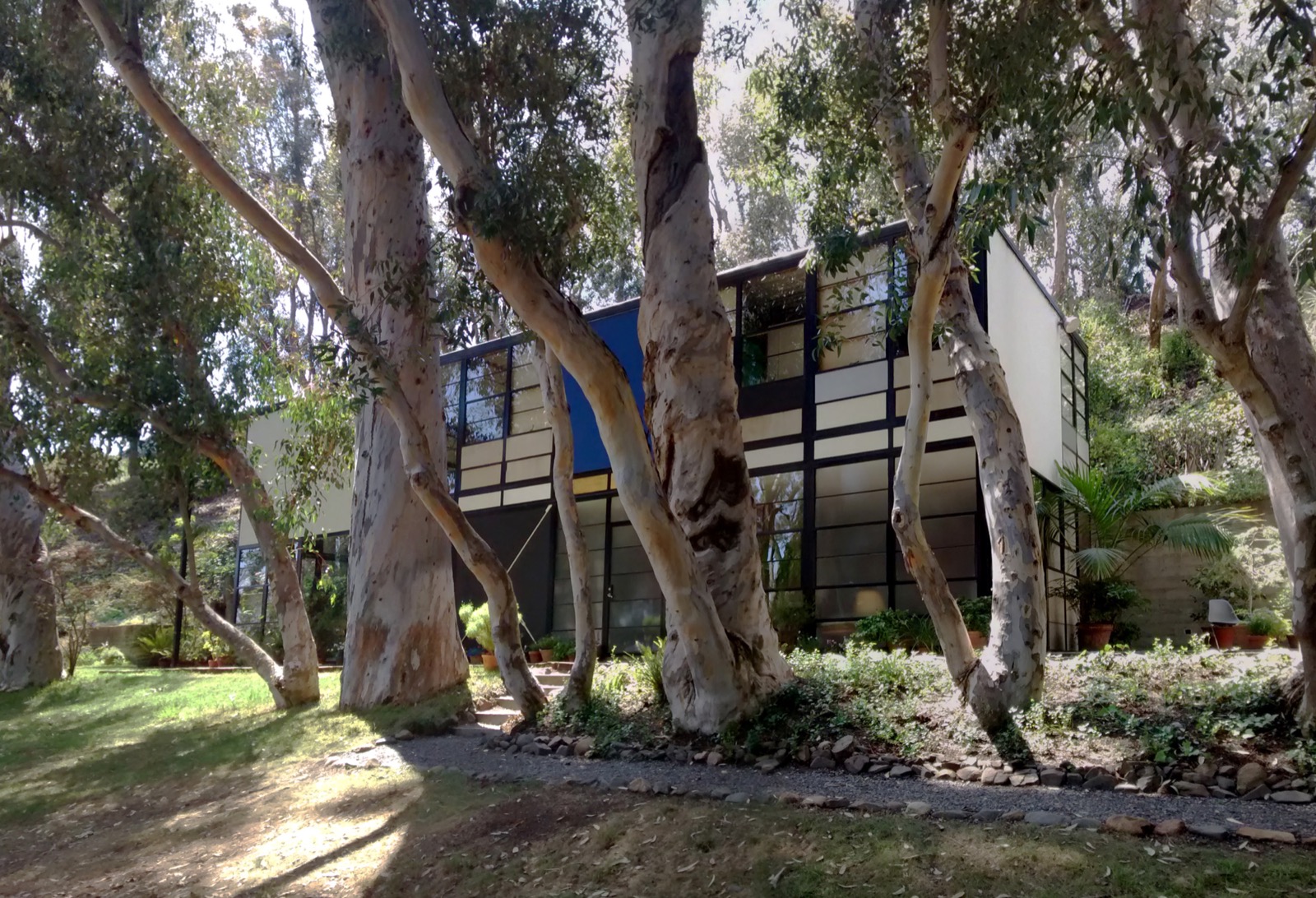
The Eames House in Pacific Palisades was commissioned by Arts & Architecture magazine as part of the Case Study House program. Charles and Ray originally designed a steel-and-glass bridge structure that would cantilever over the meadow on their site. Then they fell in love with the meadow. They redesigned the house to sit beside it rather than above it – using the same steel components but rearranged to preserve the meadow. The steel frame was erected in a day and a half from prefabricated parts.6
Ray’s contribution to the house is documented and specific. She mixed glass windows with colored panels in a composition that the Smithsons – Alison and Peter, the British architects – attributed to “Ray even more than Charles.” The arrangement resembles Mondrian’s paintings, which is not accidental: Ray’s six years with Hofmann had given her the formal vocabulary to compose a building facade as an abstract painting. The interior was equally her domain – arrangements of objects, textiles, and flowers that made the industrial shell feel inhabited and warm.6
Charles described the house’s purpose: “The house would make no demands for itself and would serve as a background for life in work.” Of the 25 Case Study Houses built, it is considered the most successful both as architecture and as a place to live.6
Eames Lounge Chair 670/671 (1956): The Exception That Proves the Rule
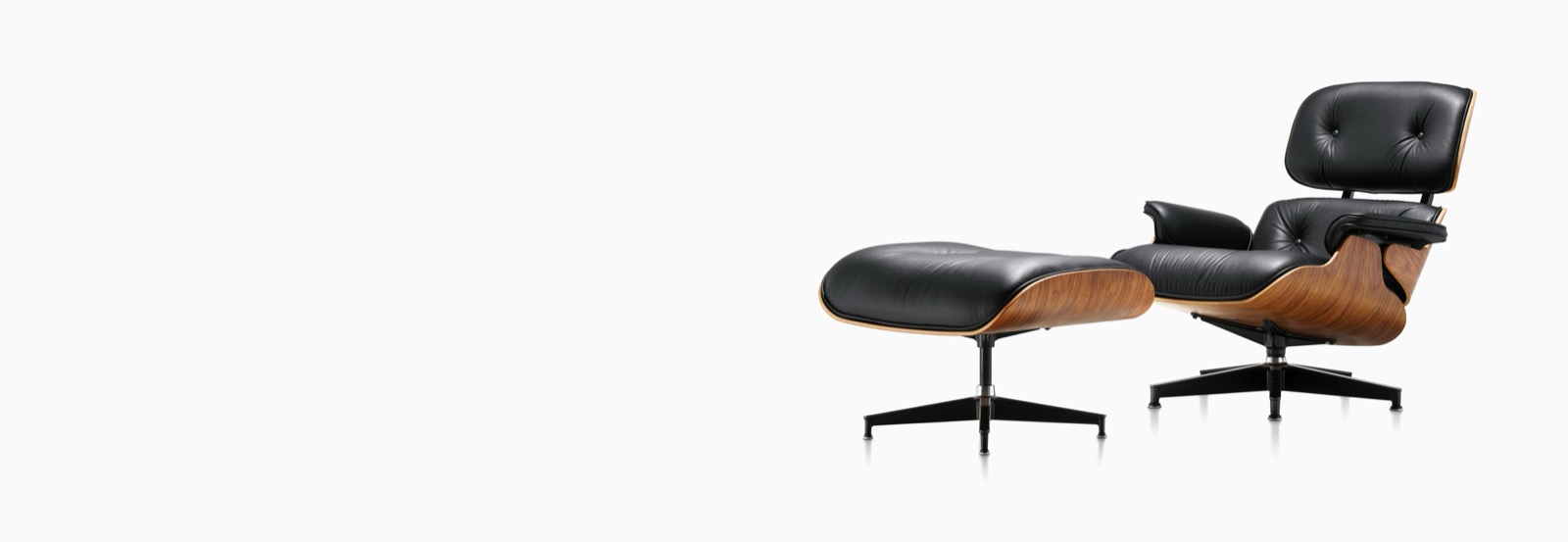
The Eameses’ stated mission was “the best for the most for the least.” The Lounge Chair was the exception: a high-end piece designed as a gift for their friend, film director Billy Wilder. It was inspired by the worn leather of an English club chair – the Eameses wanted to create a modern chair that felt immediately lived-in rather than precious.7
The molded plywood shells – originally Brazilian rosewood veneer over five layers of plywood – used the same bending technology developed for the wartime splint. Each shell was formed with heat, steam, pressure, and glue to contour to the human body. The chair first appeared on Arlene Francis’s daytime television program Home in 1956. It remains in continuous production at Herman Miller and is in MoMA’s permanent collection.7
The chair demonstrates that the Eameses’ method scaled in both directions. The same approach that produced a medical device for the Navy at 150,000 units produced a luxury object for Billy Wilder at one unit. The technology did not care about the market segment. The constraint – bend plywood into a compound curve that supports a human body – was identical.
Powers of Ten (1977): Scale as Design Principle
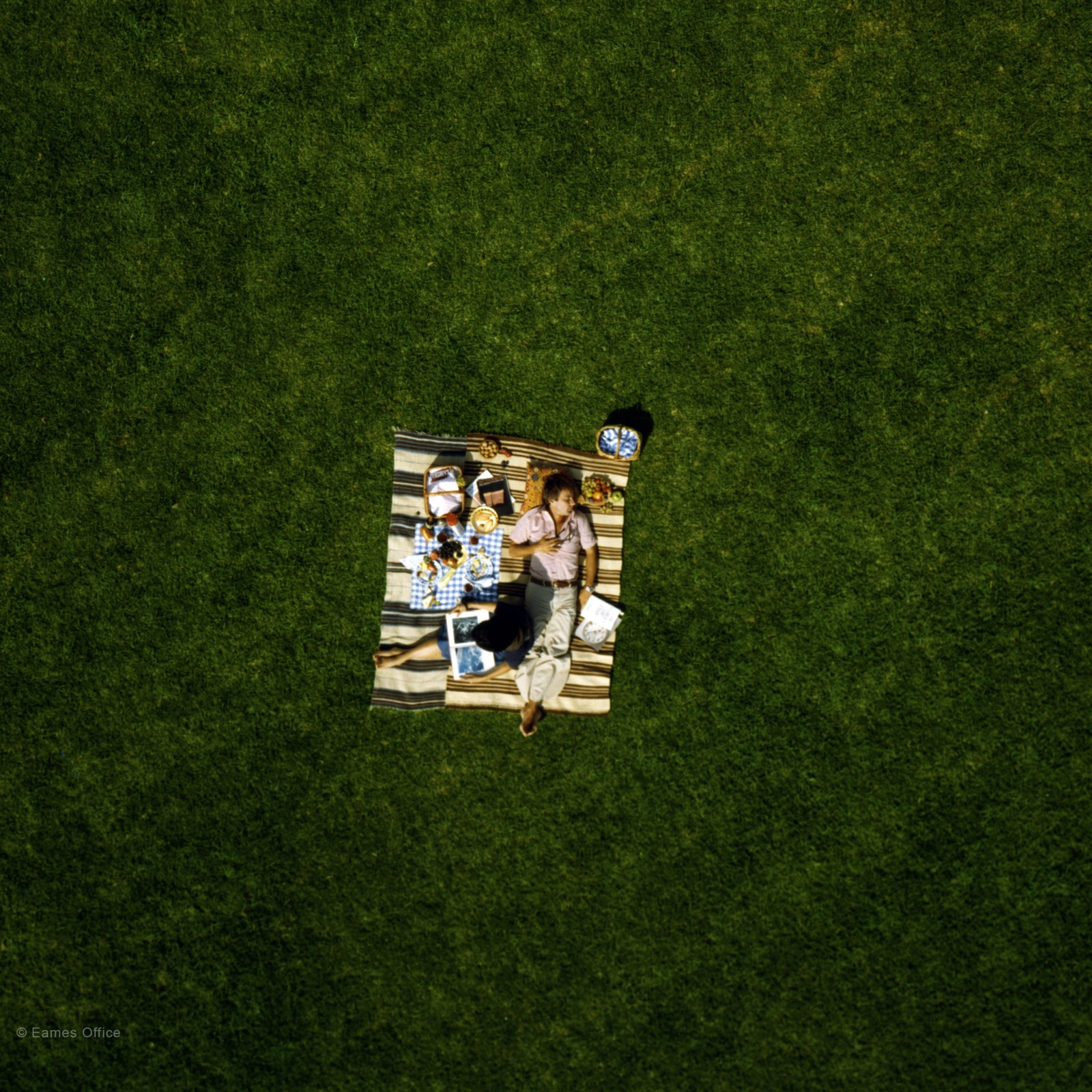
Powers of Ten is a nine-minute film that begins with a couple on a picnic blanket in Chicago, pulls back by one power of ten every ten seconds until it reaches the observable universe, then zooms inward to the subatomic scale. It is one of the most watched educational films ever produced.8
The film was not outsourced. The Eames Office produced it entirely in-house, from the photography to the animation to the narration. Ray’s editorial vision shaped the pacing and visual rhythm. The film demonstrated the Eameses’ conviction that design is not a discipline confined to objects – it is a way of seeing relationships between things at any scale. A picnic blanket and a galaxy are connected by the same physical laws. The designer’s job is to make that connection visible.
The Method
“Design depends largely on constraints,” Charles said in the 1972 Design Q&A film. “One of the few effective keys to the design problem is the ability of the designer to recognize as many of the constraints as possible – his willingness and enthusiasm for working within these constraints.”1
The Eames Office was organized as a laboratory, not a studio. Problems arrived from IBM, Herman Miller, the US government, museums, and publishers. Each problem was approached with the same method: understand the constraint, build prototypes, test them, iterate until the solution feels inevitable rather than designed. Toys filled the office – Charles considered them “preludes to serious ideas.”4
Charles was the structural thinker, the architect, the one who understood how forces move through materials. Ray was the artist – color, pattern, spatial composition, the quality that the Eames Institute describes as “the primary driver behind the Eames ‘look’” and what made the difference between “good, very good – and Eames.”9 Charles himself stated in Current Biography (1965) that Ray was “equally responsible with me for everything that goes on here.”3
Ray continued running the Eames Office for a decade after Charles died on August 21, 1978. She died on August 21, 1988 – exactly ten years to the day.
Influence Chain
Who Shaped Them
Eliel and Eero Saarinen shaped Charles through Cranbrook’s guild model – the idea that designers learn by working alongside masters on real problems, not by studying theory in isolation. The 1940 MoMA competition with Eero established the molded plywood direction that defined the Eameses’ career. (Direct influence)2
Hans Hofmann shaped Ray through six years of abstract painting instruction. Hofmann’s “push and pull” – the creation of spatial tension through color and form relationships – became the visual language Ray applied to everything from building facades to textile patterns to film editing. (Direct influence)3
Who They Shaped
Virgil Abloh cited the Eameses as formative influences. He owned a blue Eames chair and collaborated with Vitra on a Wire Chair collection in 2019. The Eameses’ conviction that design is not confined to a single medium – that a chair maker can also make a film, an exhibition, a toy – became the operating principle of Abloh’s multidisciplinary practice. (Direct influence)
The entire postwar American design establishment. The Case Study House program, the Herman Miller catalog, the IBM exhibitions – the Eameses created the template for how American companies engage with design as a strategic practice rather than a decorative afterthought. Steve Jobs absorbed this principle whole: Apple’s integration of industrial design, packaging, and retail experience descends directly from the Eameses’ conviction that every detail is the design. Jony Ive, Jobs’s chief designer, explicitly cited the Eameses as formative influences on Apple’s product philosophy. (Structural influence)
The Throughline
The Eameses prove that constraints are not obstacles to creativity – they are the material creativity works with. Dieter Rams worked within manufacturing constraints to remove everything unnecessary. The Eameses worked within material constraints to discover what was possible. Both treated the constraint as the starting point, not the limitation. But where Rams asked “what can I remove?”, the Eameses asked “what can this material become?” One is subtractive. The other is generative. Both produced work that lasts because the method – not the style – was sound. (Series bridge)
What I Take From This
“Design depends largely on constraints.” Every codebase has constraints – framework choices, API boundaries, deployment targets. The Eameses proved that the best work comes from accepting those constraints as design material rather than fighting them as limitations.
FAQ
What is Charles and Ray Eames’ design philosophy?
The Eameses believed that design is the arrangement of elements to accomplish a particular purpose, and that constraints are the designer’s most important material. Their method – prototype, test, iterate, attend to every detail – applied equally to furniture, architecture, film, and exhibition design. Charles stated: “Design depends largely on constraints.” Ray’s contribution was the conviction that function and beauty are not opposed: “What works good is better than what looks good, because what works good lasts.”13
What did Charles and Ray Eames design?
The Eameses designed the Molded Plywood Leg Splint (1942, 150,000 units for the US Navy), the LCW/DCW molded plywood chairs (1946), Case Study House #8 (1949), the Eames Lounge Chair 670/671 (1956), the Mathematica exhibition for IBM (1961), the IBM Pavilion at the 1964 World’s Fair, and the film Powers of Ten (1977). Their office produced over 900 designs across furniture, architecture, film, exhibition, textile, and graphic design.578
How did Charles and Ray Eames work together?
Charles brought architecture and structural engineering. Ray brought abstract painting, color theory, and compositional sensibility from six years studying with Hans Hofmann. Charles stated that Ray was “equally responsible for everything that goes on here.” The Eames Institute identifies Ray’s “sense of form and color” as “the primary driver behind the Eames ‘look.’” They worked thirteen-hour days, six or seven days a week, at the Eames Office in Venice, California.39
What can designers learn from Charles and Ray Eames?
Treat constraints as design material. Prototype obsessively. Details are not subordinate to the design – they are the design. And collaboration between complementary skills (architecture + painting, structure + color, engineering + art) produces work that neither party could achieve alone. The design guide traces how the Eameses’ constraint-driven method connects to other practitioners in this series.
Sources
-
Charles Eames, interview with Madame L’Amic, Design Q&A, 1972 film. Herman Miller. “Design depends largely on constraints” and “The details are not the details” quotes. ↩↩↩
-
Pat Kirkham, Charles and Ray Eames: Designers of the Twentieth Century (MIT Press, 1998). Primary scholarly source. “Designers should only innovate as a last resort” (p. 373). Cranbrook history and MoMA competition. ↩↩↩
-
Ray Eames, oral history interview, 1980. Archives of American Art, Smithsonian Institution. “I never gave up painting, I just changed my palette.” Also: Current Biography (1965) for Charles’s statement on Ray’s equal responsibility. ↩↩↩↩↩
-
Eames Office, About. 901 Washington Boulevard history, working hours, office culture. ↩↩
-
Eames Office, “Molded Plywood Leg Splint.” Also: Metropolitan Museum of Art, collection record. 150,000 units, the Kazam! machine, WWII context. ↩↩
-
Eames Office, “Case Study House #8.” Also: ArchDaily, AD Classics. Smithsons’ attribution of the house’s exterior to Ray. ↩↩↩
-
Eames Office, “Eames Lounge Chair and Ottoman.” Billy Wilder commission, rosewood veneer, 1956 television debut. ↩↩↩
-
Library of Congress, National Film Preservation Board. Powers of Ten preservation documentation. Selected for National Film Registry. ↩↩
-
Eames Institute, on Ray’s contribution. “The primary driver behind the Eames ‘look.’” Description of Ray’s role in form and color decisions. ↩↩