Design Philosophy: Pharrell Williams — Wealth Is of the Mind

The Principle
“Wealth is of the heart and mind, not the pocket.” – Billionaire Boys Club1
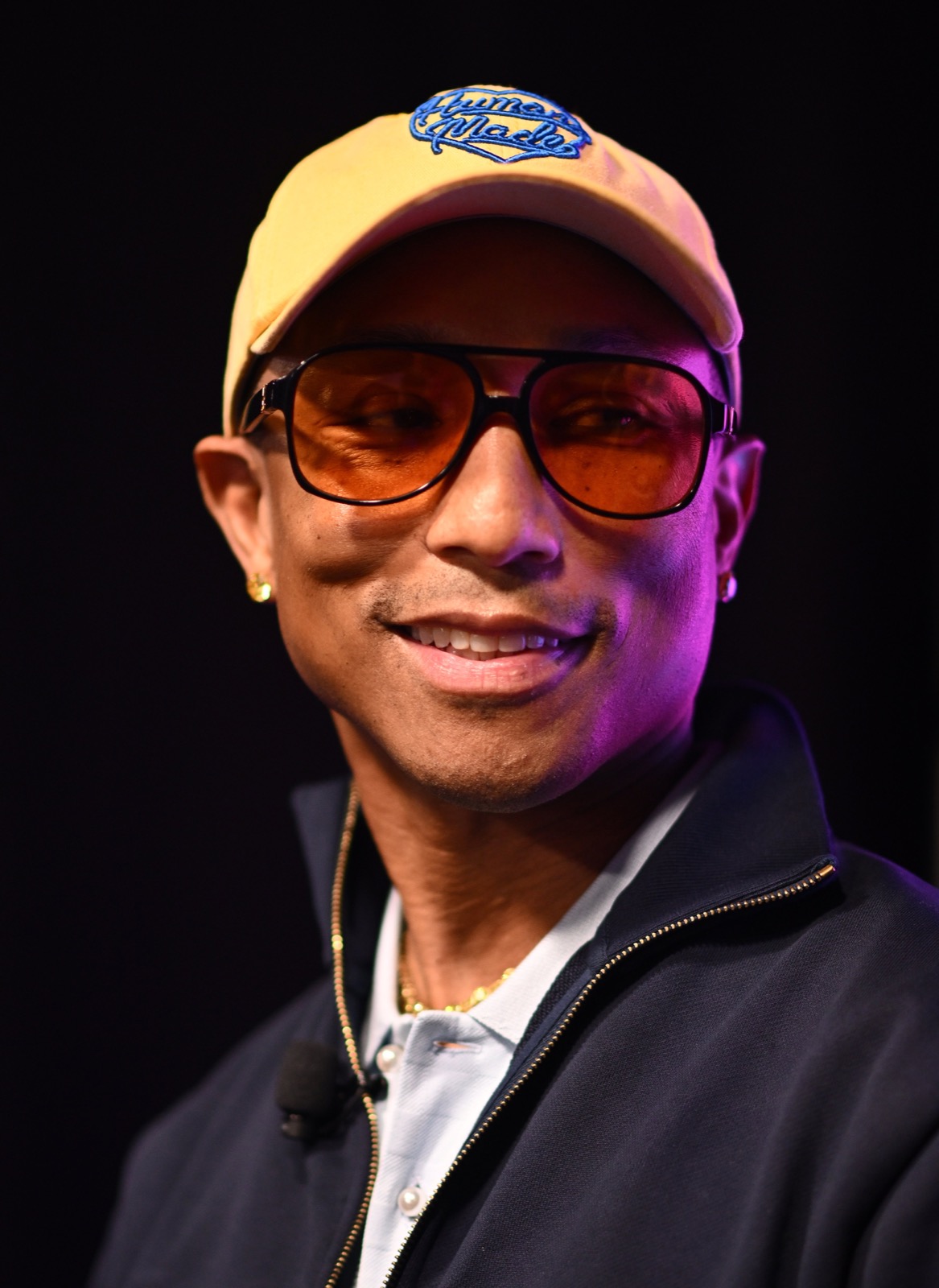
The name “Billionaire Boys Club” is a provocation. It sounds like it should sell to people who already have money. Instead, it sells to people who understand that aspiration is a creative act – that the decision to imagine yourself in a different context is itself a form of design. Pharrell Williams has built an entire practice on this inversion: using the language of wealth to talk about curiosity, using the surface of fashion to distribute ideas, and treating every medium as a channel for the same message.
He is not a fashion designer in the traditional sense. He does not cut patterns or drape fabric. He is a curator – of references, collaborators, and contexts – who understands that in the 21st century, the creative act is often selection rather than fabrication. This is the same insight Virgil Abloh articulated as the “3% approach,” but Pharrell arrived at it through music production: building songs from samples, assembling beats from fragments, composing by arrangement rather than from nothing.
Context
Pharrell Williams was born in Virginia Beach, Virginia, in 1973. His creative career began in music production as one half of The Neptunes alongside Chad Hugo, and as a member of NER*D. The Neptunes’ production credits – which include songs for Jay-Z, Snoop Dogg, Justin Timberlake, Britney Spears, and Gwen Stefani – made Pharrell one of the most commercially successful music producers of the 2000s. But the production work was the platform, not the destination.2
In 2003, Pharrell co-founded Billionaire Boys Club and its sister brand Ice Cream with NIGO, the founder of A Bathing Ape and one of the most influential figures in Japanese streetwear. The collaboration was not incidental. NIGO brought manufacturing knowledge, supply chain relationships, and a deeply developed understanding of how streetwear brands build cultural credibility. Pharrell brought an audience and a willingness to operate at the intersection of music, fashion, and visual art without treating any medium as primary.1
BBC and Ice Cream occupy the same lineage as Dapper Dan’s Harlem boutique: luxury-coded streetwear that inverts the relationship between fashion houses and street culture. Dan proved the demand existed. Abloh formalized the pipeline. Pharrell scaled it into a global brand – and did so by making the brand’s philosophy (curiosity, exploration, “wealth of the mind”) explicit rather than implied.
The Work
Billionaire Boys Club / Ice Cream (2003-present): The Astronaut as Emblem

BBC’s logo is an astronaut helmet. The choice is not decorative. Space exploration is Pharrell’s metaphor for curiosity – the willingness to go somewhere no one has been, to invest in discovery rather than certainty. “The people who belong in this club are like-minded,” Pharrell has said, “who know that education is one of the greatest gifts to life, and learning things and continuing to discover and explore is one of the greatest experiences we can ever have as humans.”1
The brand operates at a mid-luxury price point with seasonal drops, collaborative capsules, and flagship stores in New York, Tokyo, and London. The product is well-made streetwear – hoodies, graphic tees, outerwear – but the product is not the point. The brand is a container for an idea: that aspiration should be intellectual, not material.
Humanrace (2020-present): Skincare as Design Object
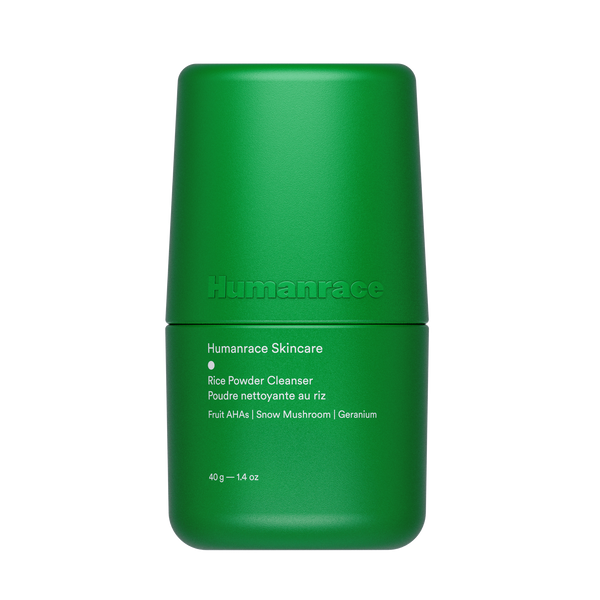
Humanrace, Pharrell’s skincare line, extends the design philosophy to personal care. The packaging – designed by Pharrell – uses soft-form objects that look more like sculpture than cosmetics bottles. The product formulations are simple (a three-step routine: exfoliate, cleanse, moisturize). The restraint is deliberate: strip the routine to its essence, make the objects beautiful enough to leave on the counter, and let the simplicity communicate the message.3
The approach is directly adjacent to Kenya Hara’s MUJI philosophy: create products that do not impose an identity on the user. Humanrace products have no aggressive branding, no gendered marketing, no complex regimen to learn. They are designed to be accessible to anyone, which is another way of saying they are designed for the broadest possible participation.
Louis Vuitton Menswear (2023-present): Succeeding Abloh
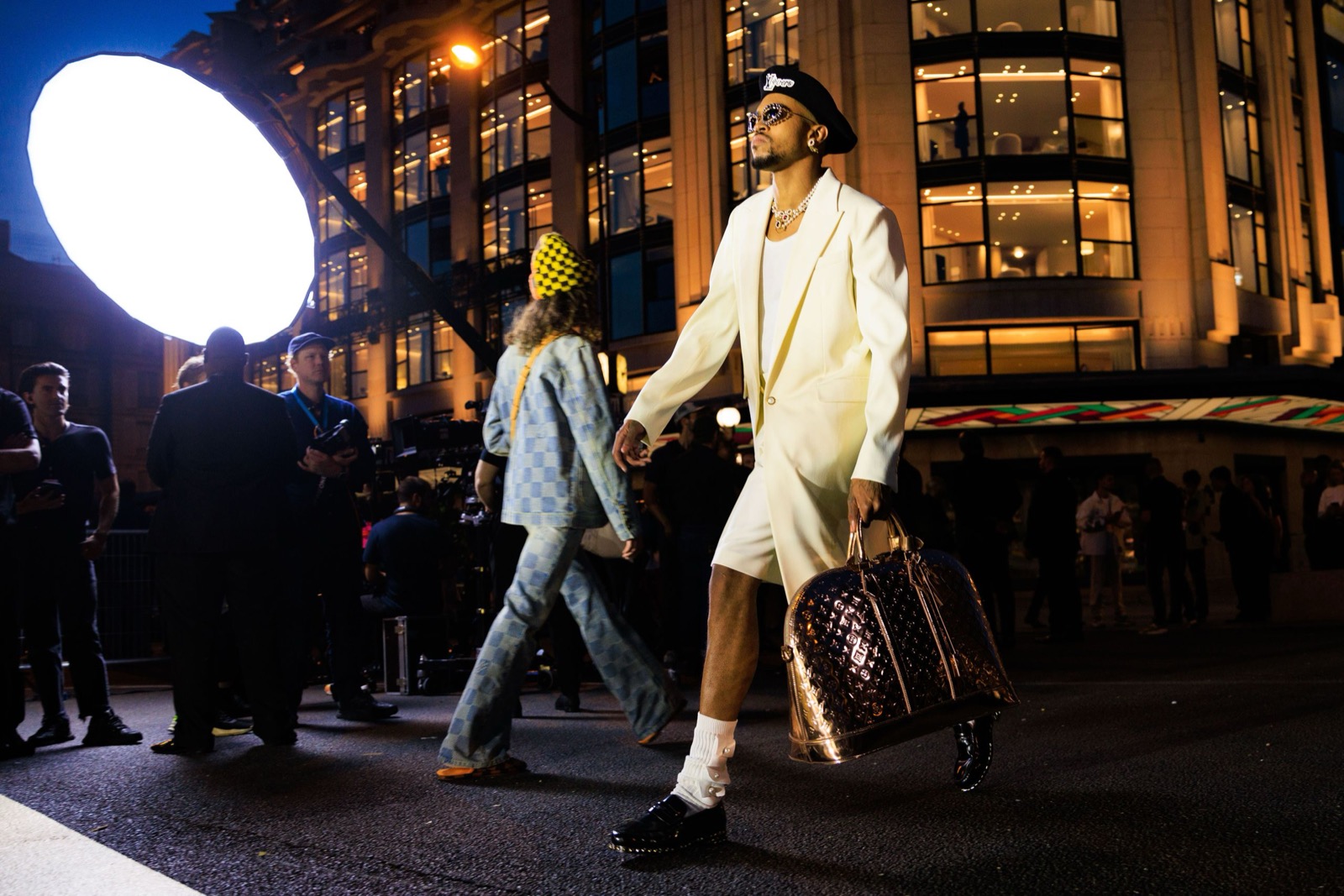
In February 2023, LVMH appointed Pharrell as men’s creative director of Louis Vuitton, succeeding Virgil Abloh, who had died in November 2021. The appointment continued the lineage that Dapper Dan started in the 1980s: streetwear culture leading luxury fashion rather than the reverse.4
Pharrell’s debut collection, shown in June 2023 on the Pont Neuf bridge in Paris, reframed Louis Vuitton’s heritage through a lens of cultural curation rather than deconstruction. Where Abloh annotated – adding quotation marks, exposing construction, making the commentary visible – Pharrell assembled. He mixed Western and African references, vintage Americana and contemporary streetwear, musical performance and fashion presentation. The show included a live performance and treated the runway as a cultural event rather than a product presentation.
The difference between Abloh and Pharrell at LV is the difference between an editor and a DJ. Abloh edited existing objects with a 3% change. Pharrell arranges existing references into new compositions – the same method he uses to produce music.
Collaboration as Method
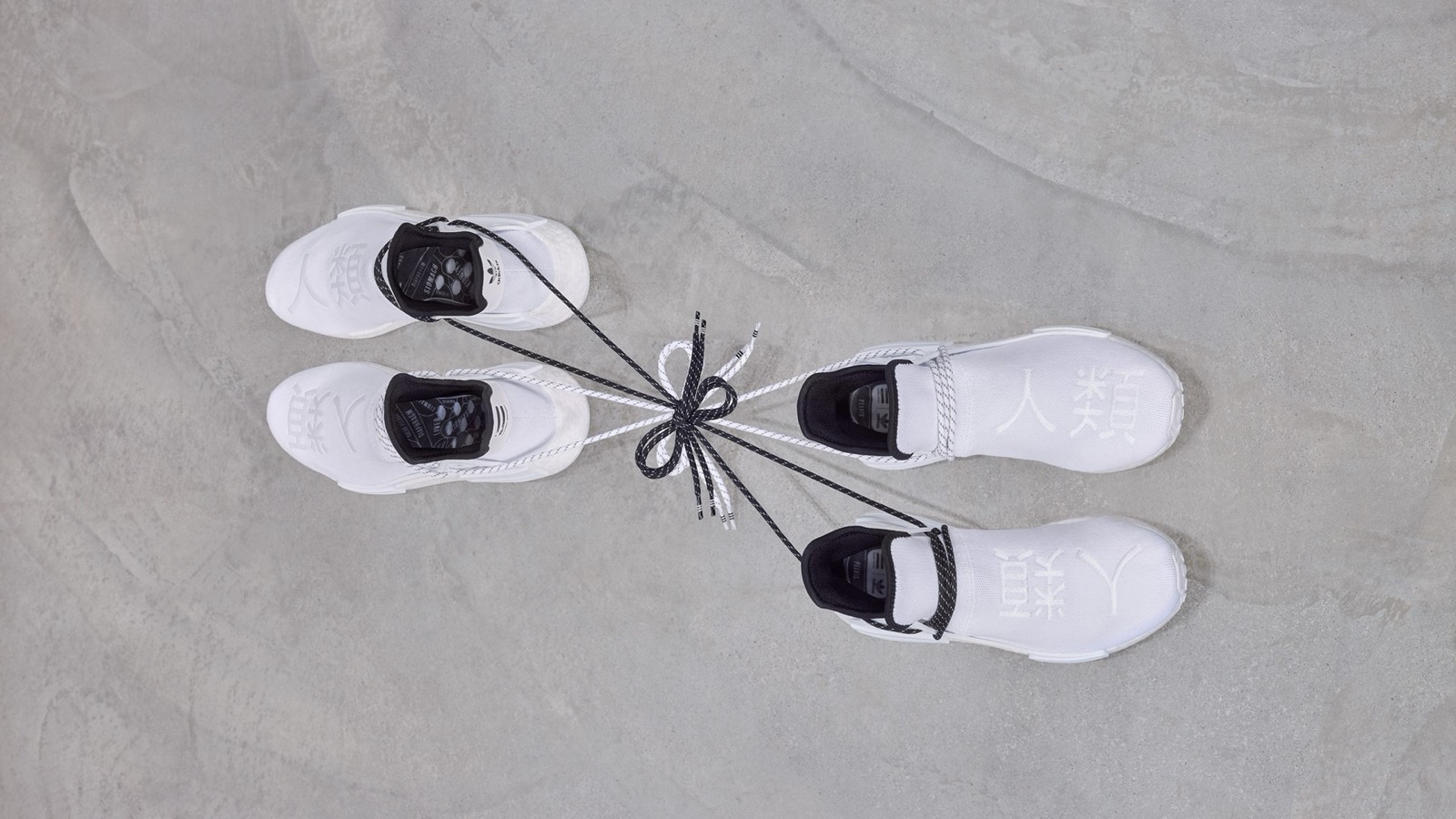
Pharrell’s design output is almost entirely collaborative. The NIGO partnership for BBC. The Adidas Supershell collaboration with Zaha Hadid. The Adidas NMD Hu collection, which printed “Human Race” across the uppers in various languages. Each collaboration extends the same philosophy through a different discipline’s expertise: Pharrell provides the concept and the audience; the collaborator provides the craft.5
This is not dilettantism. It is a model of creative direction that treats the director’s taste as the design material and the collaborator’s skill as the fabrication. The model works because Pharrell’s taste is specific and consistent – across 20 years, from BBC to Humanrace to LV, the references are the same: space, curiosity, inclusivity, and the insistence that luxury is a state of mind rather than a price point.
The Method
Pharrell describes his creative process through musical analogy. A producer assembles a beat from samples, drum patterns, melodies, and references – each element selected, not created, but the composition is original. He applies the same approach to fashion: select the right collaborator, the right reference, the right material, and arrange them into something that feels both familiar and new.2
“Layering” is the operative word. The same way a producer layers sounds in a track – each frequency occupying its own space, each element audible but contributing to a whole – Pharrell layers cultural references in a collection. A Louis Vuitton show references 1960s Americana, West African textiles, and hip-hop aesthetics simultaneously. The references are not hidden. They are made visible, the way Abloh made his source material visible through quotation marks.
The curatorial model means Pharrell’s design process is fundamentally social. He does not sketch alone in a studio. He convenes: meetings with NIGO, dinners with architects, studio sessions where fashion and music ideas develop simultaneously. The output is not the work of a single hand. It is the work of a network, directed by a single sensibility.
Influence Chain
Who Shaped Him
NIGO was the direct mentor in fashion. The A Bathing Ape founder brought Japanese streetwear’s obsessive attention to detail, limited-run economics, and brand mythology to the BBC partnership. Without NIGO’s manufacturing infrastructure and cultural credibility, BBC would have been a celebrity vanity project rather than a legitimate brand. (Direct influence)1
Dapper Dan is the lineage. Dan proved that streetwear and luxury were not separate markets but a single spectrum. Pharrell formalized this into a career that moves fluidly between price points and media. (Structural influence)
Virgil Abloh was the predecessor at Louis Vuitton and a close friend. Abloh’s tenure opened the door for a creative director whose primary credential was cultural influence rather than fashion-school training. Pharrell walked through that door into a different approach – curation rather than annotation. (Direct influence)4
Who He Shaped
The creative director as cultural figure. Pharrell’s career normalizes the idea that a person can be a music producer, fashion designer, skincare founder, and luxury creative director simultaneously – not as dilettantism but as a coherent practice. The credential is taste, not training.
Luxury fashion’s relationship to music. Before Pharrell (and Abloh before him), fashion and music collaborated on the surface – a rapper wearing a designer’s clothes. After Pharrell, the relationship is structural: the music producer runs the fashion house.
The Throughline
Pharrell is the latest point in the series’ longest lineage: Dapper Dan invented luxury streetwear in Harlem. Virgil Abloh formalized it at Off-White and brought it inside Louis Vuitton. Pharrell inherited the Louis Vuitton position and redirected it from annotation to curation. Each generation used the same source material – street culture, hip-hop, aspiration – but applied a different method. Dan fabricated. Abloh annotated. Pharrell arranges. The evolution is from maker to editor to DJ. (Series bridge)
What I Take From This
Pharrell’s curatorial model is how most software gets built now. You don’t write everything from scratch. You select the right libraries, frameworks, and services – each one chosen, not created – and compose them into something original. The composition is the creative act.
FAQ
What is Pharrell Williams’ design philosophy?
Pharrell’s philosophy treats design as cultural curation rather than fabrication. He selects references, collaborators, and contexts rather than creating objects from scratch, applying the same compositional method he uses in music production to fashion, skincare, and creative direction. His work consistently centers on curiosity, inclusivity, and the idea that “wealth is of the heart and mind, not the pocket.”1
What has Pharrell Williams designed?
Pharrell co-founded Billionaire Boys Club and Ice Cream (2003, with NIGO), created the Humanrace skincare brand (2020), and has been men’s creative director of Louis Vuitton since 2023 (succeeding Virgil Abloh). He has also collaborated with Adidas (NMD Hu collection), Zaha Hadid (Liquid Space installations), and produced hundreds of songs as half of The Neptunes production duo.134
How does Pharrell’s approach differ from Virgil Abloh’s at Louis Vuitton?
Abloh annotated – he took existing luxury objects and made the commentary visible through quotation marks, exposed construction, and the 3% approach. Pharrell curates – he assembles cultural references from diverse sources into new compositions, treating the runway as a cultural event rather than a product presentation. Abloh was an editor. Pharrell is a DJ.4
What can designers learn from Pharrell Williams?
Curation is creation. Selecting the right references, collaborators, and contexts with a consistent sensibility is as valid a creative act as fabricating from scratch. Collaboration is not a weakness – it is a design method that produces work no single practitioner could achieve. And the most powerful brand is not a logo but an idea specific enough to be recognizable across every medium.
Sources
-
Billionaire Boys Club, “About.” Brand philosophy, NIGO co-founding, astronaut emblem, “wealth of the heart and mind” motto. ↩↩↩↩↩↩
-
Wikipedia, “Pharrell Williams.” The Neptunes, NER*D, production discography, fashion career timeline. ↩↩
-
Hypebeast, “Pharrell Williams on His New Humanrace Skincare Line.” Product philosophy, packaging design, three-step routine. ↩↩
-
Louis Vuitton, “Pharrell Williams, new Men’s Creative Director.” LVMH appointment, Abloh succession, debut collection context. ↩↩↩↩
-
Adidas, Pharrell Williams x Zaha Hadid Supershell collaboration (2015). Also: The Neptunes fan site, “Pharrell Williams x Zaha Hadid Interview.” Design-architecture crossover discussion. ↩











