Design Philosophy: Kenya Hara, Emptiness, Not Simplicity

The Principle
“The Henckels knife is simple, but the yanagiba is empty. They are both wonderful, but there is a difference.” – Kenya Hara1
A Henckels knife is a German tool designed to communicate its purpose through form. The handle tells you where to grip. The blade angle tells you what to cut. Every element reduces ambiguity. It is a closed system: clear, efficient, solved. A yanagiba – the single-bevel sushi knife – has a plain wooden handle that does not instruct you where to hold it. “You can hold it in any way you wish,” Hara explains. “This simple and plain handle receives all the incredible technique of the Japanese sushi chef.”1
The Henckels knife is simple. The yanagiba is empty. Simplicity removes to clarify. Emptiness removes to invite. Dieter Rams designed objects that tell you what they are. Kenya Hara designs objects that wait for you to decide what they can become. Both arrive at “less.” But the silence in a Rams product says “nothing unnecessary remains.” The silence in a Hara product says “the space is yours.”
Context
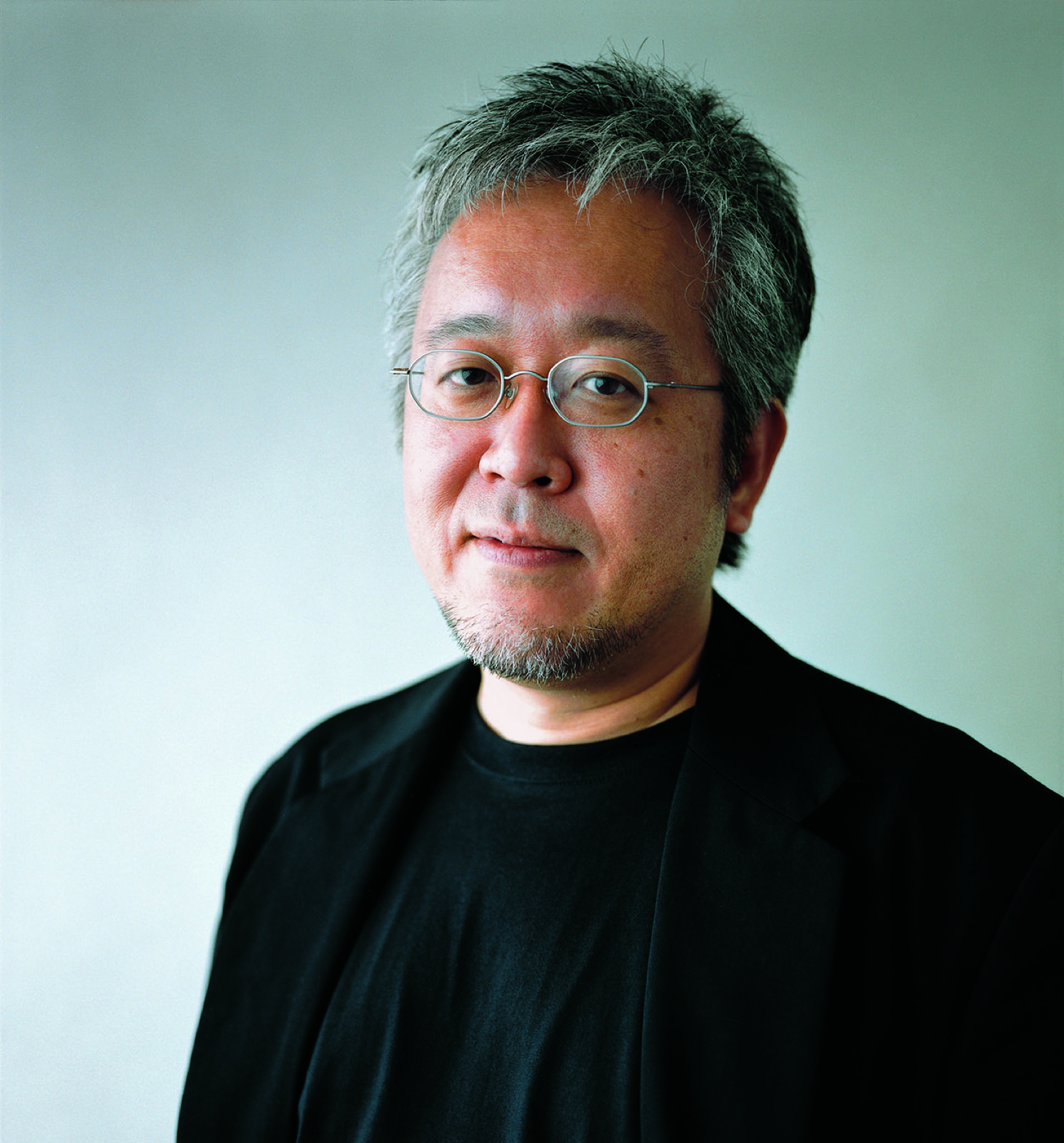
Kenya Hara was born in 1958 in Okayama Prefecture, Japan. He earned his master’s degree at Musashino Art University in 1983 and immediately joined Nippon Design Center, one of Japan’s most established design firms, where he eventually became president. In 1991, he founded the Hara Design Institute within the company – a research-oriented practice that positioned design not as commercial service but as a way of understanding the world.2
In 2002, Hara became art director of MUJI. This was not a rebranding assignment. It was a philosophical alignment: MUJI’s founding premise – Mujirushi Ryohin, “no-brand quality goods” – was already an expression of the emptiness Hara had been developing as a design concept. His role was to articulate what MUJI meant, not to change what it looked like. “Muji’s products look very minimal,” Hara told Surface Magazine. “Minimalism is very similar to the Western concept of simplicity. But there is a difference between simplicity and emptiness.”3
That difference is the thesis of his career. The taste infrastructure territory explores why this distinction – between simplicity as a reduction technique and emptiness as an invitation – matters for systems design, not just physical products.
Hara traces his aesthetic to a specific historical moment: the Onin War of 1467-1477, which devastated Kyoto and destroyed the imperial court’s material culture. What emerged from the ashes was a new aesthetic – wabi-sabi, ma, the beauty of imperfection and the meaning of empty space. Hara argues that Japanese culture did not develop emptiness as a philosophical abstraction. It was a reconstruction ethic: when everything is destroyed, you rebuild with only what is necessary, and the absence itself becomes meaningful.4
The Work
RE-DESIGN: The Daily Products of the 21st Century (2000): Making the Known Unknown
In 2000, Hara curated an exhibition that defined his approach. He invited 32 designers to redesign everyday objects – not to improve them but to make them feel unfamiliar again. “To understand something is not to be able to define it or describe it,” Hara wrote in Designing Design. “Instead, taking something that we think we already know and making it unknown thrills us afresh with its reality and deepens our understanding of it.”4
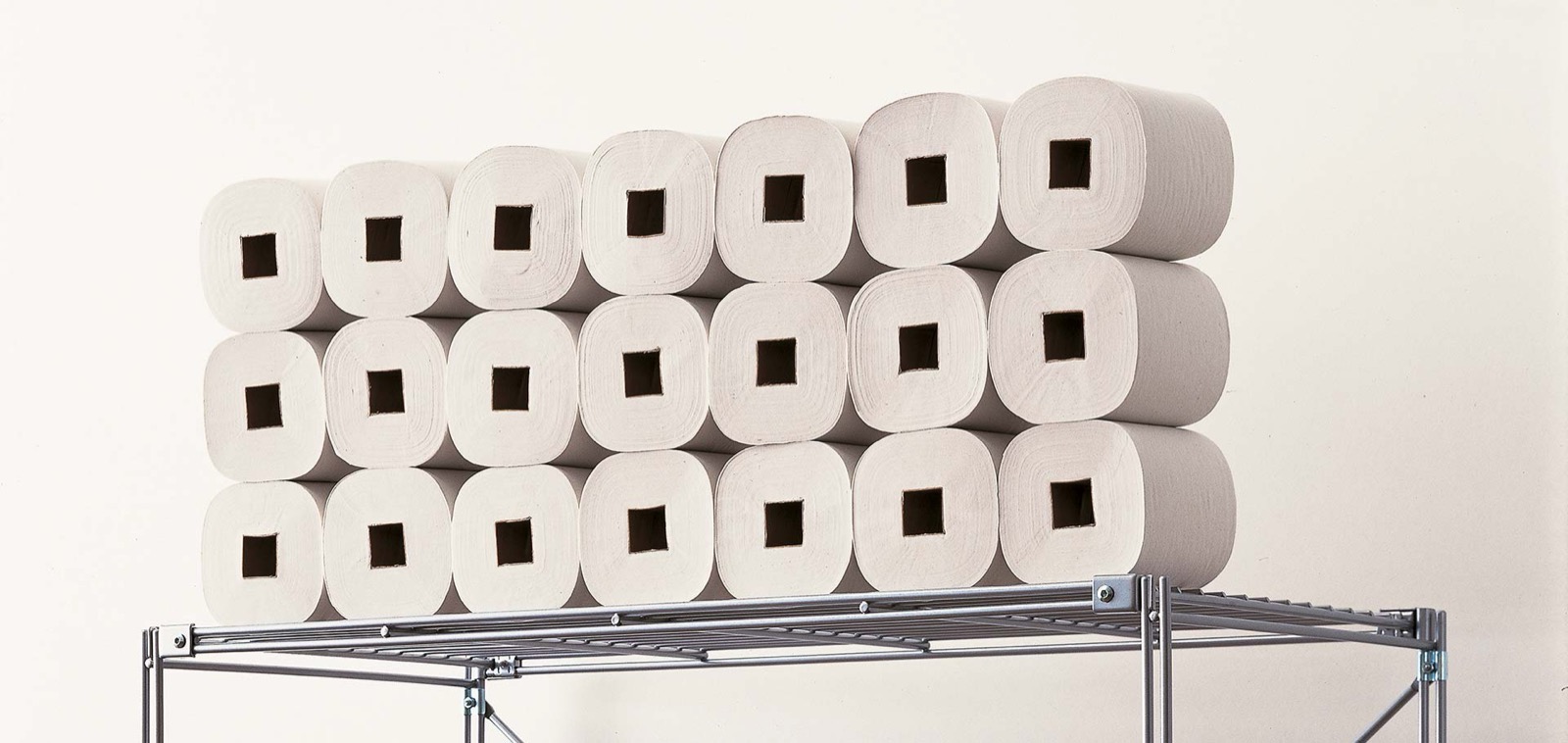
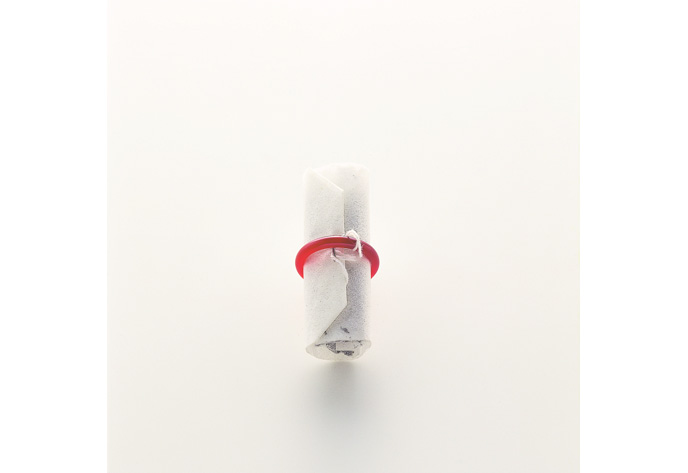
The exhibition included Shigeru Ban’s toilet paper redesigned as a square roll (so it doesn’t roll away), Kaoru Mende’s matchsticks with tips shaped like tiny trees, and Kosuke Tsumura’s diapers and menstrual pads reimagined as architectural structures. Each redesign did not solve a new problem. It revealed the assumptions embedded in the original design – assumptions so familiar they had become invisible.
RE-DESIGN was not about making better products. It was about recovering the capacity to see products at all. Kashiwa Sato applies a parallel method to brand identity – stripping visual systems to the point where the viewer re-encounters the brand rather than merely recognizing it.
MUJI “Horizon” Campaign (2003): Selling Nothing
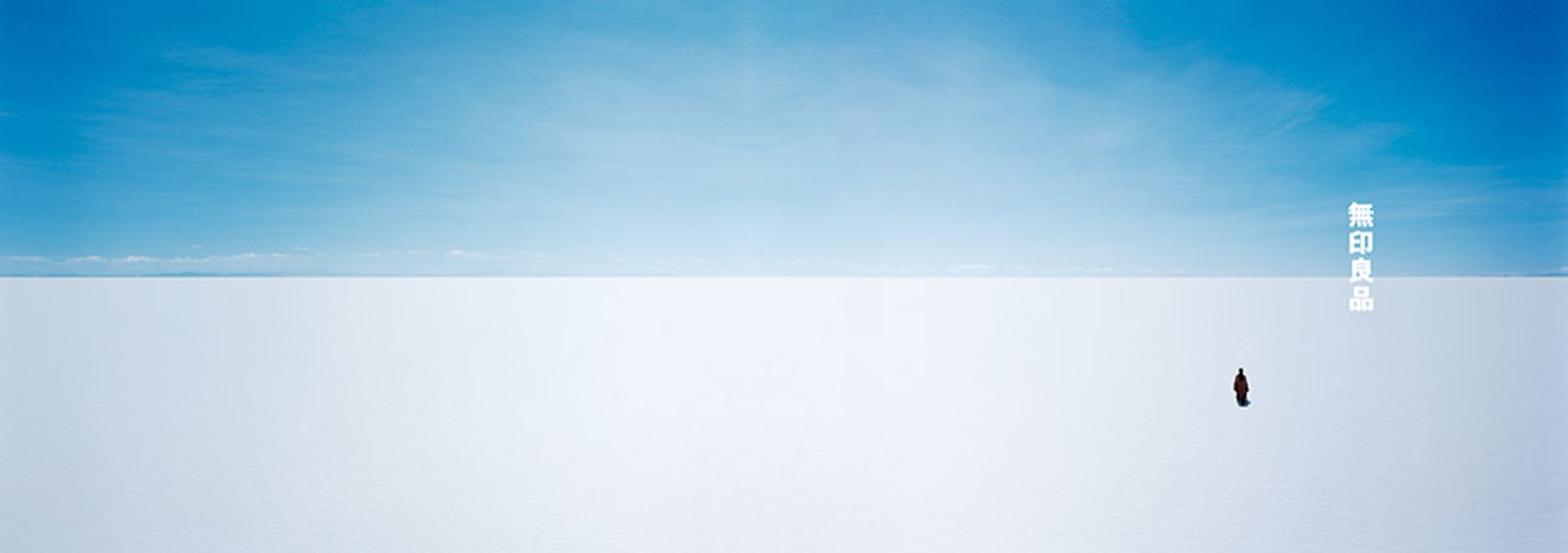
In 2003, Hara created an advertising campaign for MUJI that showed nothing. The posters depicted vast horizons – a salt flat in Bolivia, a horizon line in Mongolia – with the MUJI logo small in the corner. No products. No text beyond the name. No call to action.5
The campaign won the Grand Prize at the Tokyo Art Director’s Club and became the definitive expression of MUJI’s brand philosophy. Hara was not selling products. He was selling the condition in which MUJI products exist: a space empty enough to receive whatever the user brings to it. “I’m not so good at creating stimulating advertising, actually,” Hara told Surface Magazine. “My thinking isn’t centered around giving something a commercial aspect. Instead, I am always asking, ‘What kind of circumstance should humanity create?’”3
The Horizon campaign is the commercial application of Hara’s philosophy: if the brand is an empty vessel, then the advertising should communicate emptiness. The vast emptiness is not a metaphor for MUJI. It is the literal condition MUJI aspires to: a space so open that the user’s imagination fills it.
HAPTIC: Awakening the Senses (2004): Design Beyond Vision
Hara curated HAPTIC in 2004 with 22 participating designers. The exhibition explored design through touch, texture, and sensory experience beyond the visual. Each designer created an object that could only be understood through physical contact – not by looking at a photograph in a magazine.2
HAPTIC made Hara’s argument against screen-mediated design culture. If design is reduced to images, then only visual qualities matter. But a MUJI towel is not designed for how it looks in a catalog. It is designed for how it feels against skin after a bath. The exhibition insisted that design’s most important qualities are often the ones that cannot be photographed.
Architecture for Dogs (2012-present): Scale as Perspective
Hara’s ongoing project invites architects to design structures for dogs – thirteen breeds, thirteen architects, including Toyo Ito, Sou Fujimoto, and Kengo Kuma. The designs are open-source: anyone can download the plans and build them. The project is not about pet furniture. It is about what happens to architectural thinking when you change the scale of the inhabitant. A Chihuahua and a Great Dane experience space differently. Designing for their perspective reveals assumptions about human-scale architecture that designers take for granted.6
The Method
“Art is an expression of an individual’s will to society at large, one whose origin is very much of a personal nature,” Hara wrote. “Design, on the other hand, is basically not self-expression. Instead it originates in society. The essence of design lies in the process of discovering a problem shared by many people and trying to solve it.”4
This distinction structures everything Hara does. Art starts with the individual and moves outward. Design starts with the shared condition and works inward. The designer’s job is not to impose taste but to create receptivity – objects and spaces that receive the diversity of human experience rather than prescribing a single correct use.
His MUJI work embodies this: products are not designed to express the designer’s vision. They are designed to disappear into the user’s life. “The power of design is the receptiveness that can contain the diversity of human ideas,” Hara has said.1 A MUJI notebook does not tell you what to write. A MUJI shelf does not tell you what to display. The emptiness is not a failure of design. It is the purpose of design.
“The role of design is not to surprise or draw people’s attention with novelty,” Hara told Cereal Magazine. “It is to give humanity a chance to notice the wisdom accumulated over the ages that is hidden in all sorts of things.”1
Influence Chain
Who Shaped Him
Japanese aesthetic traditions – specifically wabi-sabi (beauty in imperfection), ma (meaningful void), and the post-Onin War reconstruction ethic – provide Hara’s philosophical foundation. These are not decorative influences. They are structural principles that determine what Hara removes from a design and why: not to clarify function (as Rams would) but to open possibility. (Cultural foundation)4
Zen Buddhism and the tea ceremony tradition inform Hara’s understanding of emptiness as a positive quality rather than an absence. An empty tea room is not a room with nothing in it. It is a room prepared to receive whatever the ceremony brings. (Philosophical foundation)
Who He Shaped
MUJI’s global identity as a design philosophy rather than a retail brand. Before Hara, MUJI was a Japanese discount alternative to branded goods. Under his art direction, MUJI became an international argument that emptiness is a design quality – that products which impose the least identity on the user create the most room for the user’s own identity.
The distinction between simplicity and emptiness as a design concept available to Western designers. Hara’s books, lectures, and exhibitions have given English-speaking designers a vocabulary for talking about what Japanese design does differently from European minimalism.
The Throughline
Hara and Dieter Rams both practice reduction, but from opposite starting points. Rams removes from an Enlightenment position: reason determines what is essential, and everything else is waste. The reduced object declares its function clearly. Hara removes from a Zen position: emptiness is not the absence of meaning but the condition in which meaning arises. The reduced object does not declare – it receives. Both are rigorous. Both require extraordinary discipline. But Rams’ object is a statement. Hara’s object is a question.
Tadao Ando occupies the space between them – see the Ando post for the full argument. Ando’s concrete voids create silence through material presence – the courtyard in the Azuma House that lets rain in is simultaneously a Rams-like declaration (this is a courtyard) and a Hara-like invitation (the sky decides what happens here). (Series bridge)
What I Take From This
Hara’s distinction between simplicity and emptiness changed how I think about API design. A simple API removes unnecessary endpoints. An empty API removes assumptions about how the developer will use it. The first is clean. The second is powerful. The argument that taste is a technical system owes something to this distinction – taste as a structural quality rather than a surface property. The design engineering guide traces how this principle operates across disciplines.
FAQ
What is Kenya Hara’s design philosophy?
Hara’s philosophy centers on emptiness (ku) as a design quality distinct from Western minimalism or simplicity. “The Henckels knife is simple, but the yanagiba is empty,” he explains. Simplicity removes to clarify function. Emptiness removes to invite the user’s imagination and use. His work for MUJI, exhibitions like RE-DESIGN and HAPTIC, and books including Designing Design and White articulate this distinction as both aesthetic theory and commercial practice.14
What did Kenya Hara design?
Hara is the art director of MUJI (since 2002), president of Nippon Design Center, and professor at Musashino Art University. He designed the Nagano Winter Olympics opening ceremony program (1998), curated RE-DESIGN (2000) and HAPTIC (2004) exhibitions, created the MUJI “Horizon” advertising campaign (2003), and launched Architecture for Dogs (2012). His books include Designing Design (2003/2007) and White (2008/2010).25
How does Kenya Hara’s approach differ from Western minimalism?
Hara distinguishes between simplicity (Western, functional, declarative) and emptiness (Japanese, receptive, invitational). A simple object tells you clearly what it is. An empty object creates space for you to decide what it can become. Both reduce. But simplicity is a closed answer. Emptiness is an open question.3
What can designers learn from Kenya Hara?
Stop designing objects that tell people what to think. Design objects that create conditions for thinking. The most powerful design quality may not be clarity but receptivity – the capacity to contain the diversity of human ideas and uses without prescribing any single one.
Sources
-
Kenya Hara, interview with Cereal Magazine. “Kenya Hara.” Henckels vs yanagiba knife metaphor, “emptiness is the pursuit of ultimate freedom,” “the power of design is receptiveness.” ↩↩↩↩↩
-
Hara Design Institute, About. Official biography, career timeline, exhibition history. ↩↩↩
-
Kenya Hara, interview with Surface Magazine, 2017. “Kenya Hara.” “There is a difference between simplicity and emptiness,” “what kind of circumstance should humanity create?” ↩↩↩
-
Kenya Hara, Designing Design (Lars Muller Publishers, 2003/2007 English edition). “Designing Design.” “Taking something that we think we already know and making it unknown” and art vs. design distinction. ↩↩↩↩↩
-
Nippon Design Center, “Nagano Olympic.” Also: Tokyo ADC Grand Prize documentation for MUJI Horizon campaign, 2003. ↩↩
-
Japan House London, “Curator Talk by Hara Kenya: Architecture for Dogs.” Open-source dog architecture project. ↩











