Francis Kéré's Design Philosophy: Architecture as Objective

The Principle
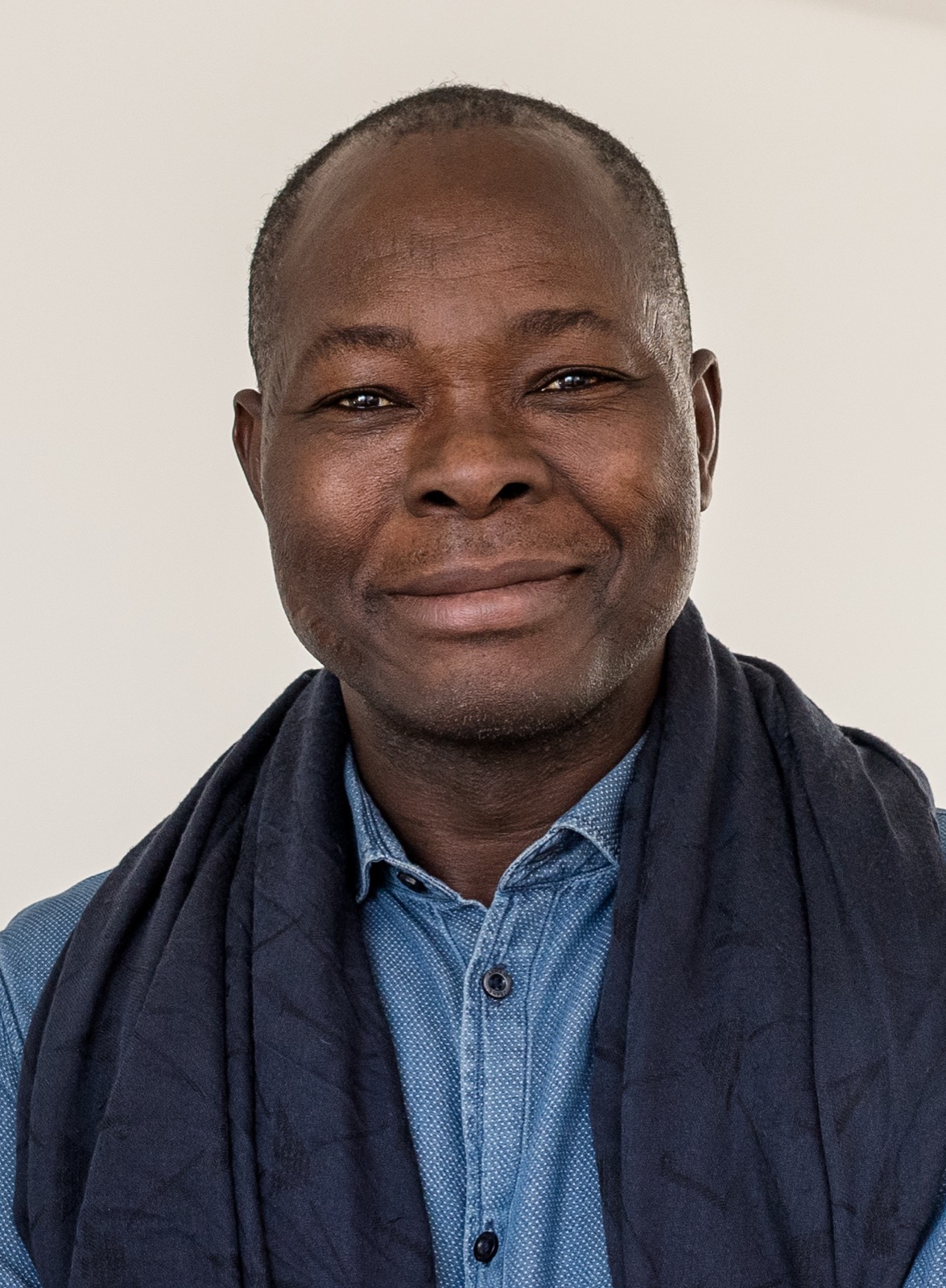
“It is not because you are rich that you should waste material. It is not because you are poor that you should not try to create quality. Everyone deserves quality, everyone deserves luxury, and everyone deserves comfort.” – Diébédo Francis Kéré, Pritzker Prize acceptance1
Kéré’s principle erases the distinction between architecture for the wealthy and architecture for the poor. His work is a foundational layer of the taste infrastructure that defines what “quality” means when material abundance is not available as a shortcut. Quality is not a budget category. It is a design decision, available at every price point, in every material, under every constraint. The corrugated metal roof that ventilates a classroom in Burkina Faso is not lesser architecture than a glass tower in Manhattan. It is architecture that solves a harder problem with fewer resources. The difficulty is the achievement.
Context
Diébédo Francis Kéré was born in 1965 in Gando, Burkina Faso, the oldest son of the village chief. He was the first person in his community to attend school, which required leaving home at age seven to study in Tenkodogo, because Gando had no school. His childhood classroom was cement blocks with no ventilation, no natural light, and over a hundred classmates.2
“I grew up in a community where there was no kindergarten, but where community was your family,” Kéré has said. “My days were filled with securing food and water, but also simply being together, talking together, building houses together. I remember the room where my grandmother would sit and tell stories with a little light, while we would huddle close to each other and her voice inside the room enclosed us, summoning us to come closer and form a safe place. This was my first sense of architecture.”2
He traveled to Berlin in 1985 on a vocational carpentry scholarship. Not architecture: carpentry. He learned to make roofs and furniture by day and attended secondary school at night. In 1995, he won a scholarship to the Technische Universität Berlin, where he studied architecture and graduated in 2004. While still a student, he established a foundation to fundraise for a school in Gando.2
He received the Pritzker Prize in 2022, the first African architect in the award’s history. The jury, chaired by Alejandro Aravena, stated: “He knows, from within, that architecture is not about the object but the objective; not the product, but the process.”3
The Work
Gando Primary School (2001): The Village Builds Its School
Kéré designed his first building while still a student at TU Berlin. The Gando Primary School was built by and for the village: the community made the compressed earth bricks, raised the walls, and learned construction skills in the process. The student body grew from 120 to 700.1
The building solved a specific climate problem: how to create a classroom that is cool enough to learn in when the outside temperature exceeds 40°C, using materials available in rural Burkina Faso. Kéré’s solution was a double roof: a ceiling of compressed earth below a raised corrugated metal roof on steel trusses, with air flowing between the two layers. The thermal mass of the earth absorbs heat. The raised roof reflects it. The gap between them creates a chimney effect that pulls hot air out and draws cooler air in. No air conditioning. No electricity required for cooling.4
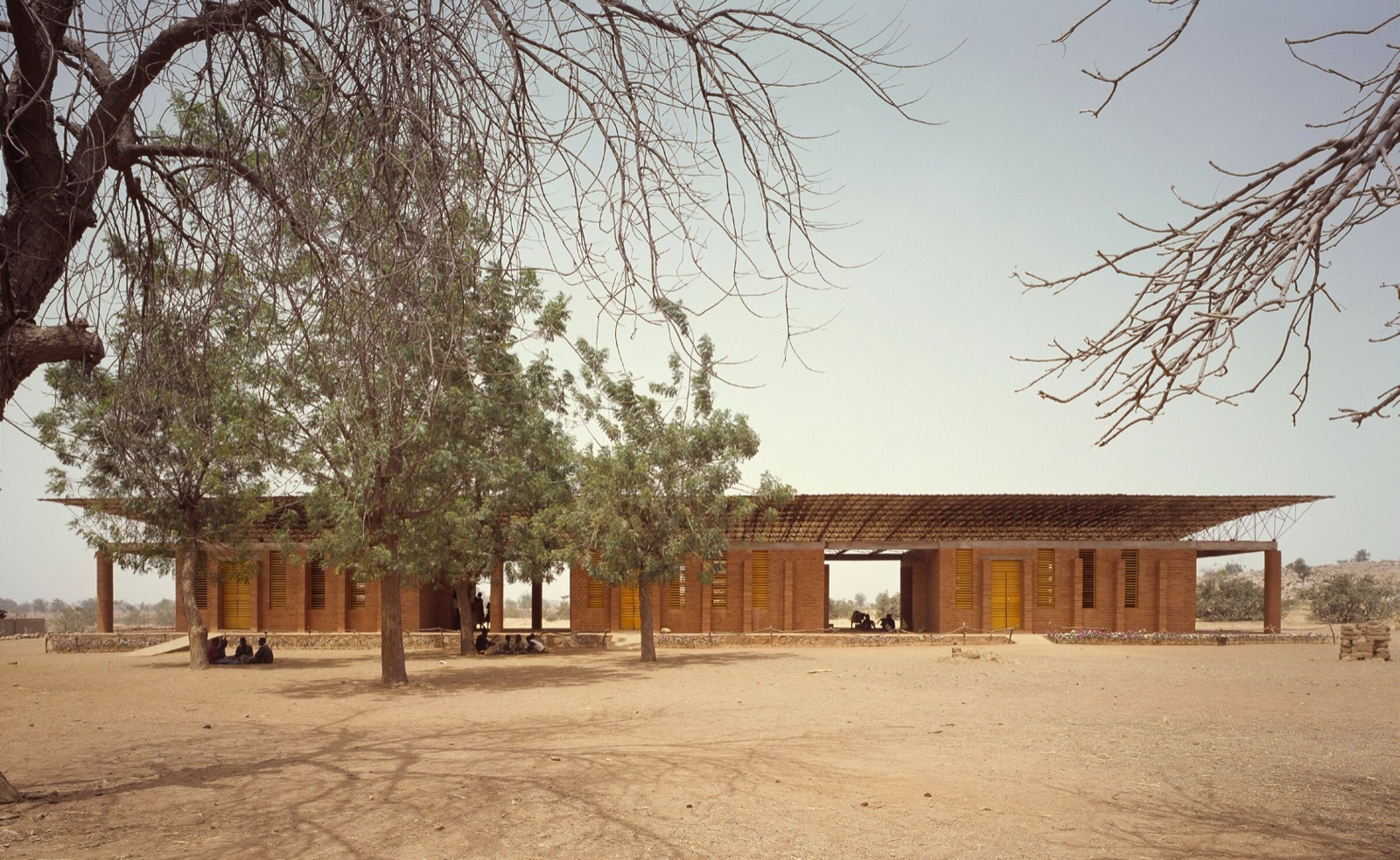
The school won the Aga Khan Award for Architecture in 2004 and launched Kéré Architecture. The project demonstrated that community participation in construction is not a compromise but a design strategy that produces buildings the community maintains because the community built them.
Serpentine Pavilion (2017): The Tree as Meeting Point
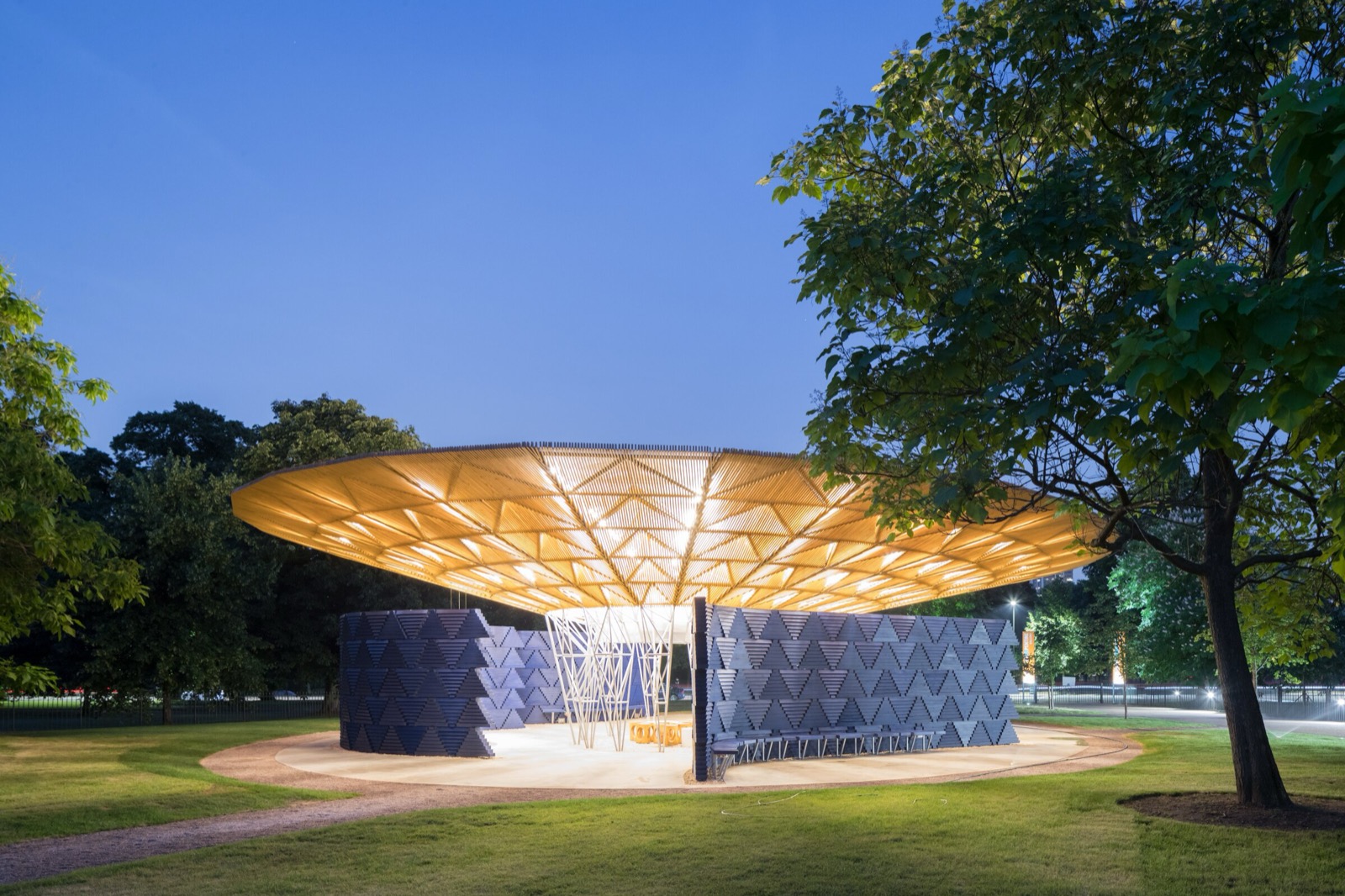
For his Serpentine Pavilion in London, Kéré drew on the communal meeting point of his childhood: a tree. The detached roof funneled rainwater through the center, highlighting water scarcity as a design concern even in London. The indigo-colored modules referenced the color of strength in his culture.5
The pavilion translated Kéré’s method from rural Burkina Faso to central London without losing its specificity. The climate problem changed (London does not need passive cooling the way Gando does), but the social problem remained: how do you create a space where strangers gather? Kéré’s answer in both cases is the same: create a canopy.
Benin National Assembly (under construction): Parliament Under the Tree
The Benin National Assembly in Porto-Novo is Kéré’s most ambitious project, a legislative building inspired by the palaver tree, the traditional West African meeting place where community decisions are made under shade. Parliament convenes inside the building. Citizens gather under the shade at its base, even when parliament is in session. The brise-soleil facade is interwoven like basket weave.1
The design makes a political argument through architecture: a parliament belongs to the public, not to the politicians. The building’s form communicates this by making the public gathering space as architecturally significant as the legislative chamber.
The Method
Kéré’s method treats climate, community, and construction as a single design problem, not three separate concerns optimized independently.
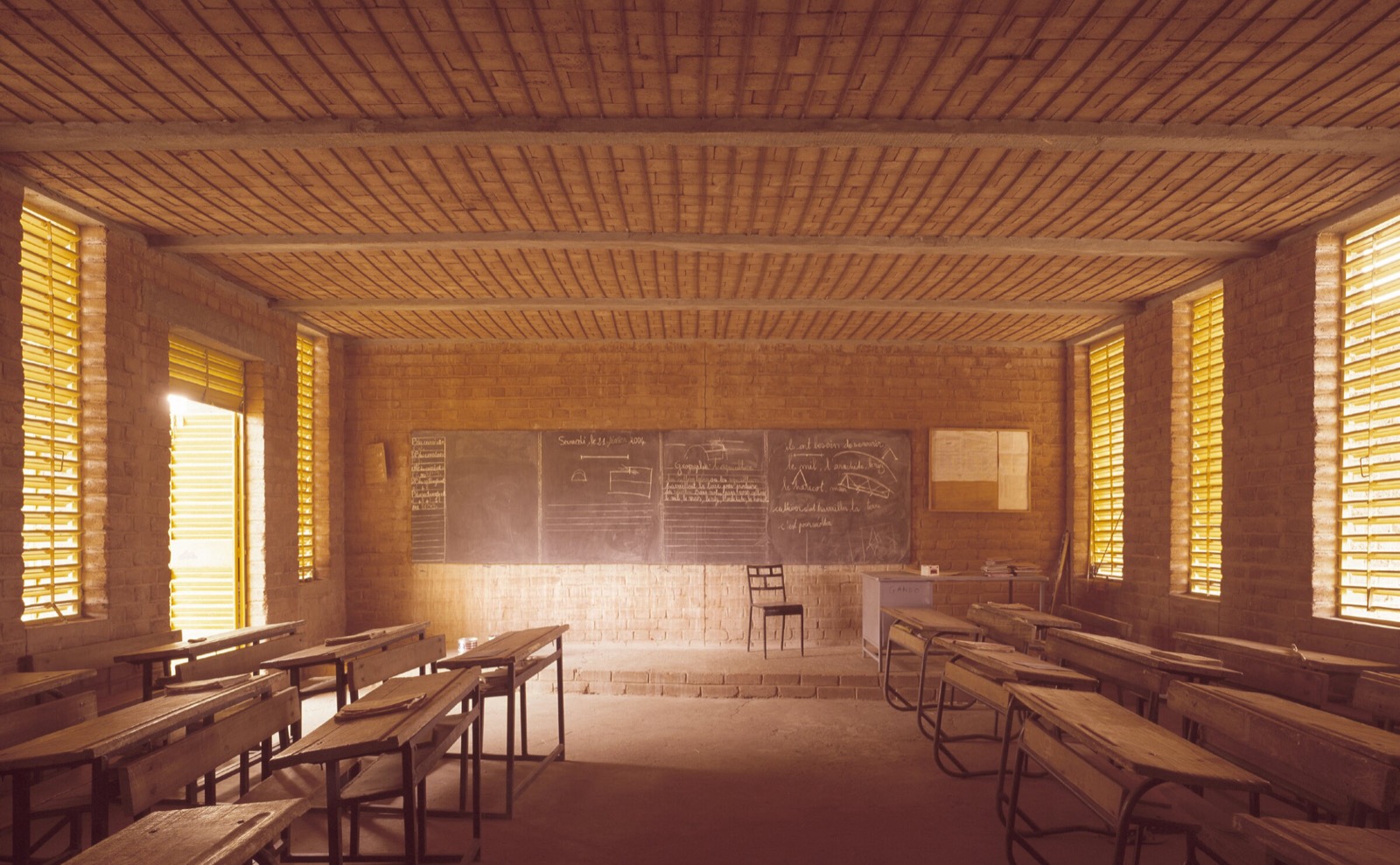
Climate drives construction. Extreme heat dictates the double-roof system, the thermal mass of clay walls, and the perforated facades. “Good architecture in Burkina Faso is a classroom where you can sit, have light that is filtered, entering the way that you want to use it, across a blackboard or on a desk. How can we take away the heat coming from the sun, but use the light to our benefit?”2
Community drives construction. Buildings are literally built by the community. Locals make compressed earth bricks, raise walls, and develop vocational skills in the process. “The users of our designs are always the start and end point of the process.”4
Construction builds community. The building process creates skills and economic opportunity. The Pritzker jury: “His built works in Africa have yielded exponential results, not only by providing academic education for children… but by instilling occupational opportunities and abiding vocational skills for adults, therefore serving and stabilizing the future of entire communities.”3
The canopy is Kéré’s signature element. “A recurring source of inspiration is the crown of a tree, the way sunlight is filtered or the sensation of air flowing through leaves and branches.”4 The Gando Library’s concrete roof was poured around traditional clay pots; when extracted, the openings let heat escape and circular beams of natural light enter.
Influence Chain
Who Shaped Him
His grandmother’s storytelling room gave Kéré his first sense of architecture, not as form but as the feeling of enclosure, warmth, and gathering. The room was architecture before he had the word for it. (Formative experience)2
TU Berlin gave him the technical framework (structural engineering, climate analysis, material science) that he applies to problems the European academy was never designed to solve. The carpentry training that preceded the architecture degree means Kéré, like Matthew Carter, trained in a physical craft before he trained in theory. (Institutional influence)
Who He Shaped
Architecture for extreme scarcity. The Pritzker jury: “Francis Kéré’s entire body of work shows us the power of materiality rooted in place.”3 His buildings demonstrated that world-class architecture is possible with compressed earth, laterite stone, and eucalyptus wood, materials the international architecture establishment had largely dismissed.
The palaver tree as architectural type. Kéré introduced the communal gathering canopy as a formal architectural element, not a metaphor but a literal design strategy. The Serpentine Pavilion, the Benin Assembly, the Gando Library all use the canopy as the primary organizing gesture.
The Throughline
Kéré closes the architecture branch of this series from the opposite direction. Frank Lloyd Wright built with materials native to the site because he chose to. Kéré builds with materials native to the site because there are no others. Wright’s constraint was philosophical. Kéré’s is material. Both arrive at the same principle, the building should grow from its place, but Kéré proves that the principle holds under conditions of extreme scarcity, not just American abundance. Fumihiko Maki designed social infrastructure for Japanese cities. Kéré designs social infrastructure for communities that have none. The ambition is identical. The stakes are different. (Series bridge)
What I Take From This
“Architecture is not about the object but the objective; not the product, but the process.” That is the correct framing for any system design. The deliverable is not the artifact. It is the capability the artifact creates.
FAQ
What is Diébédo Francis Kéré’s design philosophy?
Kéré treats climate, community, and construction as a single integrated design problem. His buildings use locally available materials (compressed earth, laterite stone, eucalyptus wood) and passive cooling strategies (double roofs, perforated walls, thermal mass) to create comfortable environments without mechanical systems. He involves communities in construction, creating vocational skills alongside buildings. “Everyone deserves quality, everyone deserves luxury, and everyone deserves comfort.”12
What did Diébédo Francis Kéré design?
Kéré founded Kéré Architecture in Berlin. His key works include Gando Primary School (2001, Aga Khan Award 2004), Lycée Schorge Secondary School (2016), Serpentine Pavilion (2017), Startup Lions Campus in Kenya (2021), and the Benin National Assembly (under construction). He received the Pritzker Prize in 2022, the first African architect to receive the award.12
Why is Kéré significant to architecture?
He proved that world-class architecture is achievable with extreme material constraints and community-built construction. His Pritzker Prize recognized not just individual buildings but a method: architecture as social infrastructure, where the construction process is as important as the finished building. The jury stated: “He has shown us how locality becomes a universal possibility.”3
What can designers learn from Kéré?
The design guide traces how Kéré’s constraint-driven approach connects to other practitioners in this series. Kunle Adeyemi and Wang Shu share Kéré’s commitment to local materials and community construction, though each operates in a different climate and cultural context. Tadao Ando demonstrates that material constraint can produce meditative beauty even in concrete, while Frank Lloyd Wright established the site-specific ethos that Kéré extends to conditions of extreme scarcity.
The constraint is not the obstacle but the design. Passive cooling in 40°C heat, construction with available earth, community labor as both method and outcome: each constraint produced architectural innovations that would not have emerged from unlimited budgets. Design for the objective, not the object.
Sources
-
Pritzker Architecture Prize, “Announcement: Diébédo Francis Kéré.” “Everyone deserves quality” quote, Benin Assembly, Gando overview. ↩↩↩↩↩
-
Pritzker Architecture Prize, “Biography: Diébédo Francis Kéré.” Grandmother’s room quote, childhood classroom, Berlin carpentry, “good architecture in Burkina Faso” quote. ↩↩↩↩↩↩↩
-
Pritzker Architecture Prize, “Jury Citation: Diébédo Francis Kéré.” “Not about the object but the objective,” “materiality rooted in place,” “locality becomes a universal possibility.” ↩↩↩↩
-
Kéré Architecture, Expertise. Double roof system, compressed earth method, canopy as signature element, community participation methodology. ↩↩↩
-
Serpentine Galleries, “Serpentine Pavilion 2017: Francis Kéré.” Tree as communal meeting point, rainwater collection, indigo color. ↩











