Design Philosophy: Don Norman — It's Not the User's Fault


The Principle
“Design for people the way they are, not for how you want them to be.” – Don Norman1
Norman’s principle inverts the blame. When a person pulls a door that should be pushed, the person is not stupid. The door is badly designed. When a user cannot find the button, the interface is wrong. When an operator misreads a dial in a nuclear control room and nearly causes a meltdown, the dial is the failure – not the operator.
This sounds obvious. It was not obvious in 1988, when Norman published The Design of Everyday Things and the prevailing assumption across every industry was that errors were caused by inattentive humans, not by indifferent design. The taste infrastructure territory traces how Norman’s insight – blame the system, not the user – extends to engineering systems where “taste” means designing defaults that prevent misuse. Norman’s contribution was not a new aesthetic. It was a new assignment of responsibility: if the user fails, the designer failed first.
Context
Donald Arthur Norman was born on December 25, 1935. He earned a bachelor’s in electrical engineering from MIT, a master’s and PhD in psychology from the University of Pennsylvania, and completed a postdoctoral fellowship at Harvard’s Center for Cognitive Studies. His training was not in design. It was in how people think – which turned out to be the missing variable in most design processes.2
At UC San Diego, Norman founded the Department of Cognitive Science and co-founded the Institute for Cognitive Science. He organized the Cognitive Science Society, whose first meeting was held at UCSD in 1979. The discipline he helped create – the study of how minds process information, form mental models, and make errors – became the intellectual foundation for everything that would later be called “user experience.”2
In 1979, Norman was part of a select team flown in to investigate the Three Mile Island nuclear accident. The investigation revealed that the control room operators had not failed through incompetence. They had failed because the control panel’s design made it nearly impossible to distinguish between a cooling system that was functioning and one that was about to cause a meltdown. The dials, switches, and indicators were arranged for engineering logic, not human perception. Three Mile Island was not a story about careless operators. It was a story about a badly designed interface at catastrophic scale.3
In 1993, Norman joined Apple as an Apple Fellow. He became the “User Experience Architect” of a three-person team called the User Experience Office – the first use of the term “User Experience” in a job title. He then became Vice President of the Advanced Technology Group. When Steve Jobs returned to Apple in 1997, he shut down the ATG. Norman left in 1998 and co-founded the Nielsen Norman Group with Jakob Nielsen.4
The Work
The Design of Everyday Things (1988): The Book That Named the Problem
Originally published as The Psychology of Everyday Things, the book’s argument is that objects communicate how they should be used – or fail to. A well-designed door has a flat plate where you push and a handle where you pull. A badly designed door has identical handles on both sides, forcing the user to guess. The badly designed door has since become universally known as a “Norman Door.” A Vox video explaining the concept has been viewed over 11 million times.5
The book introduced five fundamental design principles: affordances (what an object allows you to do), signifiers (what tells you how to do it), mapping (the relationship between controls and their effects), feedback (what tells you something happened), and conceptual models (the user’s understanding of how the thing works). These five concepts became the foundation of the entire UX profession.5
“When people make things ‘simple’ by minimizing controls, they make it much more difficult to work or to understand,” Norman has written. “Simplicity is in the mind, complexity is in the world.”1 This is a direct challenge to the subtractive design philosophy of Dieter Rams and Jony Ive: removing controls can make a product worse, not better, if the removal forces the user to guess. Norman’s simplicity is not fewer elements. It is clearer communication.

Emotional Design (2004): Beauty Works Better
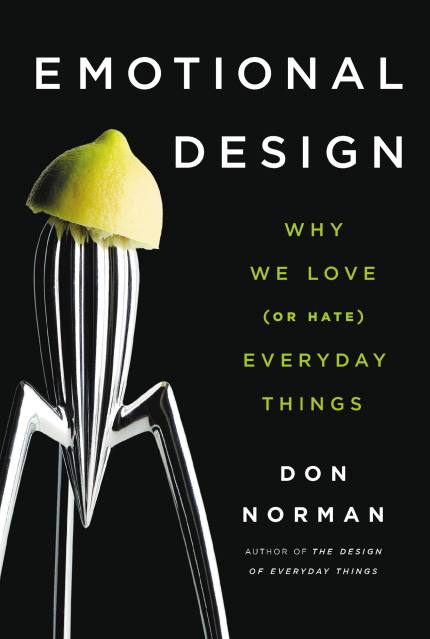
In the first edition of The Design of Everyday Things, Norman focused almost exclusively on usability. Aesthetics were secondary. By 2004, he had changed his mind. Emotional Design: Why We Love (or Hate) Everyday Things introduced three levels at which design operates:6
Visceral – the immediate, instinctive emotional response. A product’s appearance before you touch it. The “I want that” reaction.
Behavioral – usability and function during use. Does it work? Is the experience satisfying?
Reflective – meaning, self-image, and memory after use. What does owning this say about me? Will I recommend it?
The book’s central claim is that “attractive things really do work better” – not because beauty improves mechanical function, but because a positive emotional state makes the user more patient, more creative, and more forgiving of minor usability issues. The three levels are not a hierarchy. They are simultaneous: every interaction engages all three, and a product that fails at any level fails as a whole.6
Norman recanted his earlier dismissal of aesthetics explicitly: “The first edition of the book focused upon making products understandable and usable. The total experience of a product covers much more than its usability: aesthetics, pleasure, and fun play critically important roles.”5
The Term “User Experience” (1993): Naming the Discipline
Before Norman, the things that would become “UX” were scattered across human factors, ergonomics, interface design, and cognitive psychology. None of these terms captured the full scope of what Norman believed mattered: not just the interface, but every aspect of the end-user’s interaction with a company, its services, and its products.4
“‘User experience’ encompasses all aspects of the end-user’s interaction with the company, its services, and its products,” Norman and Nielsen wrote in their 1998 definition. The term was deliberately broad. It included the packaging, the documentation, the customer service call, the physical environment of a retail store – not just the screen. Norman’s UX was holistic before the word “holistic” became a design cliche.7
The Method
Norman’s method is observation. Not asking users what they want – watching them fail and then redesigning the thing that made them fail. “Engineers and business executives are good at solving problems,” he wrote, “but they seldom ask if it is the correct problem.”1
The observation method emerged from cognitive science, not design tradition. Norman watched people interact with doors, stoves, faucets, light switches, and nuclear control panels. He documented the errors. He classified them. And he traced each error back to a design decision that could have prevented it. The method is forensic: the error is evidence, and the evidence points to the design.
His evolution is itself instructive. He moved from “user-centered design” (the term he used in his 1986 book) to “human-centered design” (the revised DOET) to “humanity-centered design” (his 2023 book Design for a Better World). Each shift expanded the scope: from the individual user, to the person in context, to the species and its environment. The method stayed the same – observe, understand, redesign – but the definition of “the problem” kept growing.
“I learn more by being wrong than by being right,” he has said. “When people praise my ideas it is nice to hear, but I don’t learn anything. If people disagree, I learn.”1
Influence Chain
Who Shaped Him
J.J. Gibson gave Norman the concept of affordances. Gibson’s ecological psychology (1977/1979) proposed that objects in the environment offer possibilities for action – a chair affords sitting, a handle affords pulling. Norman adapted the concept for design, then later admitted the adaptation had diverged from Gibson’s original meaning, which led him to coin “signifier” in the 2013 revision to clarify the distinction. (Direct influence)5
Three Mile Island gave Norman the evidence that design failures could be catastrophic. The investigation showed that human error is almost always preceded by design error. (Formative experience)3
Who He Shaped
Every UX designer working today. The five principles from DOET – affordances, signifiers, mapping, feedback, conceptual models – are the vocabulary of the profession. The “Norman Door” is the most widely recognized example of bad design in popular culture. The term “User Experience” itself was Norman’s.
Steve Jobs and Apple – though the relationship is adversarial as much as influential. Norman was VP of the Advanced Technology Group when Jobs returned in 1997. Jobs shut down the ATG entirely – not because Norman’s work was wrong, but because Jobs wanted fewer projects, not more. Norman left to co-found NNG.4 But the human-centered design principles Norman championed – the insistence that technology should adapt to people, not the reverse – survived the reorganization and became foundational to the iPhone era. The principles outlasted the reorganization. The human-centered design framework Norman built at Apple became foundational to the iPhone era – even though the team that built the framework was gone before the iPhone existed.
The Throughline
Norman is the necessary counterweight to Jony Ive in this series. Ive designed objects that are beautiful, minimal, and manufactured with extraordinary precision. Norman asks: but can the user figure out how to use them? The one-button mouse is elegant. It is also, Norman would argue, a signifier failure – one button cannot communicate multiple functions without hidden gestures the user must discover or be taught. Both are right. The tension between beauty and usability is not a problem to solve but a balance to hold. (Series bridge)
What I Take From This
“Human error? No, bad design.” That is the correct mental model for debugging. When a user reports unexpected behavior, the first assumption should be that the interface misled them – not that they are wrong. Susan Kare operationalized this principle at Apple a decade before Norman’s book – the Happy Mac icon and the trash can were signifiers designed so the user could not misunderstand the system’s state. The design engineering guide explores how these principles scale from individual icons to full system architectures.
FAQ
What is Don Norman’s design philosophy?
Norman’s philosophy centers on human-centered design: the principle that design should accommodate human needs, capabilities, and behavior rather than requiring humans to adapt to the design. His core insight is that when users make errors, the design is at fault, not the user. He introduced five fundamental design principles – affordances, signifiers, mapping, feedback, and conceptual models – and three levels of emotional design: visceral, behavioral, and reflective.156
What did Don Norman design?
Norman is not a product designer. He is a cognitive scientist who created the intellectual framework for human-centered design. He wrote The Design of Everyday Things (1988/2013), coined the term “User Experience” at Apple (1993), co-founded the Nielsen Norman Group (1998), and published Emotional Design (2004) and Design for a Better World (2023). He investigated the Three Mile Island nuclear accident and founded UC San Diego’s Department of Cognitive Science.24
What is a Norman Door?
A Norman Door is any door whose design fails to communicate whether it should be pushed or pulled. The term comes from The Design of Everyday Things, where Norman uses doors as the canonical example of design that forces the user to guess rather than understand. A Vox video explaining the concept has been viewed over 11 million times.5

What can designers learn from Don Norman?
When a user fails, examine the design before blaming the user. Observation beats opinion – watch people interact with your product and redesign based on what you see them struggle with. Simplicity is not fewer elements; it is clearer communication. And beauty and usability are not opposed: attractive things genuinely work better because positive emotion makes users more capable.
Sources
-
Don Norman, jnd.org – personal website. “Design for people the way they are,” “engineers and business executives” quote, “simplicity is in the mind” quote, “I learn more by being wrong” quote. ↩↩↩↩↩
-
Don Norman, “About Don Norman.” Full biography: MIT, UPenn, UCSD cognitive science, Apple, Northwestern, five retirements. ↩↩↩
-
Don Norman, The Design of Everyday Things (revised edition, 2013), Chapter 5: “Human Error? No, Bad Design.” Norman’s account of the Three Mile Island investigation and its implications for design. Also confirmed in NNG bio and multiple published interviews. ↩↩
-
Nielsen Norman Group, “Don Norman.” Career summary, Apple Fellow, “first use of the term ‘User Experience’ in a job title,” NNG co-founding. ↩↩↩↩
-
Don Norman, The Design of Everyday Things (originally The Psychology of Everyday Things, Basic Books, 1988; revised MIT Press, 2013). Book page. Five principles, Norman Doors, signifiers addition, aesthetics recantation. ↩↩↩↩↩↩
-
Don Norman, Emotional Design: Why We Love (or Hate) Everyday Things (Basic Books, 2004). Book page. Three levels: visceral, behavioral, reflective. “Attractive things really do work better.” ↩↩↩
-
Don Norman and Jakob Nielsen, “The Definition of User Experience.” Nielsen Norman Group, 1998. “All aspects of the end-user’s interaction.” ↩