Design Philosophy: Florence Knoll — I Am Not a Decorator

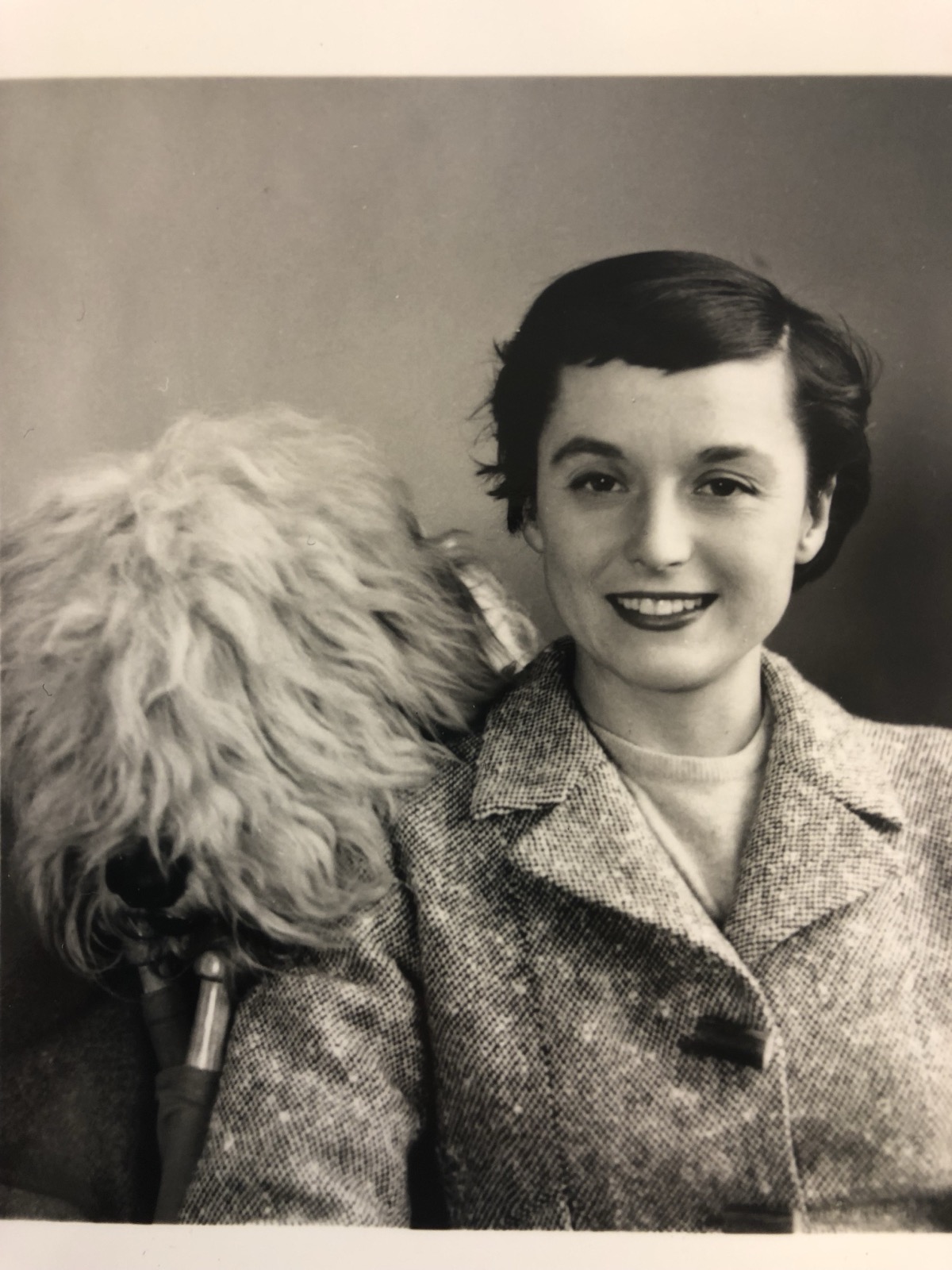
The Principle
“I am not a decorator… the only place I decorate is my own house.” – Florence Knoll, New York Times, 19641
Florence Knoll drew a line between decoration and architecture that the interior design profession has been trying to hold ever since. Her work is a foundational layer of the taste infrastructure that determines how we experience workspaces today. Decoration arranges objects in a room. Architecture determines why the room exists, what happens inside it, and how the space shapes the behavior of the people who use it. Knoll did the second thing. She studied under Mies van der Rohe, apprenticed with Gropius and Breuer, and brought an architect’s spatial logic to corporate interiors at a time when “interior design” meant a decorator choosing curtains for the boss’s office.
The result was the Knoll Planning Unit – a team of never more than eight designers that completed over 200 projects and, in the process, invented the modern American office. The design guide traces how Knoll’s systems thinking connects to other practitioners across this series.
Context
Florence Schust was born in Saginaw, Michigan, in 1917. Her father died when she was five. Her mother died when she was twelve. Orphaned and placed under a bank president’s legal guardianship, she found her way to Kingswood School for Girls at Cranbrook, where the art director recognized her talent and introduced her to Eliel Saarinen. The Saarinens became a surrogate family – Florence vacationed with them in Finland and Europe, and Eliel became her first architectural mentor.2
Her education is a direct line through the modernist canon. Cranbrook Academy of Art under Eliel Saarinen. Columbia University for town planning. The Architectural Association in London, where she originated the paste-up presentation technique she would later make standard practice. An apprenticeship with Walter Gropius and Marcel Breuer in Cambridge. And finally, a year at the Illinois Institute of Technology under Mies van der Rohe – a year she described as “very valuable.” By the time she arrived in New York in 1941, she had studied under the three most important architects of the twentieth century.2
“Being a woman, I was given interiors,” she said of her first job at Harrison & Abramovitz.3 The industry’s assumption that interiors were women’s work became the opening she used to transform the discipline. If the architecture firms would not let her design buildings, she would make interiors as rigorous as buildings.
In 1943, she joined Hans Knoll’s furniture company. In 1946, they married, renamed the company Knoll Associates, and Florence founded the Planning Unit. When Hans died in a car accident in Cuba in 1955, Florence became president of all three Knoll companies. She ran them for five more years, then stepped down to design director in 1960, and retired entirely in 1965. She was 48. She lived to 101.2
The Work
The Knoll Planning Unit (1946-1965): Architecture Without Buildings
The Planning Unit was not an interior design department. It was an architecture practice that operated at the scale of rooms instead of buildings. Florence approached each corporate client with a questionnaire – a radical concept in an era when offices were designed by purchasing agents ordering desks from catalogs.3
“In those days the boss usually had a decorator,” she explained. “They did his office and maybe some of the senior executives, but the people further down the line had offices designed by the purchasing agent, who ordered furniture out of a catalog. So when I came along with my questionnaire, I wanted to know what they needed. It was kind of a radical idea, but it was also logical and obvious.”4
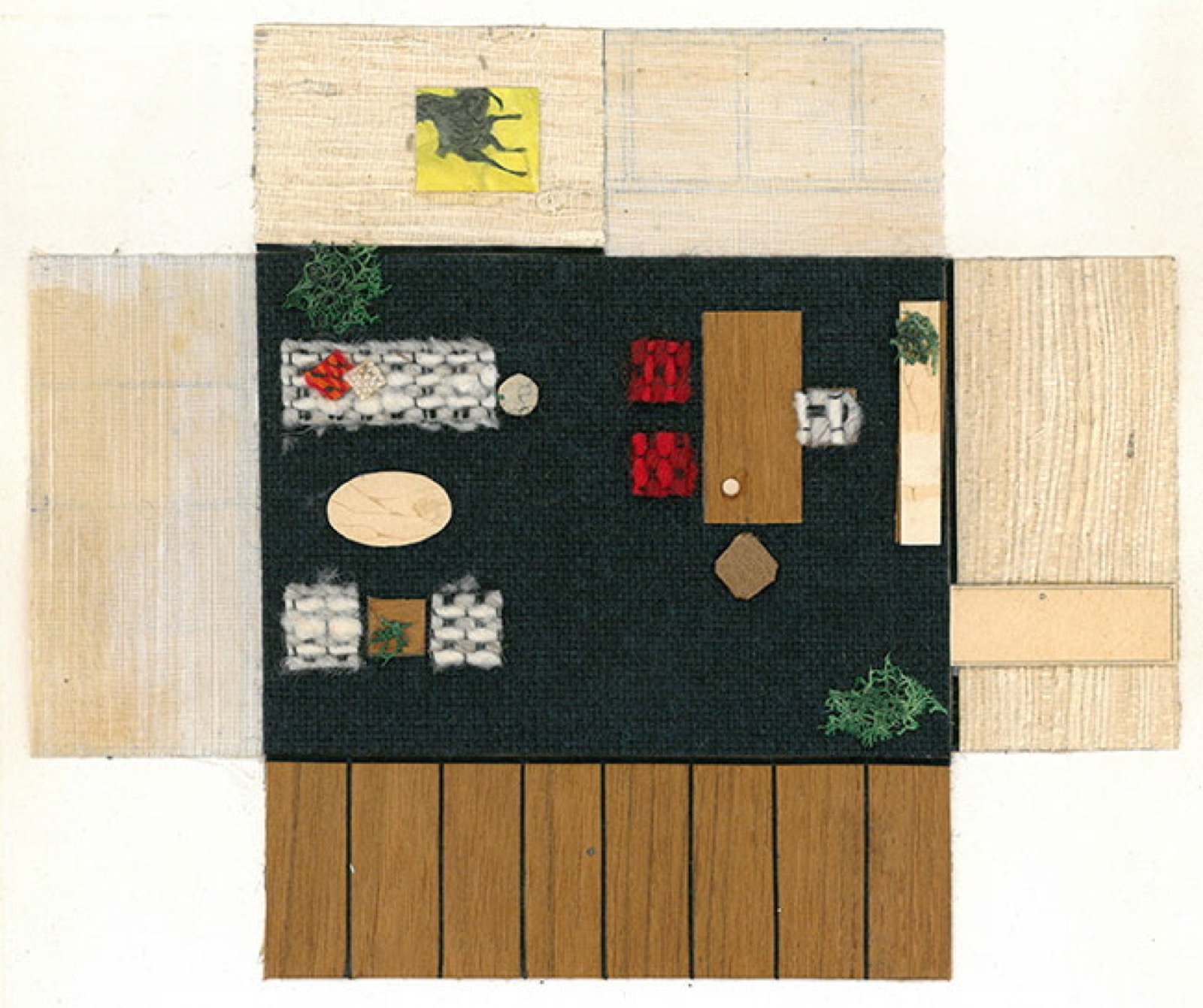
The method was systematic. Paste-up boards – small bird’s-eye-view plans with fabric swatches, wood chips, bits of leather, images of marble and stone, dabs of paint, even leaves from plants, all positioned in their designated locations. Grid-based space planning replaced the prevailing fashion of diagonal desk arrangements. Storage moved into cabinets, freeing desks to become conference tables. Informal discussion areas appeared alongside formal offices. Every element justified its presence through function, not status.4
“The planning unit was the heart and soul of the company,” Knoll said, “because it controlled all the visuals; and it was also its biggest sales tool.”4
Connecticut General Life Insurance (1957): The Proof at Scale
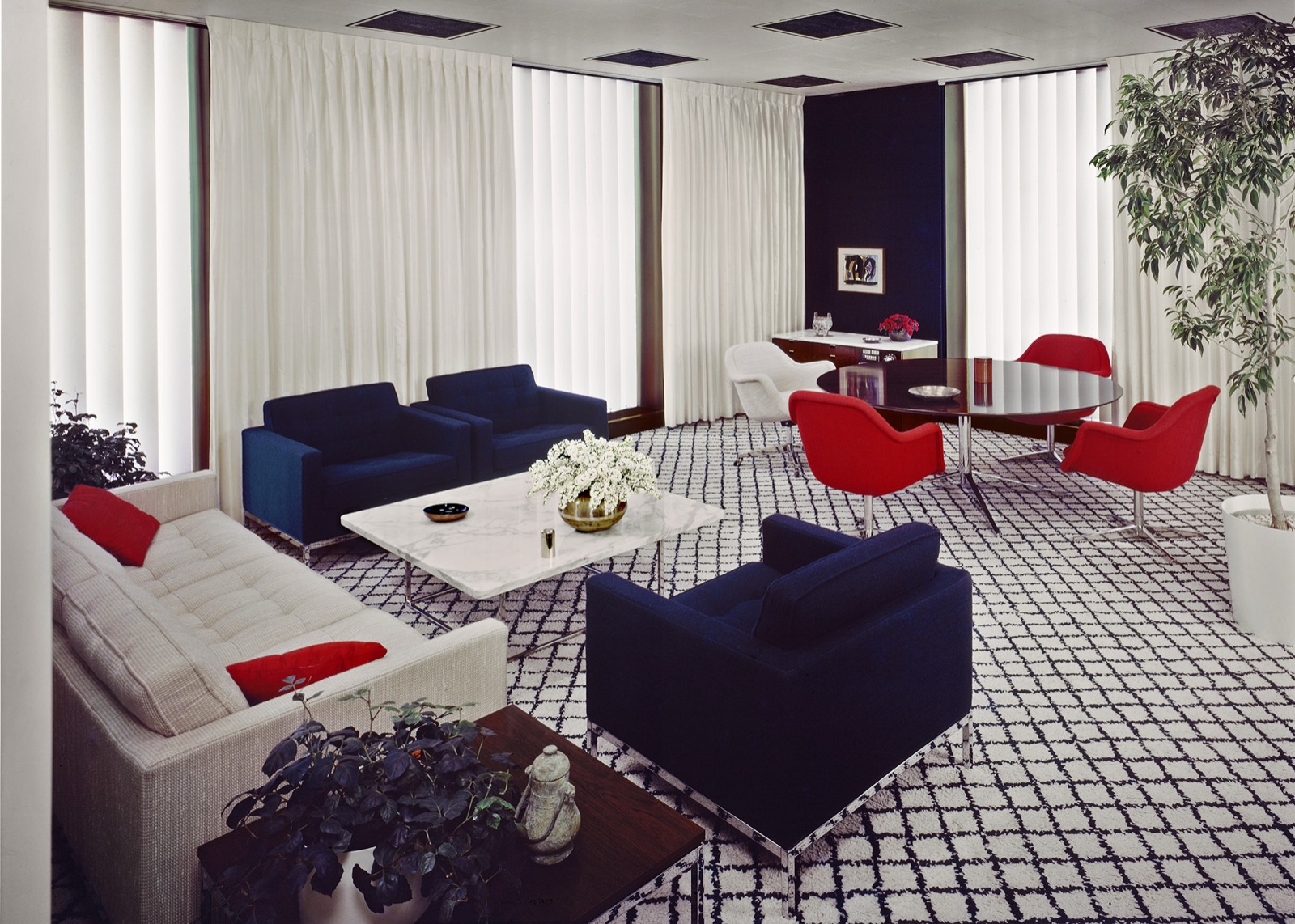
The Connecticut General headquarters in Bloomfield, designed by Gordon Bunshaft of Skidmore, Owings & Merrill, was the project that proved the Planning Unit’s approach could work at institutional scale. Knoll built a full-scale 1% mock-up on-site to test cubicle dimensions, lighting, and materials before committing to the final build. Bunshaft called it “a very happy joint venture. Our design interests were more or less the same – international modern.”5
The project demonstrated that total interior design – furniture, textiles, lighting, art, plants, spatial flow – could be planned as a single integrated system rather than assembled piecemeal by separate vendors. The mock-up was not a luxury. It was an engineering tool, applied to interior space the way an architect applies structural models to a building.
CBS “Black Rock” (1964): The Culminating Project
The CBS Building on Sixth Avenue – Eero Saarinen’s last major work, completed after his death – received Florence Knoll’s most ambitious interior. CBS president Frank Stanton believed she alone had “the vision, taste, and ability” to create interiors worthy of the building Saarinen had designed.6
Different color schemes, furniture configurations, and artworks appeared on every floor’s reception area. The 35th-floor executive suite included Tiffany glass panels – a deliberately non-modernist touch that demonstrated Knoll’s range beyond the International Style she was associated with. A Knoll executive later testified: “The thing that struck me then was the awe in which everyone held her… Her objective was to produce absolute perfection.”6
The Cowles Publications project required 197 drawings covering construction, electrical, plumbing, HVAC, finishes, furniture, floor coverings, draperies, plants, pictures, and accessories. Progressive Architecture noted: “It is this meticulous attention to every detail of interior design for which the Knoll Planning Unit is renowned.”5
The Commissions: Creating the Context
Knoll’s most lasting influence may not be the spaces she designed but the objects she commissioned for those spaces. She convinced her husband Hans to recruit architects as furniture designers and to give them credit and royalties – a radical practice when most manufacturers kept designers anonymous.2
She asked Eero Saarinen for “a great big basket of pillows that I can curl up in.” The result was the Womb Chair (1948), which required a fiberglass boat builder to manufacture. She commissioned Saarinen’s Tulip Chair, Harry Bertoia’s wire chairs (after inviting him to spend two years translating his sculpture into furniture), and secured the manufacturing rights to Mies van der Rohe’s Barcelona Chair in 1953.5
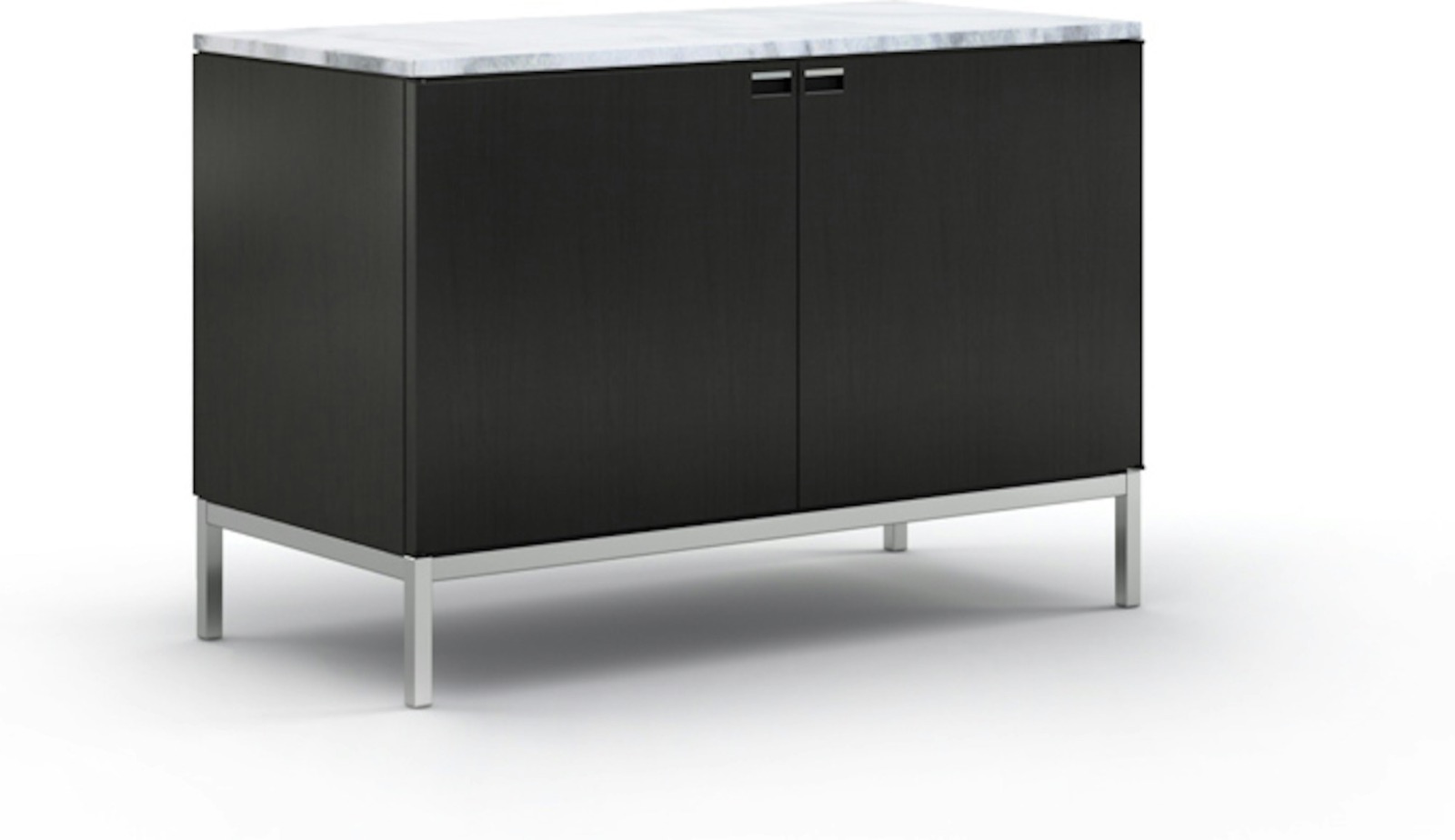
Her own furniture – the Florence Knoll Sofa, Bench, and Tables – she described as “fill-in” pieces. “[Eero Saarinen and Harry Bertoia] did the stars and I did the fill-in. I did it because I needed the piece of furniture for a job and it wasn’t there, so I designed it.”7 The modesty is precise: her pieces are not sculptural statements. They are the spatial infrastructure that makes the sculptural statements legible.
The Method
“An intelligent interior plan goes further than the furnishings which fill the space,” Knoll wrote. “It strikes at the root of living requirements and changing habits. Planning involves economics, technical efficiency, comfort, taste, and price.”4
Her method started with research, not aesthetics. The client questionnaire. The space audit. The functional requirements document. Only after the spatial logic was established did materials, colors, and furniture enter the process. The paste-up boards – her signature presentation tool – were not mood boards. They were architectural drawings that happened to include fabric swatches.
“The simpler the background, the easier the thought process,” she said.4 The Planning Unit’s offices and showrooms were laboratories for this principle – spaces designed to facilitate work, not to impress visitors. The New York showroom on Madison Avenue functioned as a model environment that clients could experience before committing to the approach for their own spaces.
Influence Chain
Who Shaped Her
Mies van der Rohe gave her the grid. His rationalist approach to space planning – modular, proportional, every element on a structural grid – became the foundation of the Planning Unit’s method. She studied under him for a year at IIT and absorbed his principle that architecture begins with the plan, not the facade. (Direct influence)2
Eliel Saarinen gave her the family and the network. Cranbrook was where she met Eero Saarinen (lifelong collaborator), Harry Bertoia, and Charles and Ray Eames – the constellation of designers who would define postwar American design. Without Cranbrook, neither Knoll the company nor Knoll the designer would have existed. (Formative influence)2
Who She Shaped
The modern corporate office as a designed environment. Paul Goldberger, New York Times architecture critic, wrote that Knoll “probably did more than any other single figure to create the modern, sleek, postwar American office, introducing contemporary furniture and a sense of open planning into the work environment.”3
The profession of interior design itself. Architectural Forum wrote in 1957: “The Knoll interior is as much a symbol of modern architecture as Tiffany glass was a symbol of the architecture of Art Nouveau.” The Planning Unit’s alumni – graduates of “Shu U” – went on to found interior design divisions at SOM and other major firms. Paula Scher later brought a similar systems-level ambition to graphic identity, treating entire corporate environments – signage, wayfinding, and spatial graphics – as unified design problems rather than piecemeal decoration.5
The Throughline
Charles and Ray Eames were fellow Cranbrook alumni whose collaborative method Knoll admired and whose furniture appeared alongside hers in the modernist canon.
Knoll is the counterpart to Dieter Rams in a different medium. Rams designed objects that disappear into use. Knoll designed rooms that disappear into work. Both practiced reduction as a service to the user, not as an aesthetic. But where Rams could control every detail of a product, Knoll had to orchestrate the contributions of architects, furniture designers, textile makers, and artists into a single coherent environment. Her design unit was literally that – a unit of design, not a single designer. The discipline was coordination, not creation. (Series bridge)
What I Take From This
“I needed the piece of furniture for a job and it wasn’t there, so I designed it.” That is exactly how good internal tools get built. You don’t design them because you want to – you design them because the work requires something that doesn’t exist yet.
FAQ
What is Florence Knoll’s design philosophy?
Knoll treated interior design as architecture, not decoration. She insisted that corporate interiors should be planned as total environments – furniture, textiles, lighting, art, and spatial flow designed as an integrated system. Her approach was research-first: client questionnaires, functional requirements, grid-based space planning, and full-scale mock-ups preceded any aesthetic decisions. “I am not a decorator,” she stated in 1964.1
What did Florence Knoll design?
Knoll founded the Knoll Planning Unit (1946-1965), which completed over 200 corporate interior projects including Connecticut General Life Insurance, CBS headquarters (“Black Rock”), and offices for IBM, Heinz, and Seagram. She designed the Florence Knoll Sofa, Bench, and Tables. She also commissioned landmark furniture designs from Eero Saarinen (Womb Chair, Tulip Chair), Harry Bertoia (Diamond Chair), and secured manufacturing rights for Mies van der Rohe’s Barcelona Chair.57
How did Florence Knoll change interior design?
She transformed interior design from decoration (choosing finishes and furniture for individual rooms) into spatial architecture (planning entire environments as integrated systems). Her Planning Unit established the model that corporate interior design firms follow today. She also pioneered the practice of crediting and paying royalties to furniture designers, creating the economic incentive for architects to design furniture.23
What can designers learn from Florence Knoll?
Don Norman later formalized many of the user-centered principles Knoll practiced intuitively — the questionnaire, the functional requirements, the insistence on understanding how people actually use a space before proposing how it should look.
Start with the problem, not the aesthetic. Research how people actually use the space before proposing how it should look. Design the system, not just the objects – coordination across multiple contributors into a coherent whole is its own discipline. And if the piece you need doesn’t exist, design it yourself. The design guide traces how Knoll’s systems thinking connects to other practitioners in this series.
Sources
-
V. L. Warren, “Woman Who Led an Office Revolution Rules an Empire of Modern Design,” New York Times, September 1, 1964, p. 40. Primary source for “I am not a decorator.” Also analyzed in: Bobbye Tigerman, “‘I Am Not a Decorator’: Florence Knoll, the Knoll Planning Unit and the Making of the Modern Office,” Journal of Design History, Vol. 20, No. 1 (2007), pp. 61-74. ↩↩
-
Knoll, “Florence Knoll.” Designer profile with biographical timeline. Also: Britannica. ↩↩↩↩↩↩↩
-
Pioneering Women of American Architecture, “Florence Knoll Bassett.” CBS project details, Goldberger quote, career overview. ↩↩↩↩
-
Metropolis Magazine, “The Wisdom of Florence Knoll.” “Planning unit was the heart and soul,” paste-up technique, client questionnaire process. ↩↩↩↩↩
-
Knoll, “The Planning Unit.” Connecticut General project, Architectural Forum quote, project methodology. ↩↩↩↩↩
-
PBS/Antiques Roadshow, “Remembering the Remarkable Florence Knoll.” CBS interiors, Frank Stanton quote. ↩↩
-
Florence Knoll Bassett Papers, 1932-2000. Archives of American Art, Smithsonian Institution. “Stars and fill-in” quote from Knoll.com designer profile. ↩↩











