Design Philosophy: Susan Kare — Meaningful, Memorable, Clear
The Principle
“Meaningful, Memorable, Clear.” – Susan Kare, on the three adjectives that define good design1
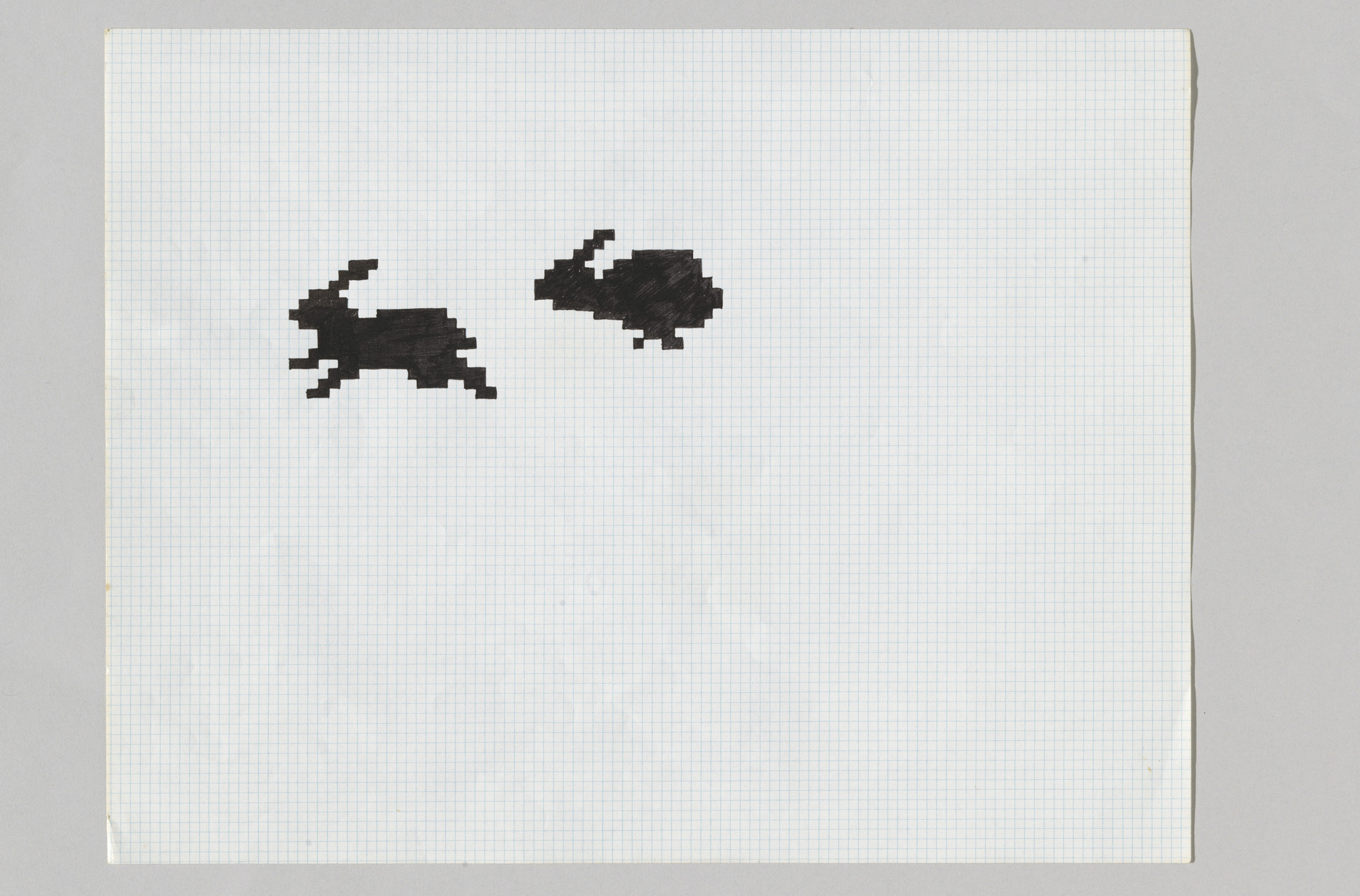
Kare designed the original Macintosh icons – the Happy Mac, the bomb, the trash can, the paintbrush, the Command key – in a 32x32 pixel grid using a $2.50 graph paper sketchbook. Every icon had to communicate its function to someone who had never used a computer. The constraint was absolute: 1,024 black or white squares to convey a concept that people would understand without instruction. She treated the constraint not as a limitation but as the problem itself, and she solved it by drawing from the oldest visual traditions available: needlepoint, mosaics, folk symbols, and traffic signs.
Her icons gave the Macintosh a personality. Before Kare, computers communicated through command lines. After Kare, they communicated through metaphors you could point at. The trash can meant delete. The document with a folded corner meant file. The smiling computer meant everything is working. These metaphors are so deeply embedded in computing that we no longer notice they were designed. That invisibility is the highest compliment the work can receive.
Context
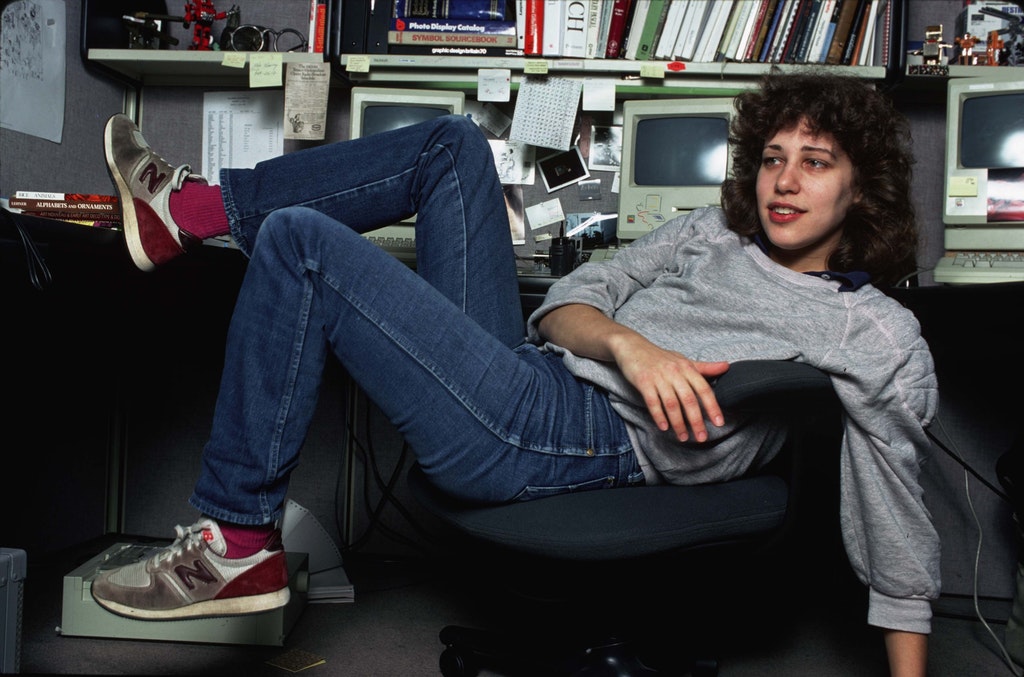
In 1982, Susan Kare was a sculptor living in the San Francisco Bay Area. She had a Ph.D. in fine arts from NYU, where her doctoral dissertation examined caricature in the sculptures of Honore Daumier and Claes Oldenburg. She had worked as a curator at the Fine Arts Museums of San Francisco. She was welding a life-sized razorback hog sculpture for an Arkansas museum when the phone rang.2
Andy Hertzfeld, a high school friend and software engineer on the Macintosh team, offered her an Apple II computer in exchange for hand-drawing “a few icons and font elements.” Kare had no computer graphics experience. She did not know how to design a typeface. She went to the Palo Alto public library, checked out books on typography, bought the smallest graph paper she could find at the University Art store for $2.50, and showed up for an interview that lasted five minutes. “When can you start?” They made her Employee #2 of the Macintosh software group, with the title “Macintosh Artist.”2
The timing mattered. Apple was building the first mass-market computer with a graphical user interface. The Lisa had established the concept, but the Macintosh was supposed to be affordable and approachable. Every element of the screen – icons, fonts, cursors, dialog boxes – needed to communicate to people who had never touched a computer and might be afraid of one. Kare later said: “I hoped to help counter the stereotypical image of computers as cold and intimidating.”3
She had no training in digital design because the field did not yet exist. What she had was a fine arts education, a sculptor’s understanding of form within constraints, and an instinct for visual metaphor drawn from folk art, needlepoint, and symbol systems. “Bitmap graphics are like mosaics and needlepoint and other pseudo-digital art forms, all of which I had practiced before going to Apple,” she said.3 The pixel grid was not foreign to someone who had spent years filling in squares on graph paper and counting stitches in needlework.
The Work
The Macintosh Icons (1983-1984): Making Machines Human
Hertzfeld told Kare to buy graph paper and draw 32x32 grids. Each filled square would be one pixel. She drew icons in pencil and colored pen, testing metaphors on paper before committing them to screen. When Hertzfeld wrote an icon editor that let her toggle bits with a mouse, the sketchbook became the design tool and the editor became the production tool. Her original sketchbook is now in MoMA’s permanent collection, jointly acquired with SFMOMA in 2015.4
The Happy Mac – a smiling computer face that greeted users at startup – was designed to counteract fear. The bomb icon – which appeared during system errors – was designed to be “playful rather than alarming.” The paint bucket was tested as a paint roller and several other options before Kare settled on the pouring can because it “made the most sense to people.” The trash can inherited its concept from the Lisa but was redrawn for the Macintosh’s different pixel dimensions.2
Each icon went through a specific design process: Kare would make several options, then show them to people and watch their reactions. “I tried to make a selection and get people’s opinions” rather than declaring a final design. She avoided text and puns deliberately: “I tried not to use words, and not to use puns, because they don’t translate.” This decision – visual metaphors only, no English-language dependencies – meant the icons worked across every language from launch.2
The Command key has the most specific origin story. Steve Jobs walked into the software area and declared: “There are too many Apples on the screen! It’s ridiculous!” The team had used the Apple logo as the keyboard modifier symbol, and Jobs wanted it replaced. The keyboard hardware was already being finalized – they had days, not weeks. Kare found a looped square symbol (a Bowen knot, used in Swedish campground maps to indicate “place of interest”) in an international symbol dictionary and created a 16x16 pixel bitmap. The team approved it. The symbol has appeared on every Mac keyboard since 1984.5
Chicago Typeface (1984): Constraint as Medium
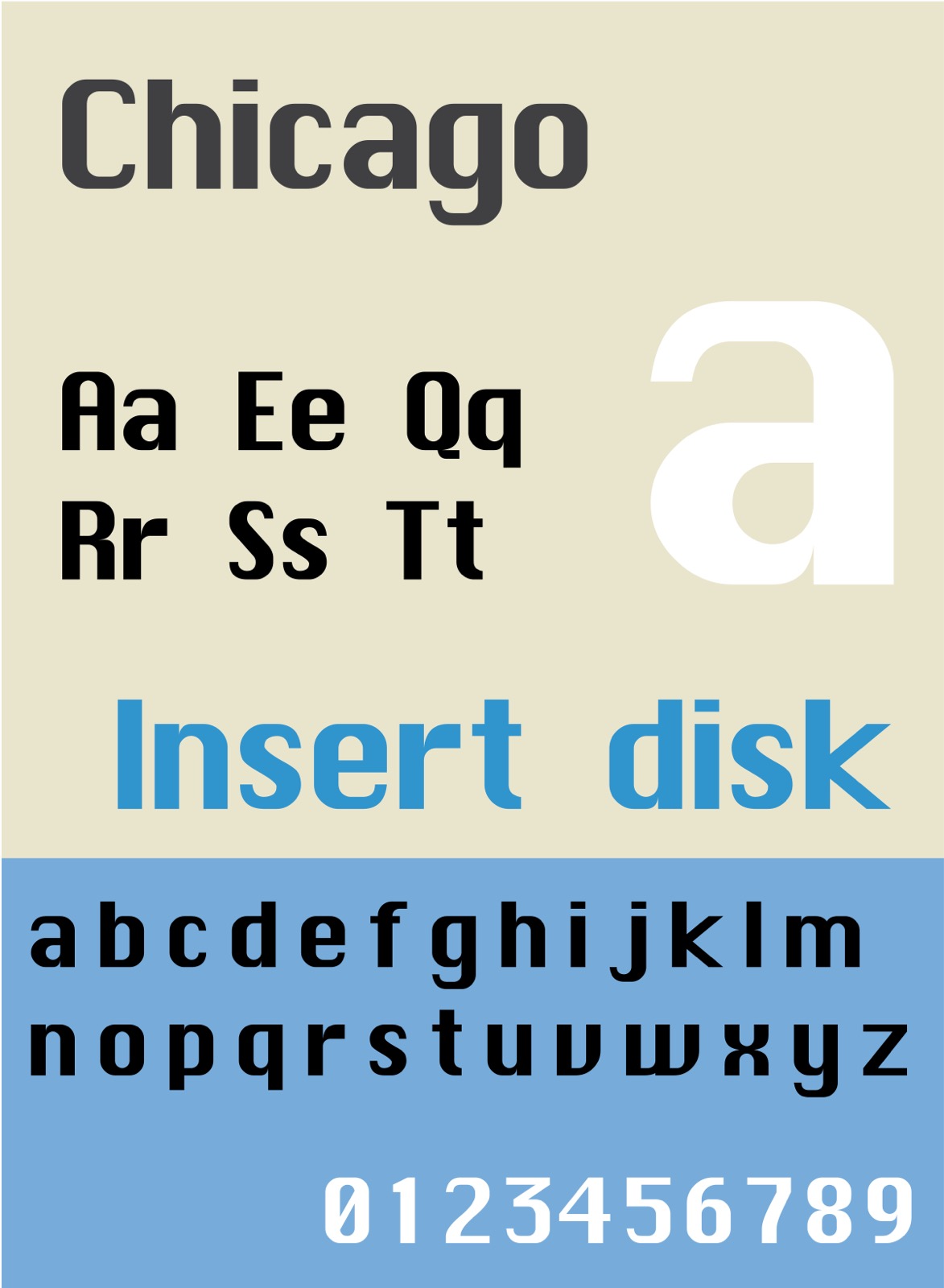
The Macintosh needed a system font. Kare designed Chicago within a 9x7 pixel grid per character, restricted to horizontal, vertical, and 45-degree-angle strokes only. No curves. This constraint was not aesthetic – curves at bitmap resolution create jagged edges (“jaggies”) that make text harder to read. By restricting to straight lines and 45-degree diagonals, Kare made a font that was crisp and legible on the Mac’s 72-dpi screen.2
The font was originally named “Elefont” as a placeholder. Jobs renamed it. The original Macintosh fonts were named after Philadelphia Main Line commuter train stops, but Jobs decided they should be “world class cities” – Chicago, Geneva, London, Toronto, Venice, New York. Chicago remained Apple’s system font from 1984 through the classic Mac OS era, was revived for the iPod interface (2001-2004), and stayed in use for over twenty years.2
Chicago was the first proportionally spaced system font on a mass-market personal computer – a departure from the monospaced typewriter fonts that most users had encountered. Each letter occupied only the space its form required. This single decision made the Macintosh screen feel less like a terminal and more like a printed page.
Windows 3.0 Solitaire Cards (1990): Clarity Across Platforms
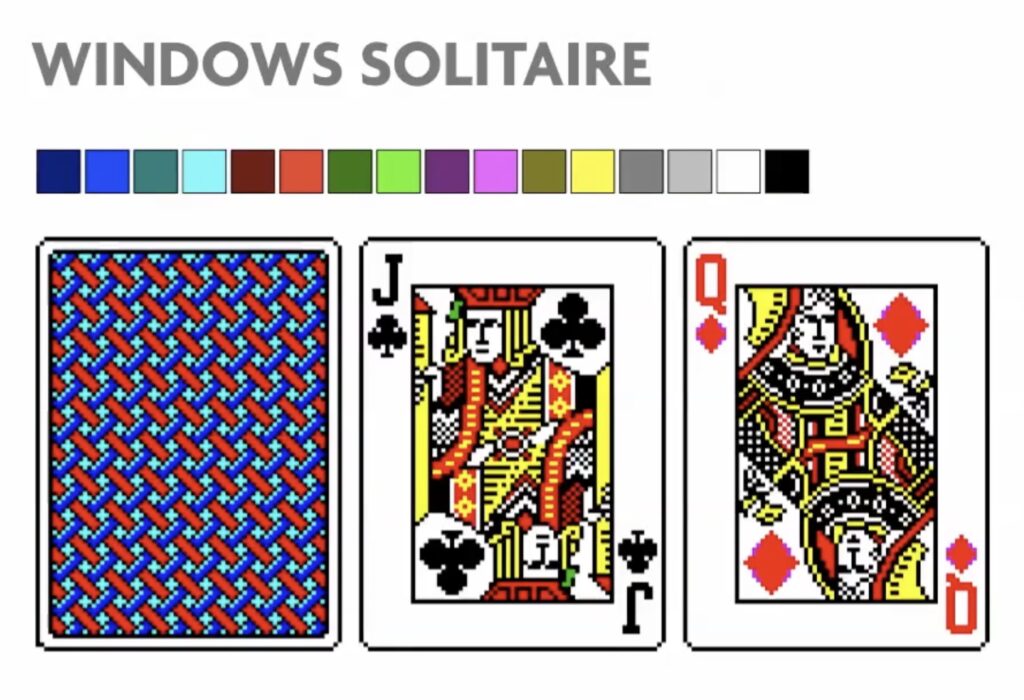
After leaving Apple and then NeXT, Kare opened her own studio. Microsoft hired her to design the card deck graphics for Windows 3.0’s Solitaire game, which existed specifically to teach users how to use a mouse – dragging, dropping, clicking. Kare designed the cards using Microsoft Paint and the 16-color VGA palette.6
“The card faces only required black, red, and yellow,” she said. “I was inspired by classic card decks, and had the most fun trying to translate the complicated patterns of the Jacks, Queens, and Kings to a 72 dots-per-inch grid.” The same card designs were used by Microsoft from 1990 to 2007 – seventeen years of continuous use across billions of Windows installations. The work demonstrated that her constraint-driven approach was not platform-specific. The method – understand the metaphor, strip to essence, test with real people – transferred from Mac to Windows to any medium with a pixel grid.6
The Method
Kare’s process was consistent across four decades: understand the constraint, find the right metaphor, strip it to the minimum number of pixels that convey the concept, and test it with people who are not designers.
Her primary reference book was Henry Dreyfuss’s Symbol Sourcebook (1972), a compendium of international symbols organized by category. She was particularly drawn to the section on hobo signals – symbols that hobos used to communicate when traveling. “I tried not to use English, and I tried not to use puns,” she said, “because they don’t translate.”2
She described her icon philosophy as designing “more like traffic signs than illustrations – easily comprehensible and not laden with extraneous detail.” A stop sign does not need to be redesigned every two years. Neither does a well-designed icon. “Nobody seems to need to redesign the stop sign every two years,” she noted in a podcast interview.7
The 32x32 pixel canvas – which she considered “generous for icons” – demanded what she called “a peculiar sort of minimal pointillism.” She loved “the puzzle-like nature of working in sixteen-by-sixteen and thirty-two-by-thirty-two pixel icon grids, and the marriage of craft and metaphor.”8
When asked if constraints limit creativity, she answered directly: “Technical constraints (such as working in black and white, or limited screen real estate) don’t necessarily hamper creativity. It’s just good to understand what’s possible, and work from there.”9
Influence Chain
Who Shaped Her
Paul Rand was her stated “design hero.” She adopted his maxim: “Don’t try to be original, just try to be good.” At NeXT, she introduced Steve Jobs to Rand and hired him to design the NeXT logo – connecting the two most important figures in her professional life. (Direct influence)1
Henry Dreyfuss shaped her method. His Symbol Sourcebook (1972) was her primary reference for icon design. The book’s taxonomy of universal symbols – traffic signs, hobo marks, scientific notation – gave her a vocabulary for communicating without language. (Direct influence)2
Folk art, needlepoint, and mosaics gave her the formal vocabulary for bitmap work. She recognized that filling in pixels was structurally identical to counting stitches in needlework or placing tiles in a mosaic: “You study art history you learn there’s nothing new under the sun – have you ever seen some 18th century needle point?”7
Who She Shaped
Every graphical user interface since 1984. Kare’s Macintosh icons established the visual metaphors that became universal: the document with a turned corner, the trash can, the hand pointer, the magnifying glass for search. These were not inevitable. Someone had to decide that “delete” looks like a trash can and “file” looks like a folded page. Kare made those decisions, and every operating system since has followed them.
Emoji designers. Kare’s Cairo typeface (1984) was a proto-emoji – a font containing palm trees, crescent moons, skateboards, and other pictographic characters.2 It is a conceptual precursor to Shigetaka Kurita’s 1999 emoji set for NTT DoCoMo’s i-mode platform. Cairo used typeface slots to encode pictographic meaning rather than alphabetic characters – fifteen years before emoji became a global communication system.
The Throughline
Kare proved that constraints do not limit creativity – they focus it. A 32x32 pixel grid with only black and white is not a prison. It is a design brief. The constraint forces every pixel to justify its existence, which is exactly Dieter Rams’ tenth principle applied to a different medium. (Series bridge)
What I Take From This
“Give me 16x16 pixels and a concept and I feel pretty fearless.” That’s the attitude. The constraint is the tool, not the obstacle.
FAQ
What is Susan Kare’s design philosophy?
Kare’s philosophy is built on three words: meaningful, memorable, clear. She approaches icon design as visual problem-solving within constraints, drawing from folk art, needlepoint, and international symbol systems rather than illustration. Her icons function “more like traffic signs than illustrations – easily comprehensible and not laden with extraneous detail.”7
What did Susan Kare design?
Kare designed the original Macintosh icons (Happy Mac, Command key, trash can, bomb, paint bucket), the Chicago typeface, the Cairo proto-emoji font, and the system graphics for the 1984 Macintosh. She later designed the card faces for Windows 3.0 Solitaire (used 1990-2007), virtual gifts for Facebook, and has worked with Pinterest and Niantic Labs.26
How did Susan Kare influence modern design?
Kare established the visual metaphors that define graphical computing: the trash can for deletion, the document icon with a folded corner, the pointer hand, and the concept that software should communicate through recognizable symbols rather than text commands. Her Cairo typeface (1984) was a pictographic font that preceded Shigetaka Kurita’s emoji set by fifteen years.2
What can designers learn from Susan Kare?
Constraints focus creativity rather than limiting it. A 32x32 pixel grid forces every pixel to justify its existence. Test designs with real people, not other designers. Avoid text and puns because they do not translate. Draw from existing symbol systems (traffic signs, folk art, international pictograms) rather than inventing new visual languages from scratch.
Sources
-
Susan Kare, Q&A for Cooper Hewitt National Design Awards, 2019. “NDA 20 Yrs: Q&A with Susan Kare.” “Meaningful, Memorable, Clear” as her three adjectives for good design. ↩↩
-
Susan Kare, interview with Alex Pang, Stanford University, September 8, 2000. Full transcript. Primary source for: graph paper process, icon design decisions, font naming, Paul Rand, Andy Hertzfeld recruitment. ↩↩↩↩↩↩↩↩↩↩↩
-
Smithsonian Lemelson Center for the Study of Invention and Innovation, “Susan Kare: Iconic Designer.” “Bitmap graphics are like mosaics and needlepoint” quote and biographical context. ↩↩
-
MoMA, “Apple Macintosh OS Icon Sketchbook, 1982.” Bound sketchbook, ink and felt-tipped pen on paper. Gift of Susan Kare. ↩
-
Andy Hertzfeld, “Swedish Campground,” Folklore.org. Primary source for the Command key origin story, including Jobs’ “too many Apples” outburst. ↩
-
Susan Kare, interview with Designboom, October 2014. “Interview with graphic designer Susan Kare.” “Give me 16x16 pixels” quote and Solitaire card design details. ↩↩↩
-
Susan Kare, “Pixels and Personality,” Ledger podcast. “Nobody seems to need to redesign the stop sign” and needlepoint comparison quotes. ↩↩↩
-
Susan Kare, AIGA Medal acceptance / New Yorker interview, 2018. “Puzzle-like nature” and “peculiar sort of minimal pointillism” quotes. ↩
-
Susan Kare, interview with Quartz, October 2019. “Mac icon designer Susan Kare explains the inspiration for her designs.” “Technical constraints don’t necessarily hamper creativity” quote. ↩