Apple's September 2026 Event, Verified on Apple's Pages

This post has not been translated yet, so you are reading the English original. Read it at the English URL
What did Apple announce on September 9, 2026? iPhone 18 Pro and Pro Max on the A20 Pro at $1,199 and $1,299, AirPods 5 at $129, Apple Watch Series 12 at $399 and Ultra 4 at $799 with a Health Sensing System that reads heart rate every five seconds, iOS 27 for Monday, September 14, and iPhone Duo, the first folding iPhone, at $1,999, shipping October 23 on iOS 27.1.34568 The post below is the record of the live coverage: verified tables from Apple’s releases, the developer drops as they landed through the afternoon, a timeline, and the keynote log with stills, each entry carrying the Apple page it was checked against and the time it landed. Rumors stayed out.
TL;DR: Apple announced five products in 79 minutes. iPhone 18 Pro starts at $1,199 and iPhone 18 Pro Max at $1,299 on the 2-nanometer A20 Pro, pre-orders September 12, in stores September 18.3 AirPods 5 are $129, or $149 with a wireless charging case.4 Apple Watch Series 12 starts at $399 and Apple Watch Ultra 4 at $799, both with a Health Sensing System that reads heart rate every five seconds.56 iPhone Duo, the first foldable iPhone, starts at $1,999 with a 7.6-inch inner display, pre-orders October 16 and availability October 23 on iOS 27.1.8 iOS 27 ships Monday, September 14, with Siri AI in beta in English and not in the EU at launch.3
Covered live on September 9, 2026; last updated 4:29 p.m. PT that day. The keynote ended at 11:19 a.m. PT. Verified tables come first, then the running log of what the stream showed. Keynote stills are frames from Apple’s event stream.
Verified on Apple’s pages
Apple’s Newsroom posted its first two press releases at about 10:38 a.m. PT. These tables carry only what those pages say, with the page linked in each row.
| Time (PT) | Product | Fact | Apple source |
|---|---|---|---|
| 10:38 | iPhone 18 Pro, iPhone 18 Pro Max | Starts at $1,199 and $1,299. Storage 256GB, 512GB, 1TB, 2TB. Finishes: black, silver, glacier, burgundy. | Newsroom |
| 10:38 | iPhone 18 Pro, iPhone 18 Pro Max | Pre-orders open Saturday, September 12, at 5 a.m. PT; availability Friday, September 18, in more than 65 countries and regions. | Newsroom |
| 10:38 | A20 Pro | 2-nanometer process. 6-core CPU with integrated Neural Accelerators, 7-core GPU up to 40 percent faster than A19 Pro, 50 percent more memory bandwidth than A19 Pro. Die packaged beside memory and attached to a vapor chamber with three times the surface area of the previous one. | Newsroom |
| 10:38 | iPhone 18 Pro camera | 48MP Fusion main camera with variable aperture, six laser-cut blades. Pro controls for aperture, shutter speed, and white balance. Apple Reference Image signs sensor data for photo authenticity. | Newsroom |
| 10:38 | iPhone 18 Pro battery and radios | eSIM-only models: up to 36 hours of video playback on iPhone 18 Pro, up to 45 hours on iPhone 18 Pro Max. Up to 50 percent charge in about 15 minutes. N1 wireless chip (Wi-Fi 7, Bluetooth 6, Thread) and the C2 cellular modem. | Newsroom |
| 10:38 | AirPods 5 | $129, and $149 with Wireless Charging Case. Pre-orders open today; in stores Friday, September 18. Removes up to 50 percent more noise than AirPods 4 with ANC. Up to five hours of playback with ANC, one hour more than AirPods 4 with ANC, and up to 22 hours with the case. | Newsroom |
| 10:38 | iOS 27 and Apple Intelligence | iOS 27 ships as a free update on Monday, September 14. Apple Intelligence arrives with it the same day. | Newsroom |
| 10:38 | Siri AI | Rolls out with iOS 27 as a beta on September 14 in English; French, Japanese, Korean, Portuguese, and Spanish in October. Apple’s footnote: “Siri AI will not be available initially in the EU on iOS, iPadOS, and watchOS.” The keynote slide also named China. | Newsroom |
| 10:38 | Satellite features | Free access extended one more year for existing iPhone 14, 15, and 16 users. | Newsroom |
| 10:58 | Apple Watch Series 12 | Starts at $399. 42mm and 46mm. Aluminum in dark bronze, black, light gold, and space gray; titanium in radiant gold and natural; a ceramic version in pearl white and night blue. Pre-orders open today; in stores Friday, September 18. Up to 24 hours of everyday battery, up to 10 hours in an outdoor workout, 15 minutes of charging for up to 12 hours. | Newsroom |
| 10:58 | Apple Watch Ultra 4 | Starts at $799, natural and black titanium. Pre-orders open today; in stores September 18. Up to 50 hours of battery, up to 84 hours in Low Power Mode, 15 minutes of charging for up to 18 hours, up to 25 hours of Extended Workout with full GPS. | Newsroom |
| 10:58 | Health Sensing System | New optical and electrical heart sensors with larger green LEDs on Series 12 and Ultra 4. Heart rate measured every five seconds all day, which is what the keynote’s “60x more frequent” slide referred to. Readiness scores each day from 0 to 10 with one of four calls: Recover, Pace Yourself, Ready, or Go For It. | Newsroom |
| 10:58 | Health app and labs | Redesigned Health app on Apple Intelligence-enabled iPhone and iPad; Health Age requires an Apple Watch. Movement evaluations for flexibility, strength, and balance use vision models on iPhone. Lab tests with more than 50 biomarkers can be scheduled and purchased for $119. | Newsroom |
| 10:58 | Audio Intelligence | Live Rewind, Siri Recap, Sound Recognition, and faster Shazam, requiring Series 12 or Ultra 4. Live Rewind and Siri Recap arrive in beta in late 2026 and need an Apple Intelligence-enabled iPhone 16 or later. | Newsroom |
| 10:58 | watchOS 27 | Monday, September 14, for Apple Watch Series 9 or later, SE 3, and Ultra 2 or later; requires an iPhone 11 or later on iOS 27. | Newsroom |
| 11:18 | iPhone Duo | The foldable’s name. Starts at $1,999 in star white and night sky, 256GB to 2TB. Pre-orders Friday, October 16, at 5 a.m. PT; availability Friday, October 23, in more than 70 countries and regions. Ships with iOS 27.1. | Newsroom |
| 11:18 | iPhone Duo displays | 7.6-inch inner Super Retina XDR (7.58 inches measured as a rectangle) and 5.4-inch outer (5.36 inches), the outer giving 90 percent of the screen area of iPhone 18 Pro. Inner cover layer is a nano-textured custom polymer Apple says is up to 40 percent stiffer than industry alternatives, with a scratch-resistant coating. | Newsroom |
| 11:18 | iPhone Duo build | Grade 5 titanium with a mirror-polished enclosure and a 3D-printed hinge cover; Ceramic Shield on the back; IP68 to 6 meters for 30 minutes; eSIM-only worldwide. Thinnest iPhone ever when open. | Newsroom |
| 11:18 | iPhone Duo silicon and battery | A20 Pro, the same chip as iPhone 18 Pro, on a package attached to a custom vapor chamber, for up to 35 percent better sustained performance than iPhone 17 Pro. One battery in each half, run as one, for up to 31 hours of video playback. | Newsroom |
| 11:18 | iPhone Duo cameras | 48MP Fusion Ultra Wide shared with iPhone 18 Pro; Center Stage front camera that shoots in any orientation. Duo Preview shows the live shot on the outer display, Kid Cue plays Peanuts animations there, and Duo FaceTime puts a second party on the outer screen. | Newsroom |
| 11:18 | iPhone Duo software | Split View with two apps side by side on an iPhone for the first time, two windows of one app, StandBy on either display without charging, Lock Screen and Dock moved to the side. Netflix, Zoom, and Slack already adapted; Xcode’s Device Hub gains iPhone Duo support in an upcoming release. | Newsroom |
| 11:18 | iPhone Duo accessories | iPhone Duo Case $79 in navy blue and sand; iPhone Duo Folio with Kickstand $129 in navy blue and taupe; both orderable October 16. | Newsroom |
| 11:23 | Product pages | Apple’s pages went live for iPhone Duo, iPhone 18 Pro, AirPods 5, Apple Watch Series 12, and Apple Watch Ultra 4. The iOS 27 and watchOS 27 pages were still 404 at this check. | apple.com |
What reached developer.apple.com
- 09:00 PT, Newest developer build before the keynote. iOS 27.0 beta 8 (24A5430a), August 31. Source: Releases.
- 10:17 PT, Transporter 1.4.5. Posted to the releases feed. Source: Releases.
- 10:38 PT, iOS 27 release date. Monday, September 14 (from the Newsroom release; no RC in the releases feed yet) Source: Newsroom.
- 11:58 PT, Release candidates. Apple’s release-notes pages now carry RC titles for every platform: iOS and iPadOS 27 RC, Xcode 27 RC (“Xcode 27 RC includes Swift 6.4 and SDKs for iOS 27, iPadOS 27, tvOS 27, watchOS 27, macOS 27, and visionOS 27”), macOS 27 Golden Gate RC, watchOS 27 RC, visionOS 27 RC, and tvOS 27 RC. By 12:24 the releases feed listed the builds too: iOS 27.0 RC (24A435), iPadOS 27.0 RC (24A435), macOS 27.0 RC (26A428), tvOS 27.0 RC (24J360), visionOS 27.0 RC (24M362), and watchOS 27.0 RC (24R363), all timestamped 10:00 a.m. PT. Neither the Xcode 27 RC notes nor the iOS 27 RC notes mention iPhone Duo, so the Duo SDK work Apple promised is still ahead, consistent with the device shipping on iOS 27.1. The iOS 27 RC notes do confirm that supported interface orientations are no longer a condition for continuous resizability, which the resizable-iPhone checklist on this site relies on.
- 13:04 PT, iPhone Duo developer page and Tech Talks. Apple posted Get Ready for iPhone Duo: six Tech Talks available now (Prepare your app for iPhone Duo, Raise the bar, Strike a pose with adaptive layouts, Leverage multiple displays and scenes, Build a great camera experience, Design for iPhone Duo); online Group Labs September 16 at 8 p.m. PT and September 17 at 8 a.m. PT; forum Q&As on Photos and Camera, SwiftUI, and UIKit on September 23; the Xcode 27.1 beta, the “Preparing your app for iPhone Duo” guide, and in-person workshops “coming later this month”; “Designing for iPhone Duo” “coming soon.” Apple’s developer news post Get ready for iPhone Duo is dated 11:00 a.m. PT and surfaced in the news feed between 1:40 and 1:45 p.m. The Duo developer post has the layout arithmetic, the talks’ rules, and the design guide’s reserved regions and arrangement views.
- 13:40 PT, What the Tech Talks say. The talks’ subtitle tracks carry the rules the release did not. Prepare your app for iPhone Duo: “Your app will work on iPhone Duo even if you haven’t built it with the iOS 27 SDK” (0:29); with the iOS 27 SDK, “your app will extend to the left of the status bar area on the inner display” (0:57); with the iOS 27.1 SDK, “your app extends to the edge of the screen” and “standard navigation and toolbar buttons now lay out vertically under the status bar” (1:05 to 1:11); Xcode 27.1’s iPhone Duo simulator in Device Hub has controls “to open, close, rotate, or fold iPhone Duo” (1:25); the outer display reports the usual iPhone size classes while the inner display “has regular horizontal and vertical size classes” (3:08 to 3:26); “the inner display doesn’t honor your supported interface orientations” (3:46); “iPhone Duo will continue to honor the UI requires full screen key, but your app will still resize when someone opens or closes their iPhone Duo” (4:36). Leverage multiple displays and scenes on iPhone Duo: “iPhone Duo is the first iPhone to support multiple instances of your app’s UI. If your app supports this on iPad, it also will on iPhone Duo” (3:38); “on the outer display of iPhone Duo, new windows cannot be created” (3:53); the new CameraCaptureAccessory pairs UI on the outer display while the app’s main UI stays on the inner display (4:59). Build a great camera experience for iPhone Duo: a Virtual Front Camera, “a new AV Capture device that automatically switches between the outer and inner physical cameras” (1:20), plus built-in outer and inner ultrawide device types (1:58 to 2:04).
- 15:00 PT, App Store Connect: iPhone Duo screenshot and app-preview specifications. App Store Connect’s release notes, entry dated September 9: “The app preview and screenshot specifications for iPhone Duo, iPhone 18 Pro Max, iPhone 18 Pro, Apple Watch Ultra 4, and Apple Watch Series 12 have been added. Support for uploading assets for iPhone Duo in App Store Connect will be available later this year.” The screenshot specifications list 1398 × 2034 pixels for the outer display and 2007 × 2853 pixels for the inner display; the app preview specifications list the same two sizes under “Device resolutions.” 2007 × 2853 is 669 × 951 points at 3x on a 1878 × 2670 panel, which supersedes the 626 × 890 arithmetic in the first version of the developer post; the releases feed stamps this update 3:00 p.m. PT, and I first saw the rows on September 10, so this row is a September 10 addition to the table.
- 16:00 PT, App Store submissions open for iOS 27. Apple’s developer news post App Store submissions now open for the latest OS releases, dated 4:00 p.m. PT: “iOS 27, iPadOS 27, macOS 27, tvOS 27, visionOS 27, and watchOS 27 will soon be available to customers worldwide, which means you can now submit apps and games that take advantage of the latest Apple technologies.” It points at the Xcode 27 Release Candidate, says “macOS 27 will be Apple silicon only,” and asks apps with social media capabilities to say so in App Store Connect for the new Time Allowances. At 4:05 p.m. Apple also re-dated its Get ready for iPhone Duo news post, which had carried an 11:00 a.m. date.
- 16:10 PT, Designing for iPhone Duo, in the Human Interface Guidelines. Apple’s developer page no longer marks the design guide “coming soon”; it now links Designing for iPhone Duo in the Human Interface Guidelines, live by 4:10 p.m. PT (it still read “Coming soon” at 1:50 p.m.). The page covers anatomy (an inner and an outer display, each with a front camera; controls on the side of the outer display), device poses (“partially folded like a book, placed down on a surface, or standing on its edges”), and reserved regions: one for the status bar and Dynamic Island that is always present, one for the inner camera that appears only when the camera is active, and a folding region that “divides the inner display into multiple usable regions” when the device is partially open. Its layout rule: “A compact width layout for the outer display and a regular width layout for the inner display give you the fundamentals for every pose.” The Xcode 27.1 beta and the “Preparing your app for iPhone Duo” guide still say “Coming later this month.” Designing for iPhone Duo on this site reads the guide and its three design talks as rules.
Early reaction
Reaction, not fact: by 11:40 a.m. PT the iPhone Duo thread on Hacker News had 224 points and 251 comments, ahead of the AirPods 5, Apple Watch Series 12, and iPhone 18 Pro threads combined. Three themes dominate it. The $1,999 price, which several commenters set against an iPhone plus an iPad costing less. The aspect ratio: the open display is close to 1:1.41, the square root of two, so it keeps its proportions when folded, which one commenter recognized as the metric-paper ratio, while others point out that 16:9 video gains little height on it. And durability, with people who have owned other foldables asking about hinge dust and the crease after a few thousand folds. On the Watch thread, the readiness score is being read as Apple catching up to Whoop and Garmin, with frequent HRV named as the feature that makes the comparison fair.
Timeline
Every entry in the log, in order. Times are Pacific.
- 10:00 the keynote opens
- 10:06 Apple Intelligence first
- 10:08 hardware begins with an exploded iPhone
- 10:10 Siri, with a number
- 10:14 Siri AI languages and a footnote
- 10:15 A20 Pro
- 10:19 iPhone 18 Pro Max named, with a battery number
- 10:22 camera, from a film backlot
- 10:24 camera controls, Styles, and another regional footnote
- 10:28 Screen Time for families, then carrier logos
- 10:30 the iPhone 18 Pro recap slide
- 10:31 audio next
- 10:33 AirPods 5, with noise cancellation in the open-ear design
- 10:37 Apple Watch Series 12, read off the case back
- 10:40 Readiness, and a number called Health Age
- 10:44 the Health recap, then a title card that read “Audio Intelligence”
- 10:46 Audio Intelligence, with a four-line privacy slide
- 10:49 to 10:57 eight minutes the capture missed
- 10:57 the foldable
- 11:00 Joswiak takes the foldable, and one number
- 11:03 Federighi on the software side of the fold
- 11:06 the display, from the lab
- 11:09 inside the fold, A20 Pro and C2
- 11:11 “All-day battery life,” then the foldable’s cameras
- 11:15 the foldable’s recap slide, with the sizes
- 11:16 the name is iPhone Duo, and the keynote closes
Live from the keynote
Entries here record what Apple’s stream showed, with the time each frame was captured. Product names, prices, and specifications wait for Apple’s own pages and land in the tables below.
10:00 a.m. PT: the keynote opens
The stream opened with a short film, then cut to a presenter on the ring at Apple Park, with the Santa Cruz Mountains behind the glass.

Frame from Apple’s September 9, 2026 event stream, 10:04 a.m. PT.
10:06 a.m. PT: Apple Intelligence first
The first segment was Apple Intelligence. App icons floated around the presenter, a demo film showed a rider using an iPhone on a train, and the segment closed on a diagram of the Apple Intelligence glyph on a phone and inside a cloud, Apple’s on-device and Private Cloud Compute split drawn as one picture.
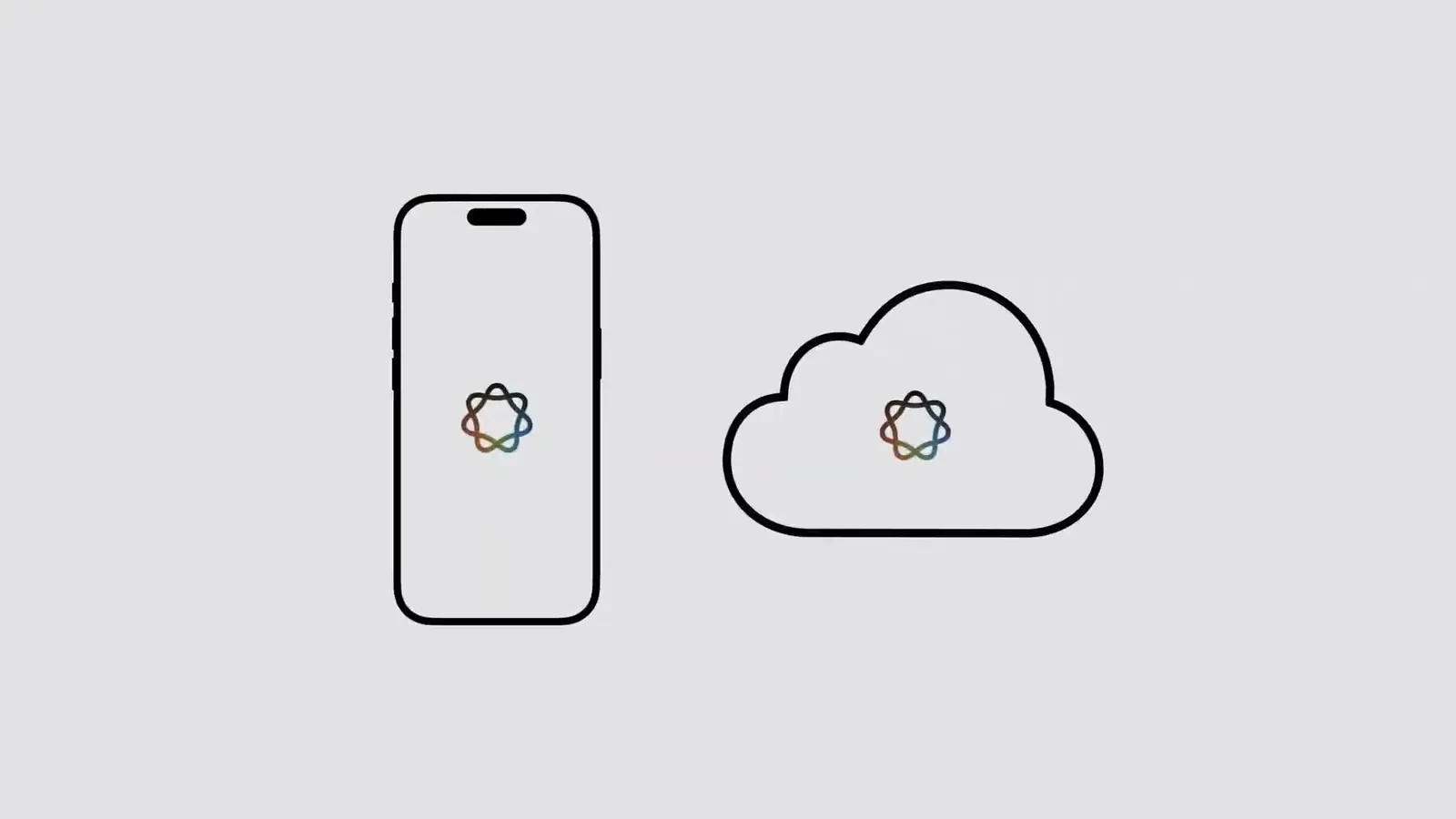
Frame from Apple’s September 9, 2026 event stream, 10:07 a.m. PT.
10:08 a.m. PT: hardware begins with an exploded iPhone
The stream moved to hardware with an exploded view of an iPhone, its frame, board, camera module, and display laid out as separate parts. The model was not named on screen at that moment.
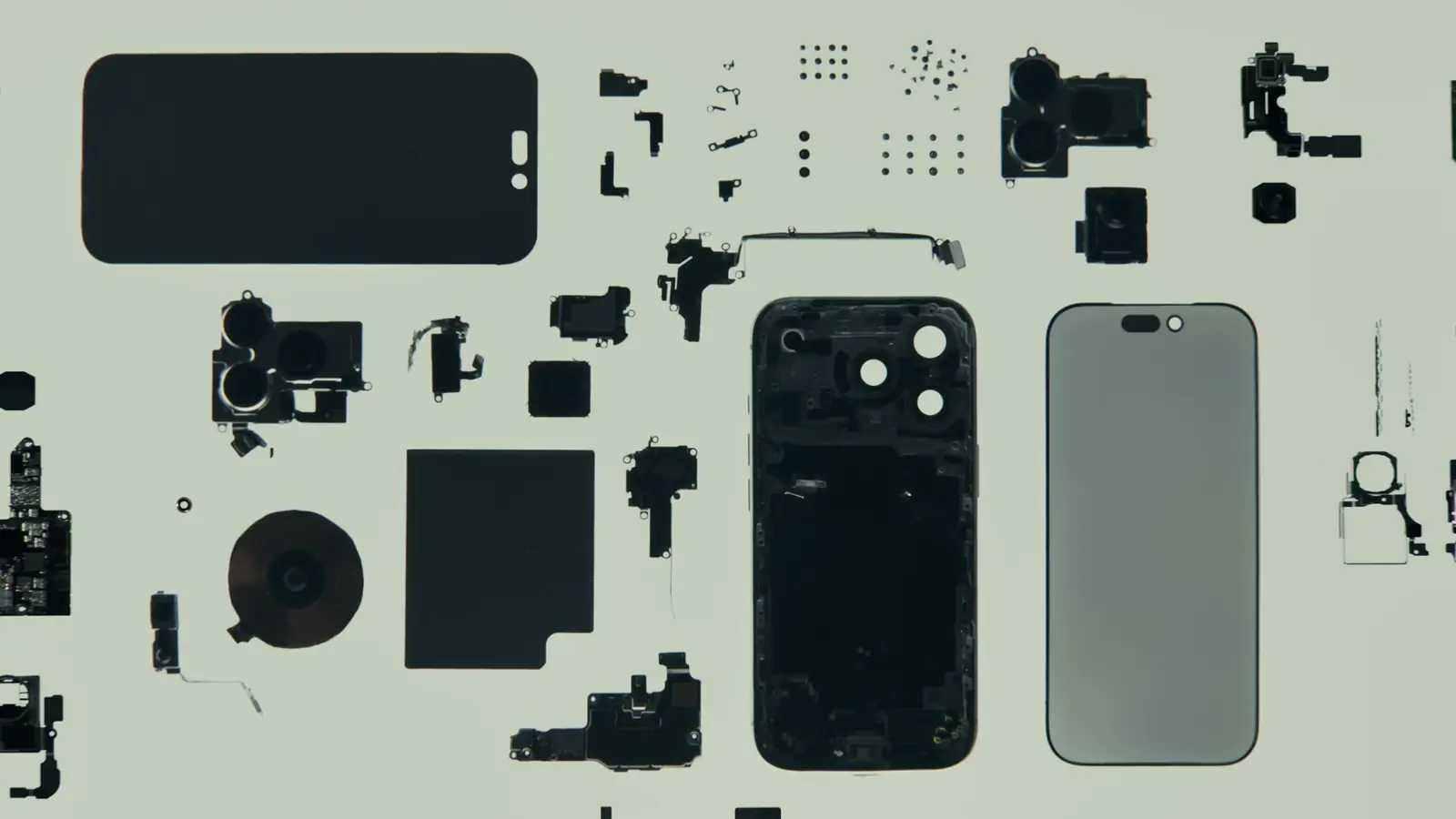
Frame from Apple’s September 9, 2026 event stream, 10:08 a.m. PT.
10:10 a.m. PT: Siri, with a number
A second presenter took the Siri segment. A slide read “2.5 billion requests per day,” and the demos that followed were everyday ones: asking Siri at a market stall to add the rest of a recipe’s ingredients to a grocery list, a lock-screen “Notify Me” alert reporting that a web page had changed, and visual intelligence identifying a scene from a photo.
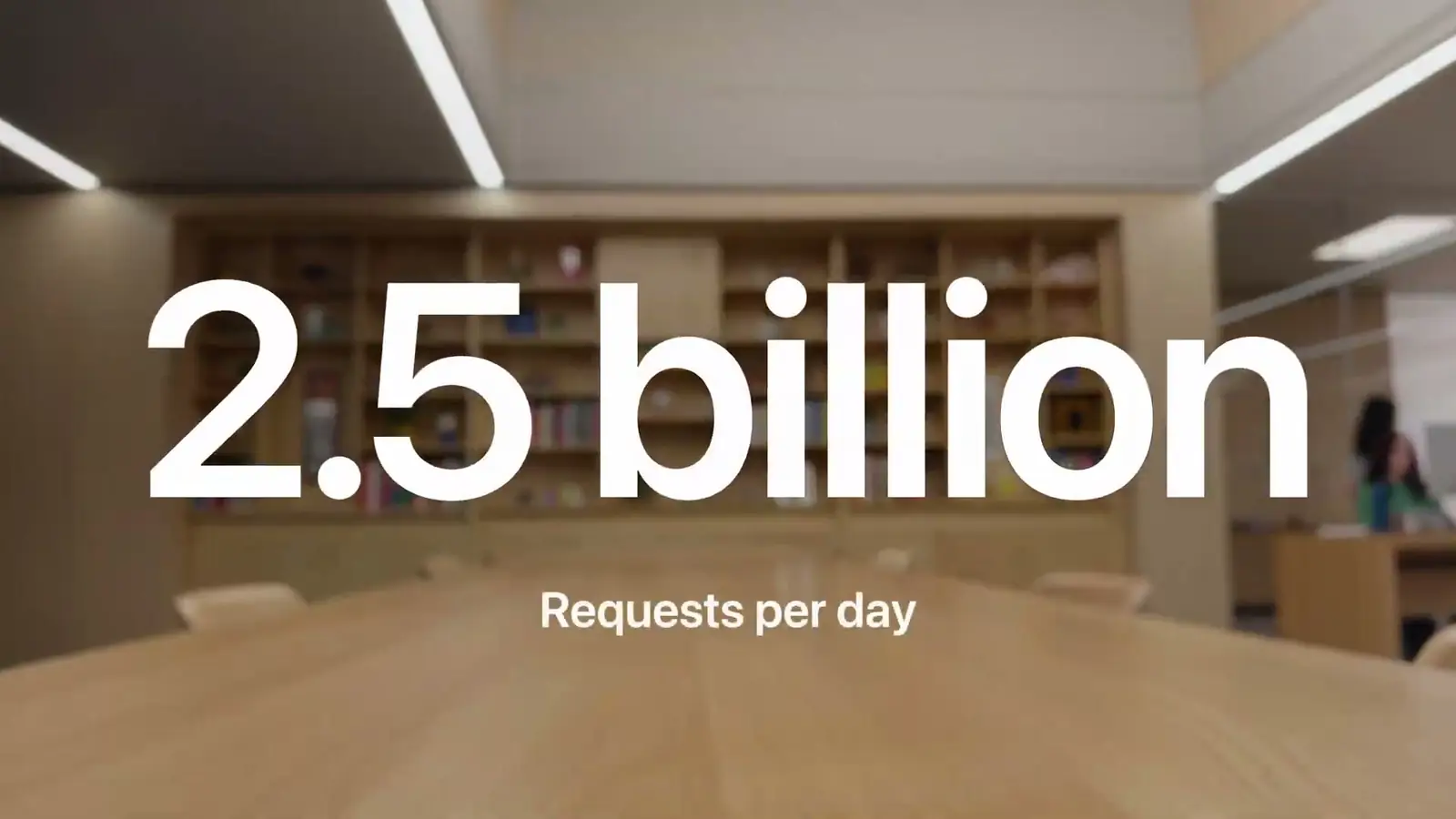
Frame from Apple’s September 9, 2026 event stream, 10:10 a.m. PT.
10:14 a.m. PT: Siri AI languages and a footnote
The rollout slide named the product “Siri AI”: available in beta in English, coming in October in French, Japanese, Korean, Portuguese, and Spanish. The footnote at the bottom of the slide read “Siri AI will not be available in the EU and China.”
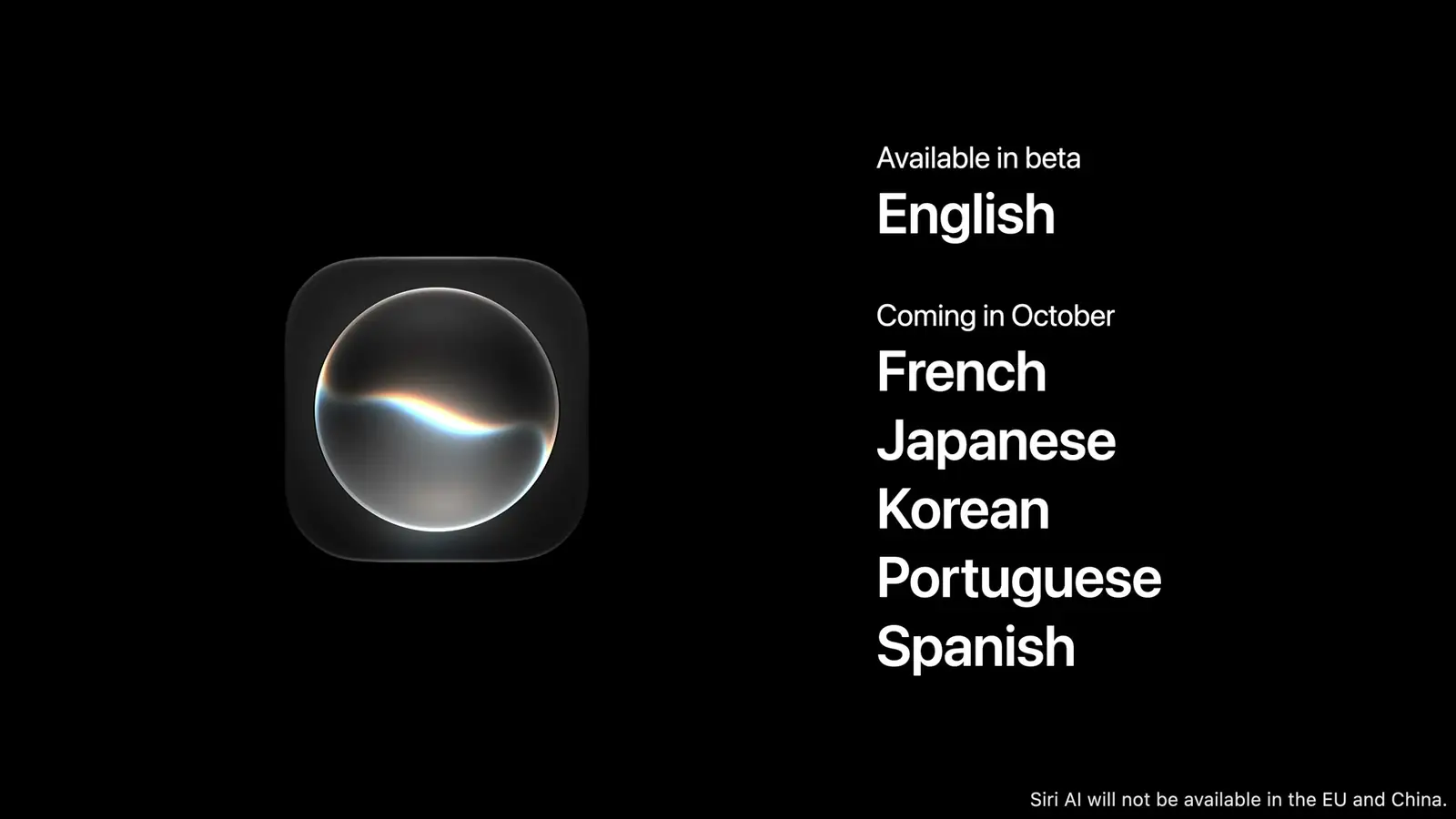
Frame from Apple’s September 9, 2026 event stream, 10:14 a.m. PT.
10:15 a.m. PT: A20 Pro
Hardware proper opened with the chip. The A20 Pro slides listed a 6-core CPU with two new “super cores” labeled 20% faster and four new efficiency cores, then a 7-core GPU labeled “40% faster graphics performance,” then a Neural Engine with “32 total cores.” The process node did not appear on screen.
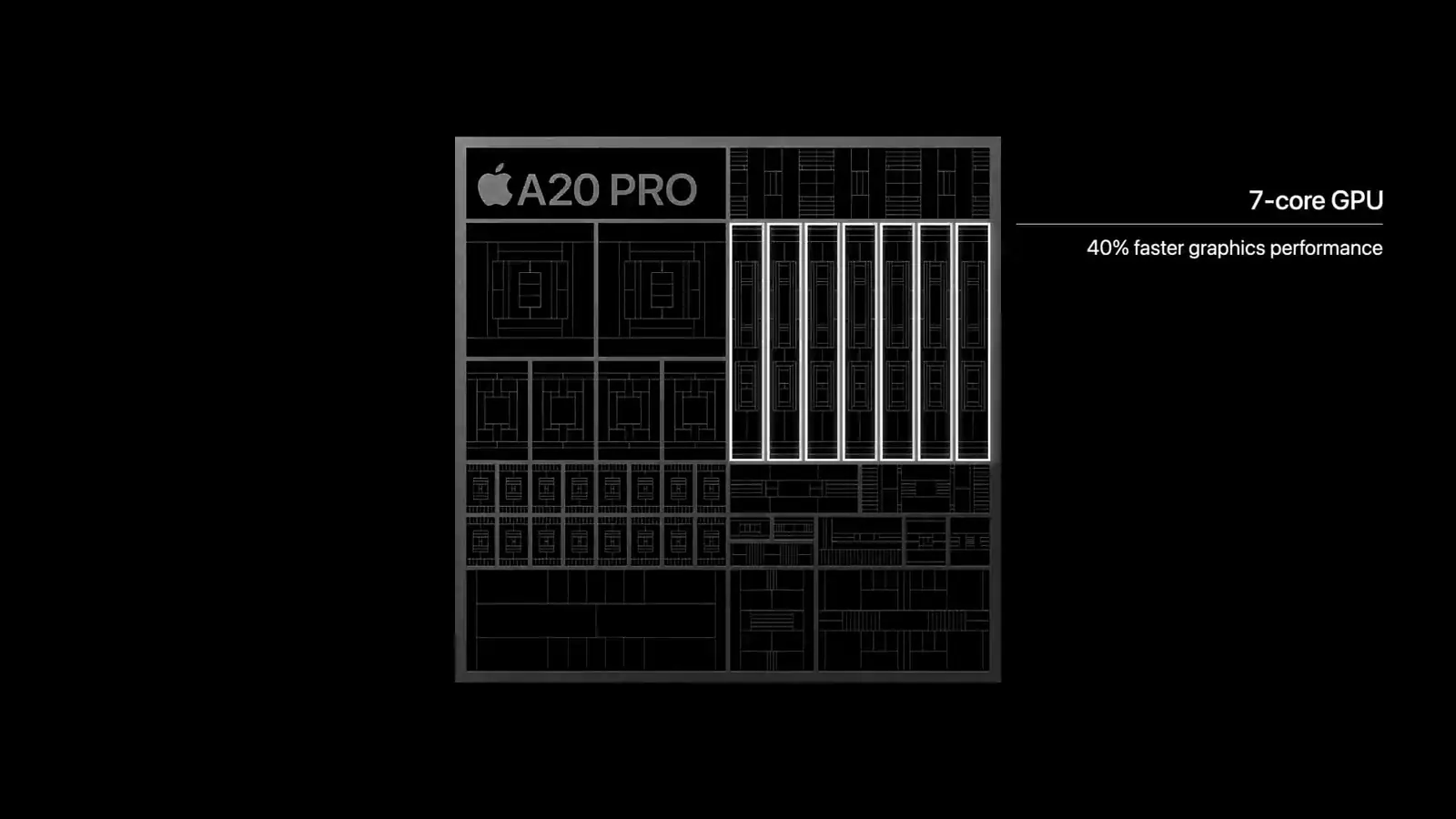
Frame from Apple’s September 9, 2026 event stream, 10:16 a.m. PT.
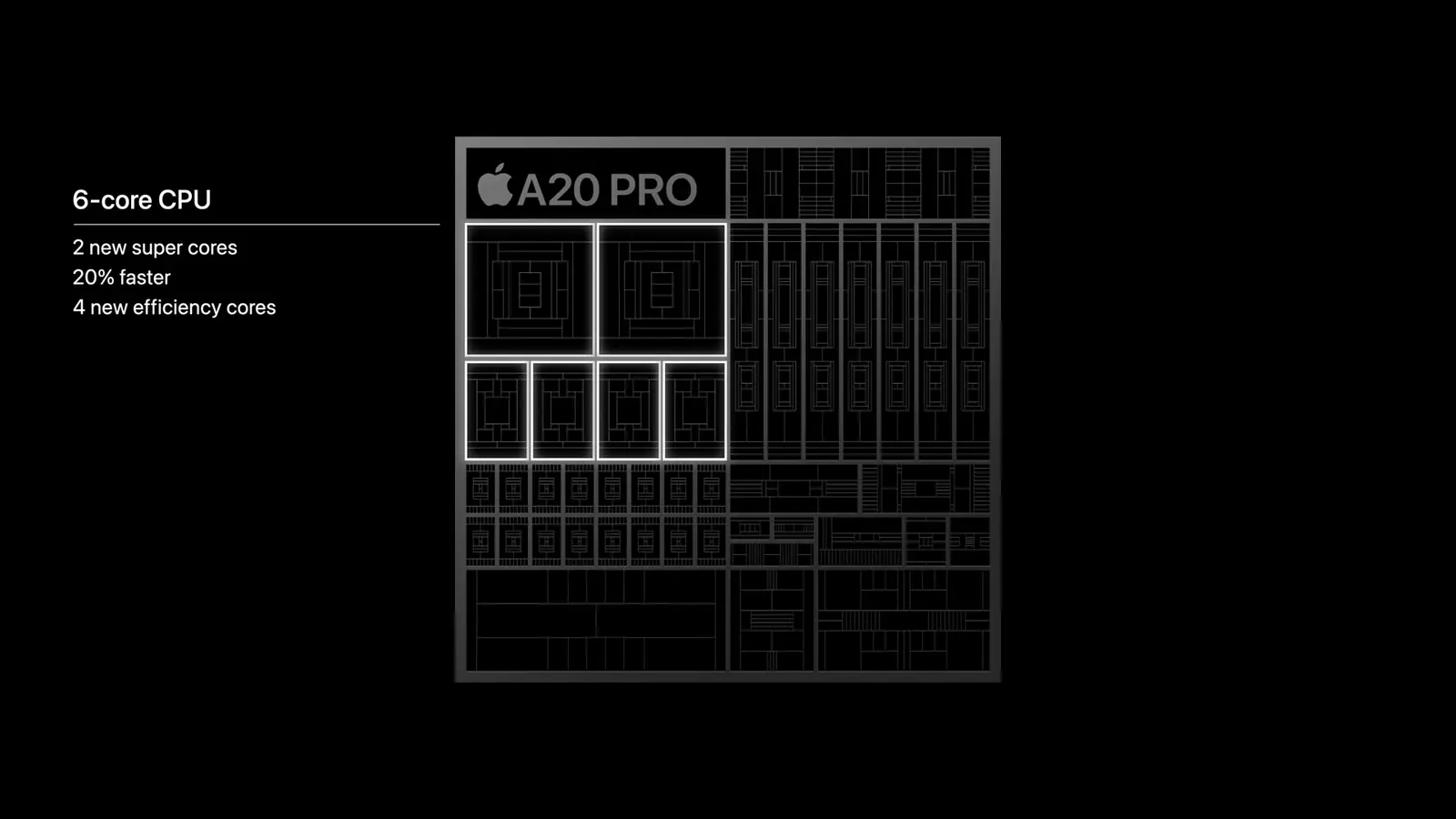
Frame from Apple’s September 9, 2026 event stream, 10:15 a.m. PT.
10:19 a.m. PT: iPhone 18 Pro Max named, with a battery number
The first model name appeared in the battery segment. A “Battery” title card led to a slide reading “45 hours, video playback on iPhone 18 Pro Max,” then a side-by-side of two phones labeled “24 hours per charge” and “30 hours per charge.” The frame did not label which models the two figures belong to.
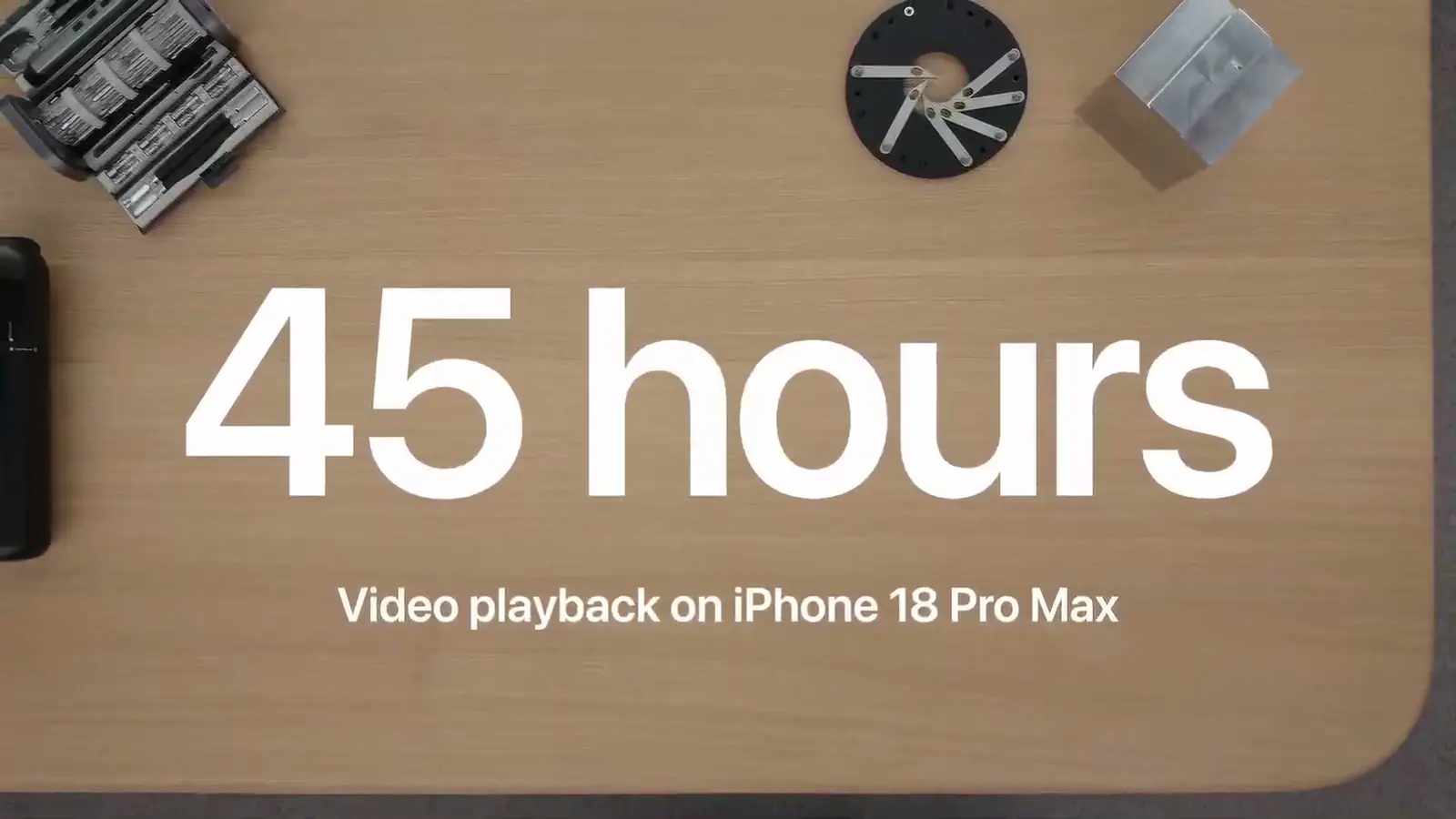
Frame from Apple’s September 9, 2026 event stream, 10:19 a.m. PT.
10:22 a.m. PT: camera, from a film backlot
A gaming demo ran on the new phone first, a dragon fight filmed on a soundstage. Then a presenter on a studio backlot opened the camera segment. The stream cut to a close-up of a camera module’s mechanism, a night-sky photo with a capture-data card, and a landscape labeled “Time-lapse in 4K.”
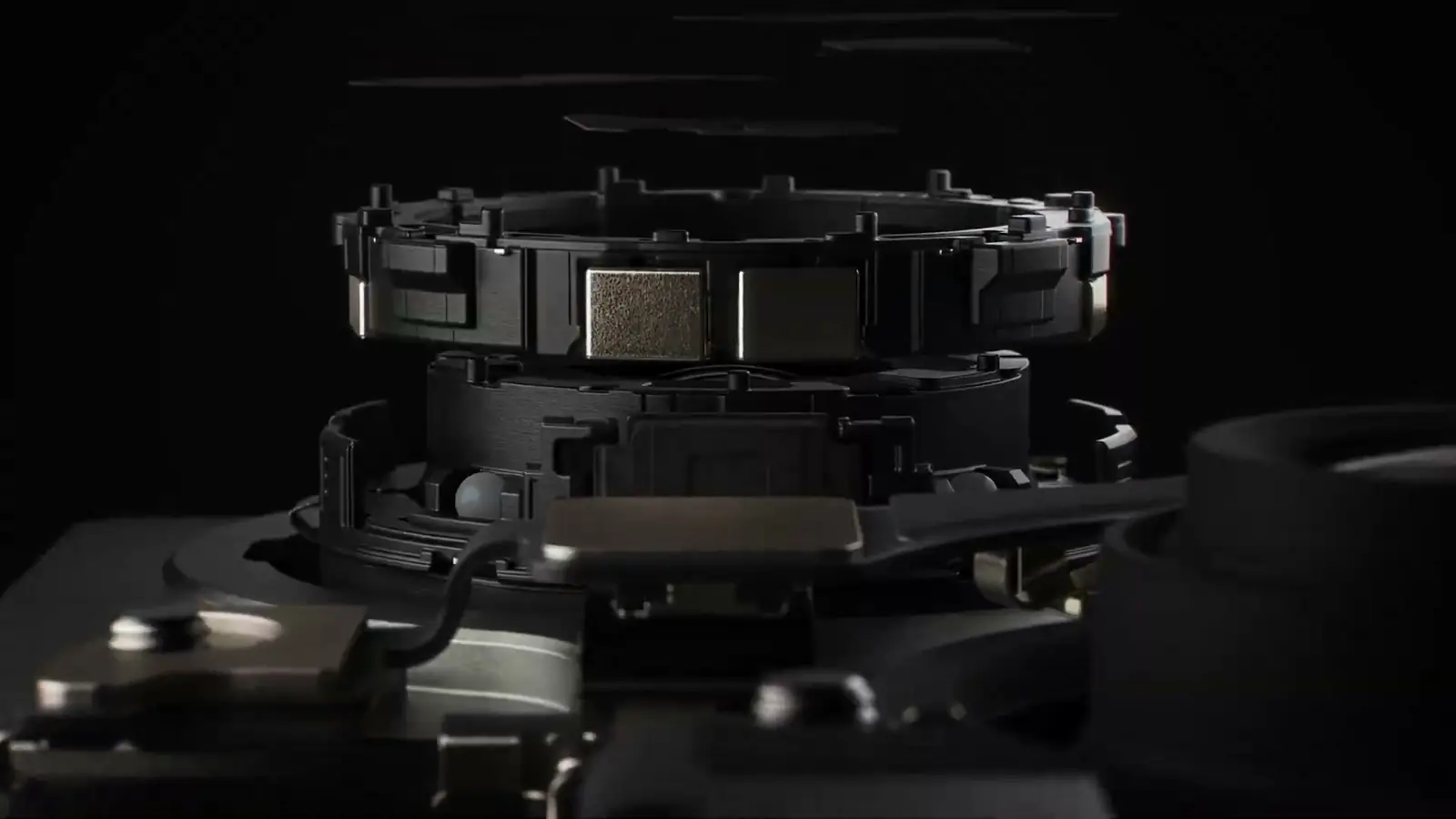
Frame from Apple’s September 9, 2026 event stream, 10:22 a.m. PT.
10:24 a.m. PT: camera controls, Styles, and another regional footnote
On a rain-soaked backlot set, the camera segment went through the app itself: a white balance control with a “Cloudy” preset, a Styles screen with palette and texture sliders, and a “Reference Image” feature for matching a look to a photo. That screen’s footnote read “Apple Reference Image is not available in the EU and China,” the second EU and China exclusion of the morning after Siri AI.
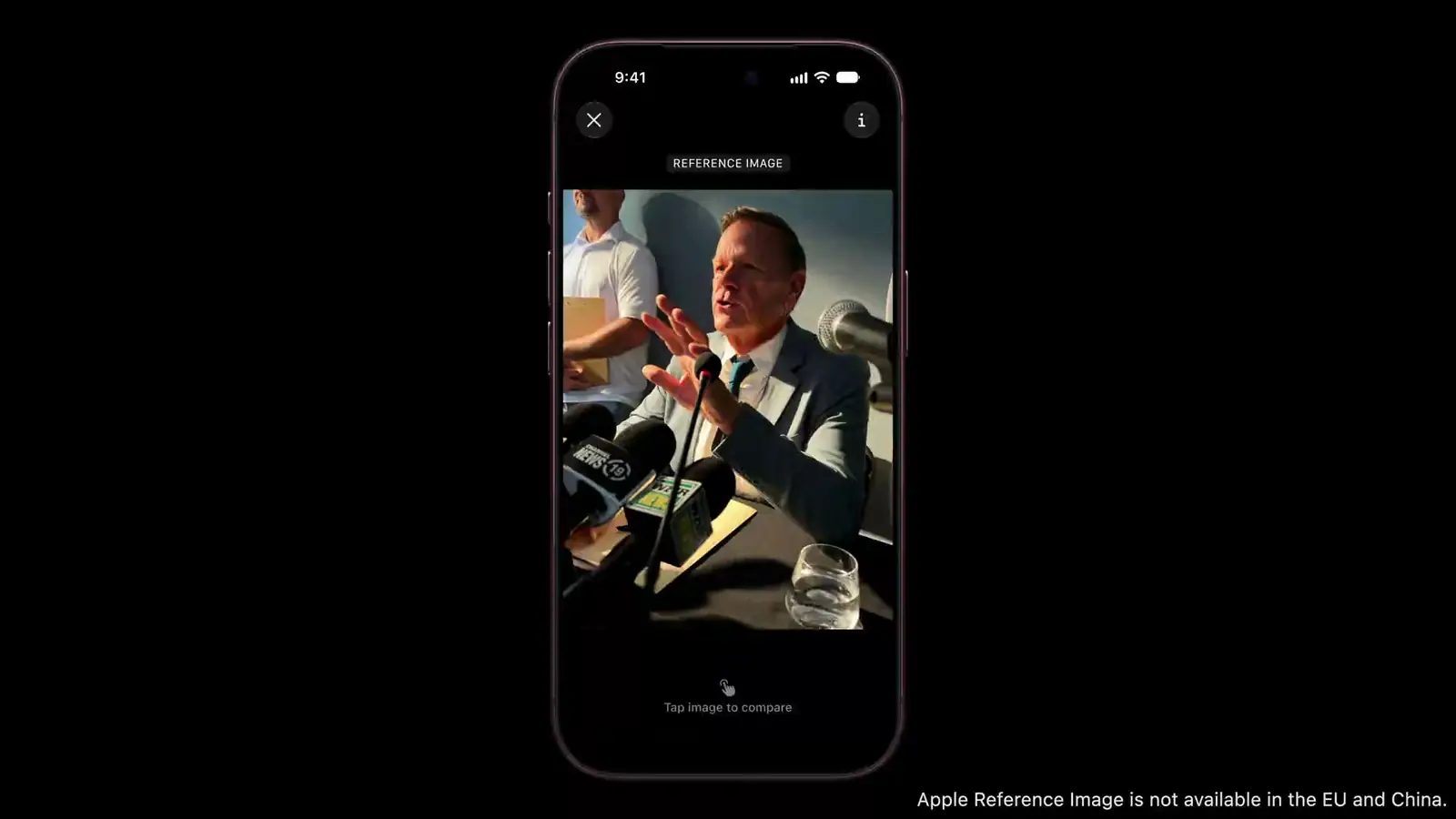
Frame from Apple’s September 9, 2026 event stream, 10:27 a.m. PT.
10:28 a.m. PT: Screen Time for families, then carrier logos
Software followed the camera: a Live Activity pill showing a 53-minute route, then three Screen Time screens labeled Screen Time Schedule and Time Allowances, with a shared allowance of 1h 30m and per-category limits for a child’s device. The carrier logos that came next, T-Mobile, Verizon, and EE, usually sit right before pricing and availability.
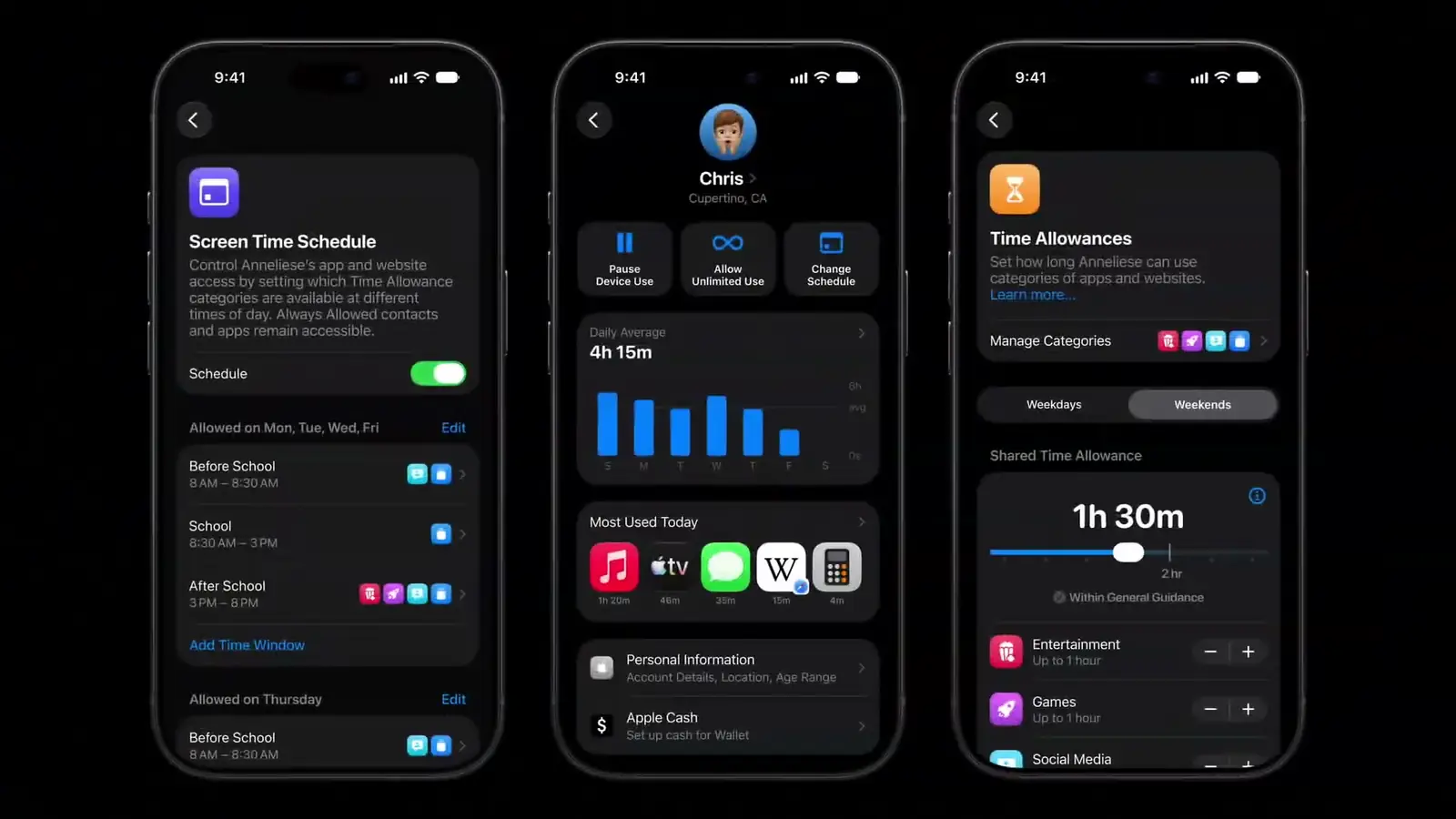
Frame from Apple’s September 9, 2026 event stream, 10:28 a.m. PT.
10:30 a.m. PT: the iPhone 18 Pro recap slide
The segment closed on Apple’s usual wall of tiles, and it is the densest single frame of the morning. Read off the slide: A20 Pro with “massive performance gains,” a 48MP Fusion main camera with variable aperture, 4x and 8x Fusion telephoto, 6.9-inch and 6.3-inch sizes, a redesigned Dynamic Island, a next-generation vapor chamber, “best battery life ever,” faster wired charging, Photographic Styles with texture control, Cinematic from regular video, Apple Reference Image, Pro controls, Siri AI, and new colors. A strap and lanyard accessory line followed in several colors. The next slide read “iPhone 18 Pro, up to $1,200 off with trade-in of iPhone 14 or newer.” A base price did not appear in the captured frames; Apple’s product page will carry it.
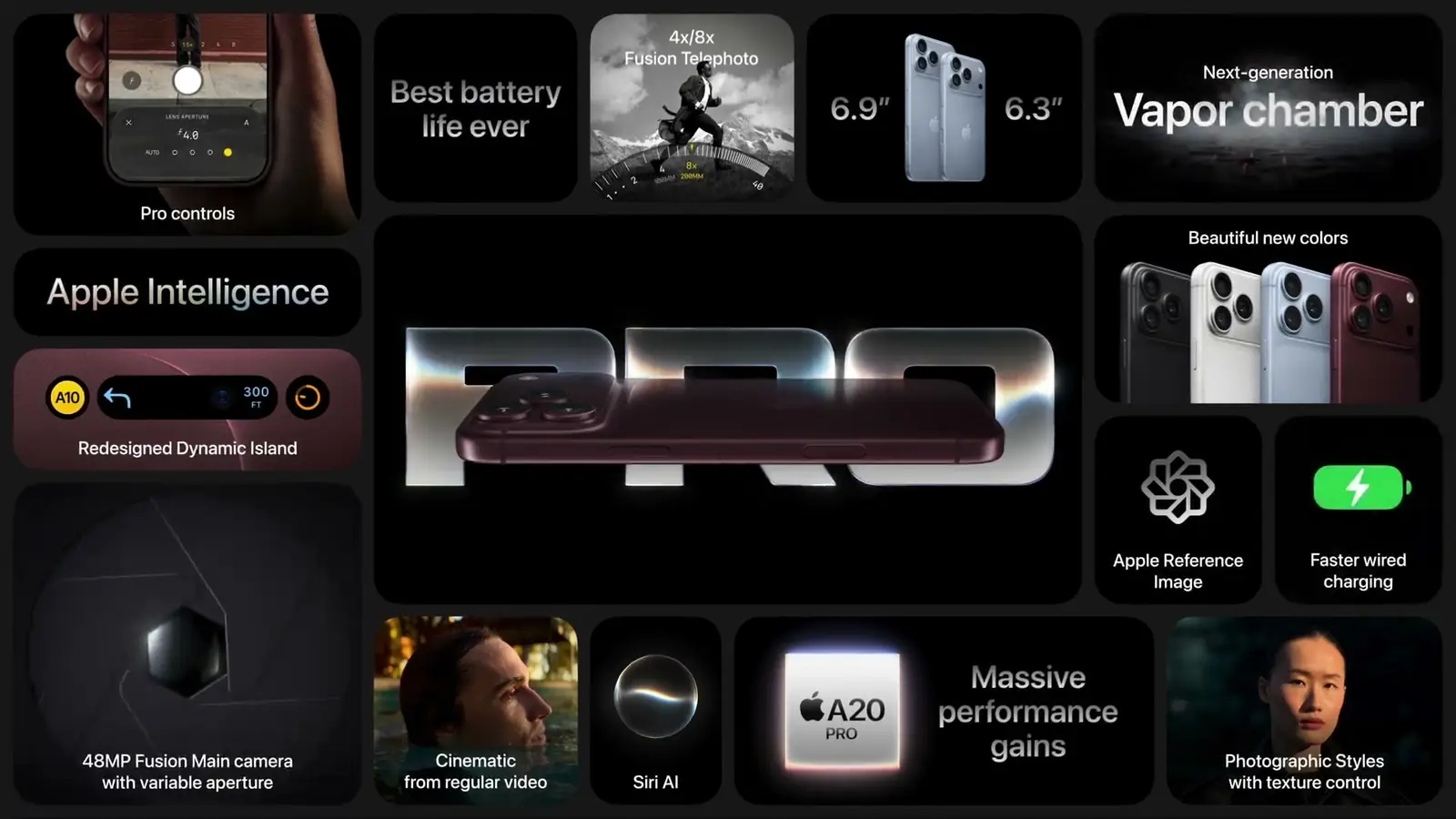
Frame from Apple’s September 9, 2026 event stream, 10:29 a.m. PT.
10:31 a.m. PT: audio next
A presenter in an anechoic chamber, the wedge-lined room Apple uses for acoustic work, opened the next segment, followed by a film of someone wearing earbuds at a cafe table. AirPods were expected today; the product name had not appeared on screen at this frame.
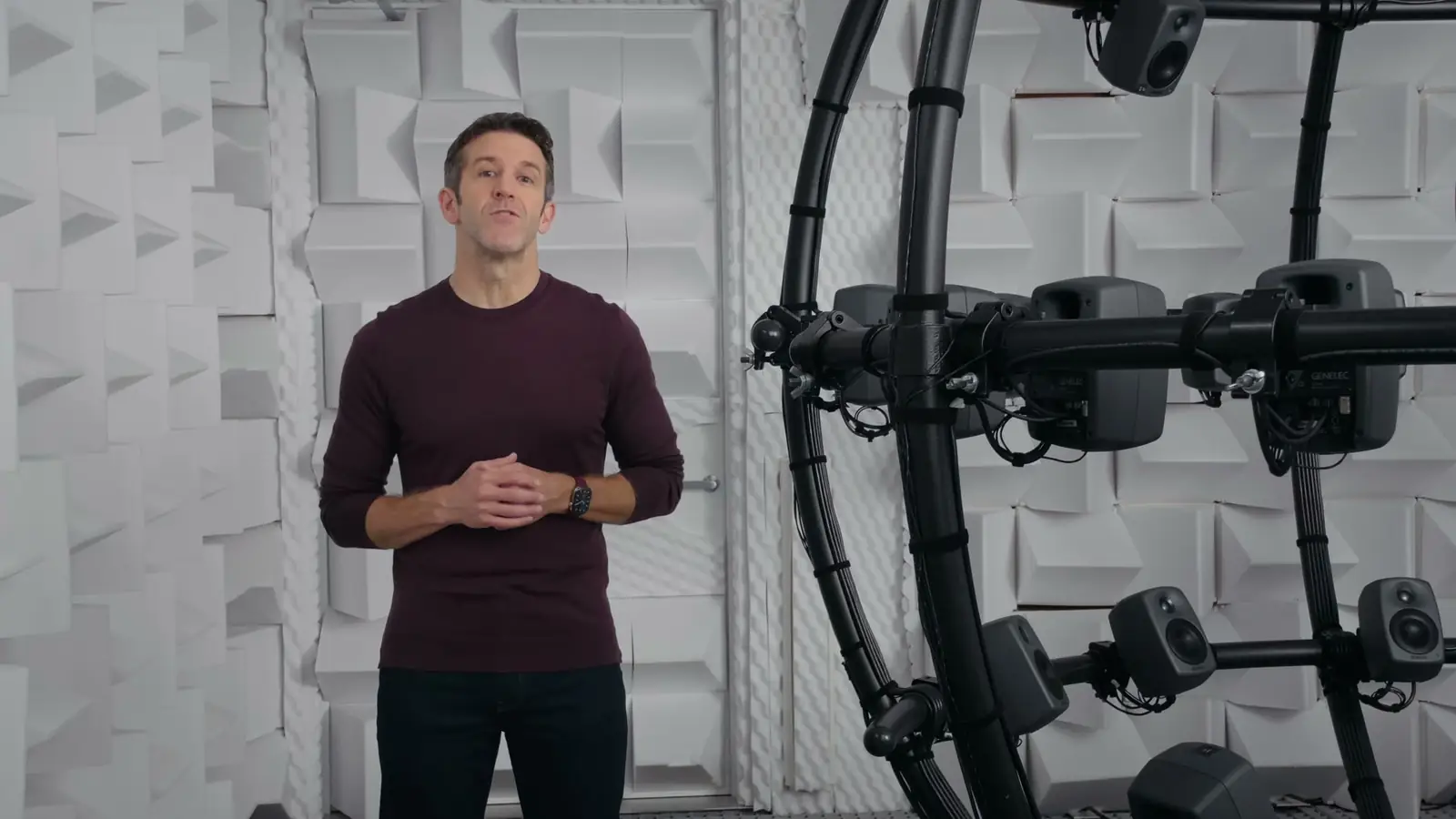
Frame from Apple’s September 9, 2026 event stream, 10:31 a.m. PT.
10:33 a.m. PT: AirPods 5, with noise cancellation in the open-ear design
The audio segment moved to a train station set. The claim slide read “Best ANC in an open-ear design,” and the demos were everyday ones: a traveler reading a departures board with the earbuds in, then a ticket in hand. The price slides followed: AirPods 5 at $129, and AirPods 5 with a Wireless Charging Case at $149.
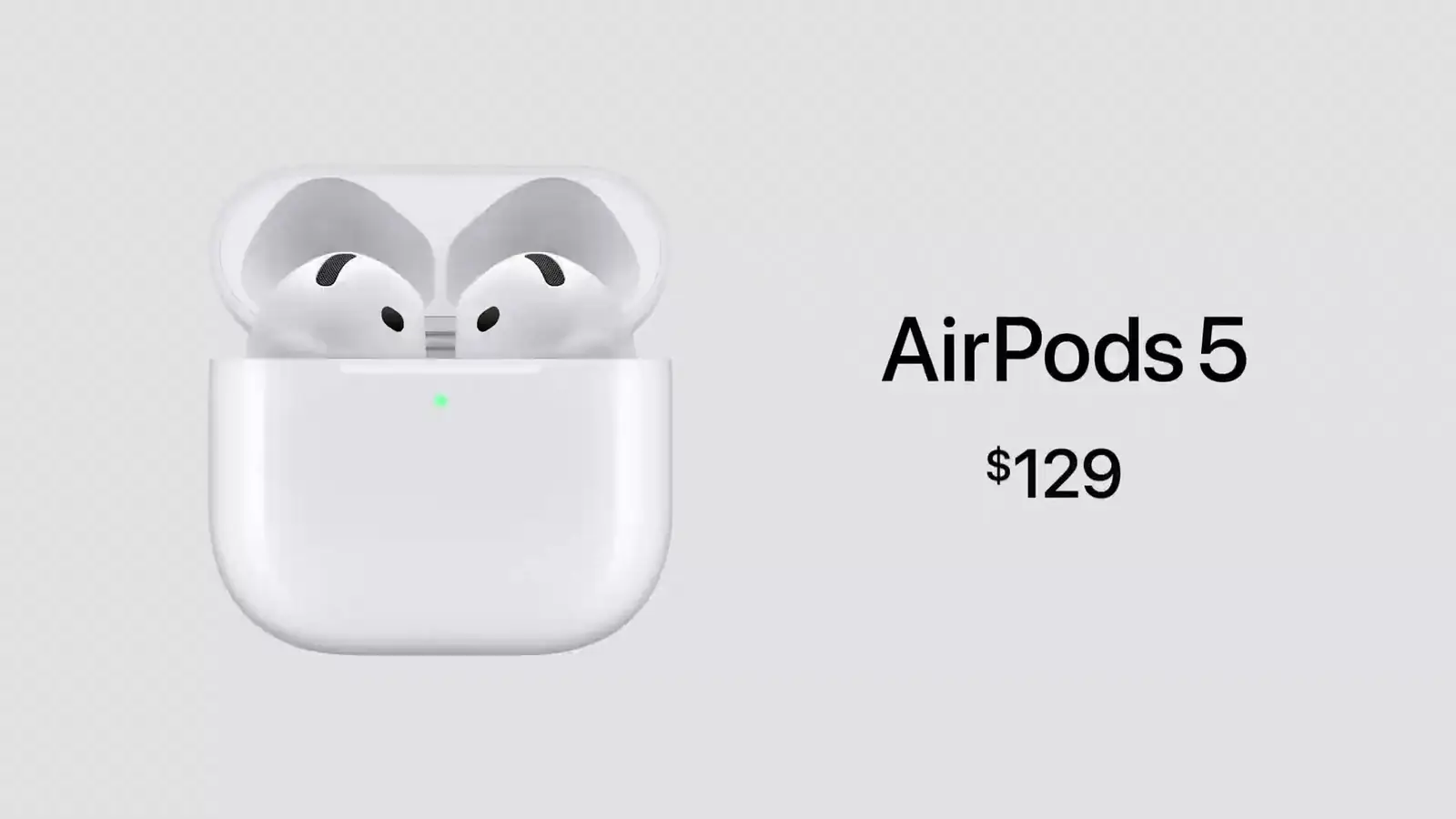
Frame from Apple’s September 9, 2026 event stream, 10:35 a.m. PT.
The recap slide, read off the frame: Personalized Spatial Audio, Adaptive Audio, Transparency mode, Conversation Awareness, best-in-class Active Noise Cancellation, Live Translation, USB-C and wireless charging, up to 5 hours with Active Noise Cancellation, next-generation Adaptive EQ, IP57 dust, sweat, and water resistance, hands-free Siri AI, Voice Isolation, Custom EQ, camera remote, and volume swipe.
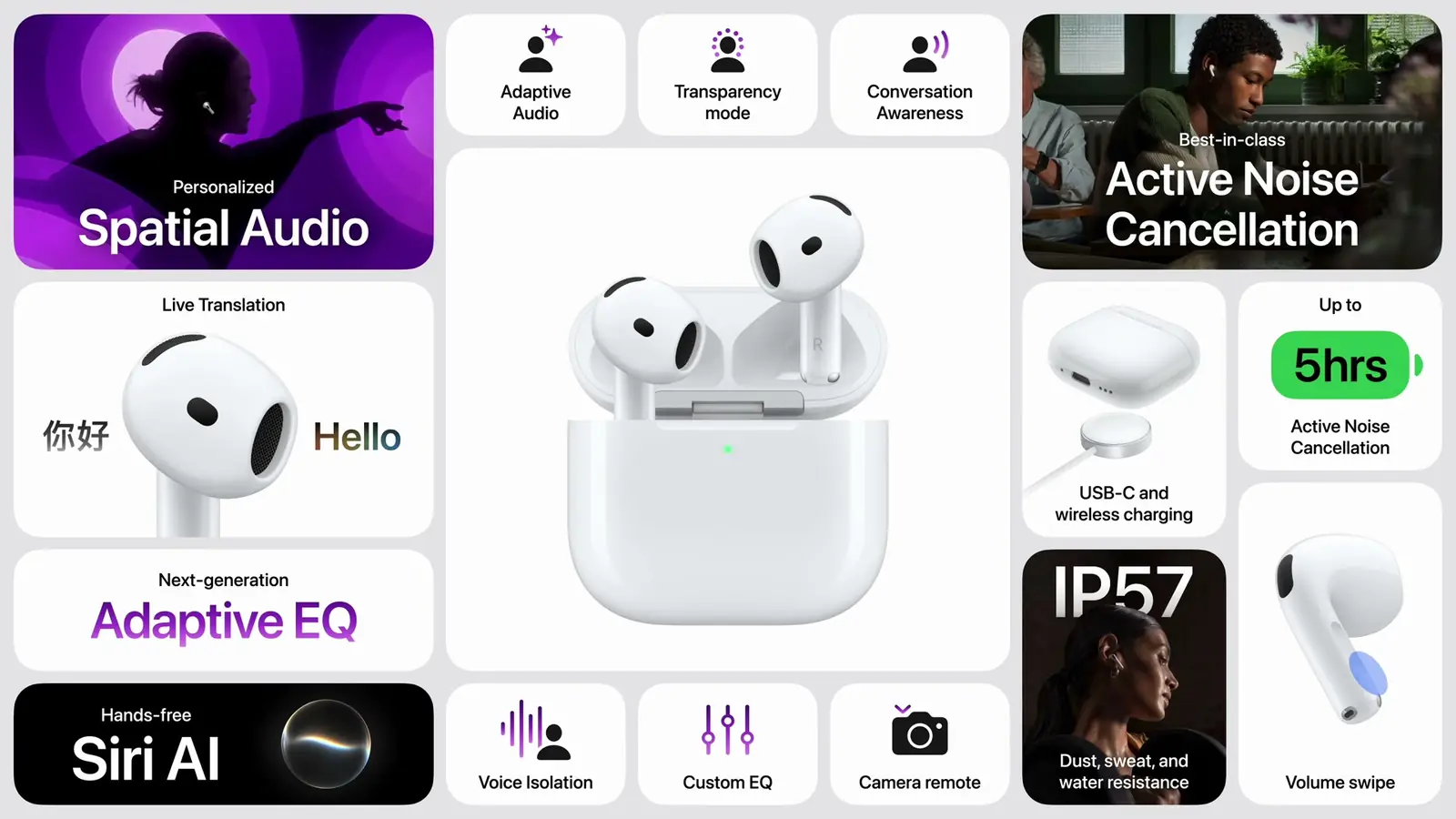
Frame from Apple’s September 9, 2026 event stream, 10:36 a.m. PT.
10:37 a.m. PT: Apple Watch Series 12, read off the case back
The Watch segment opened in a fitness lab and went straight to the hardware. The engraving on the case back gave the name and the basics before any slide did: Series 12, 46mm aluminum case, WR-50M, glass ceramic, GPS and Cellular. A grid of health and fitness app icons followed, then a sensor diagram labeled “LEDs,” then a slide reading “60x, more frequent than before.” The frame did not say what is sampled 60 times more often.
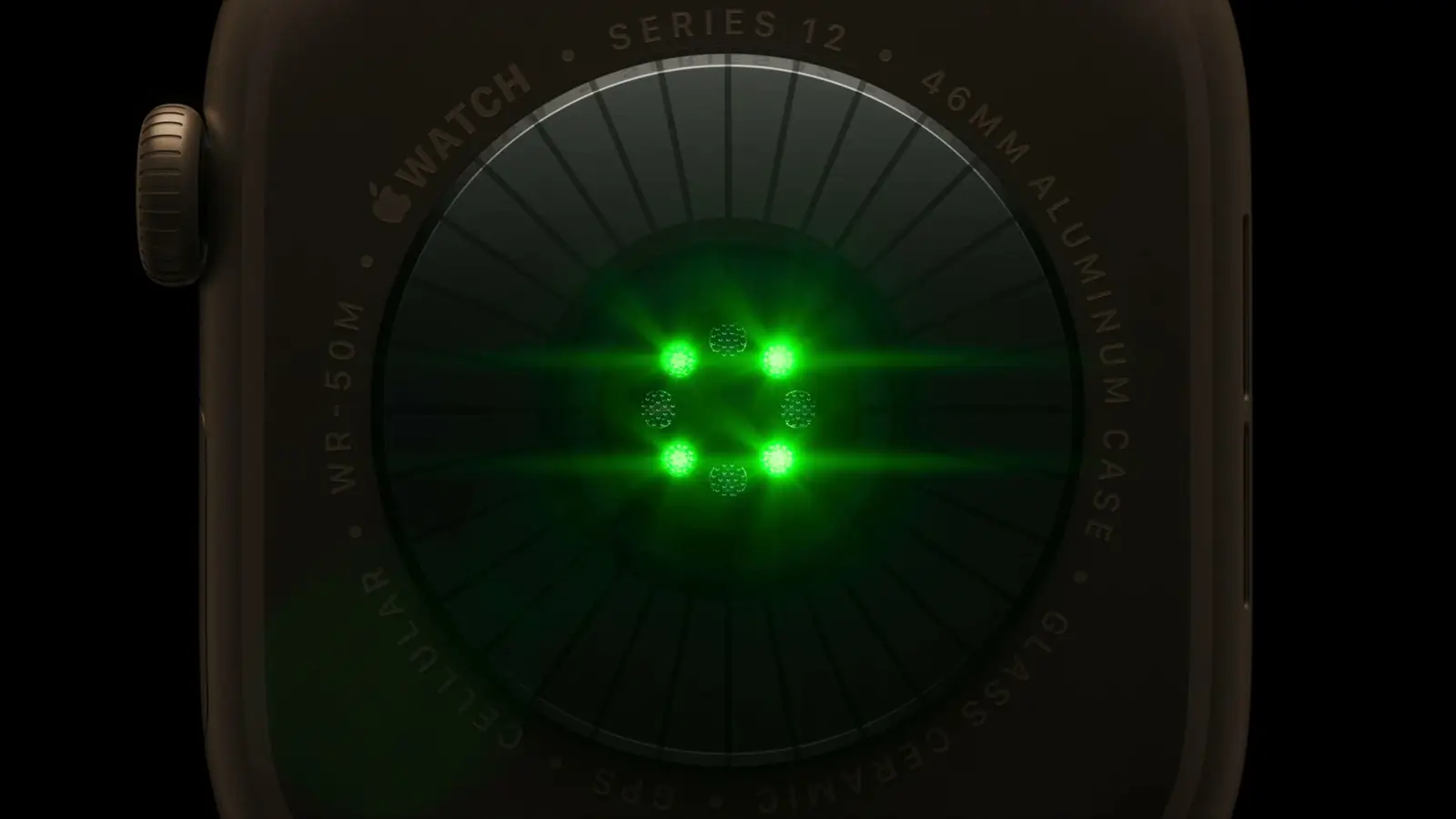
Frame from Apple’s September 9, 2026 event stream, 10:37 a.m. PT.
10:40 a.m. PT: Readiness, and a number called Health Age
The Watch software half ran through health screens in quick succession. A heart-rate face showed 63 BPM with a two-minute history. A “Readiness” title card led to a Recover gauge, then Health app cards: a sleep score of 84 under “A Good Night’s Sleep,” a Readiness tile reading “Ready,” and a “For You” suggestion, labeled “based on your health,” proposing a run broken into two-minute hard intervals with one-minute walks. The card that will get talked about is Health Age: minus 3.9 years, with a health age of 26.1 against an actual age of 30. How Apple computes it did not appear on screen.
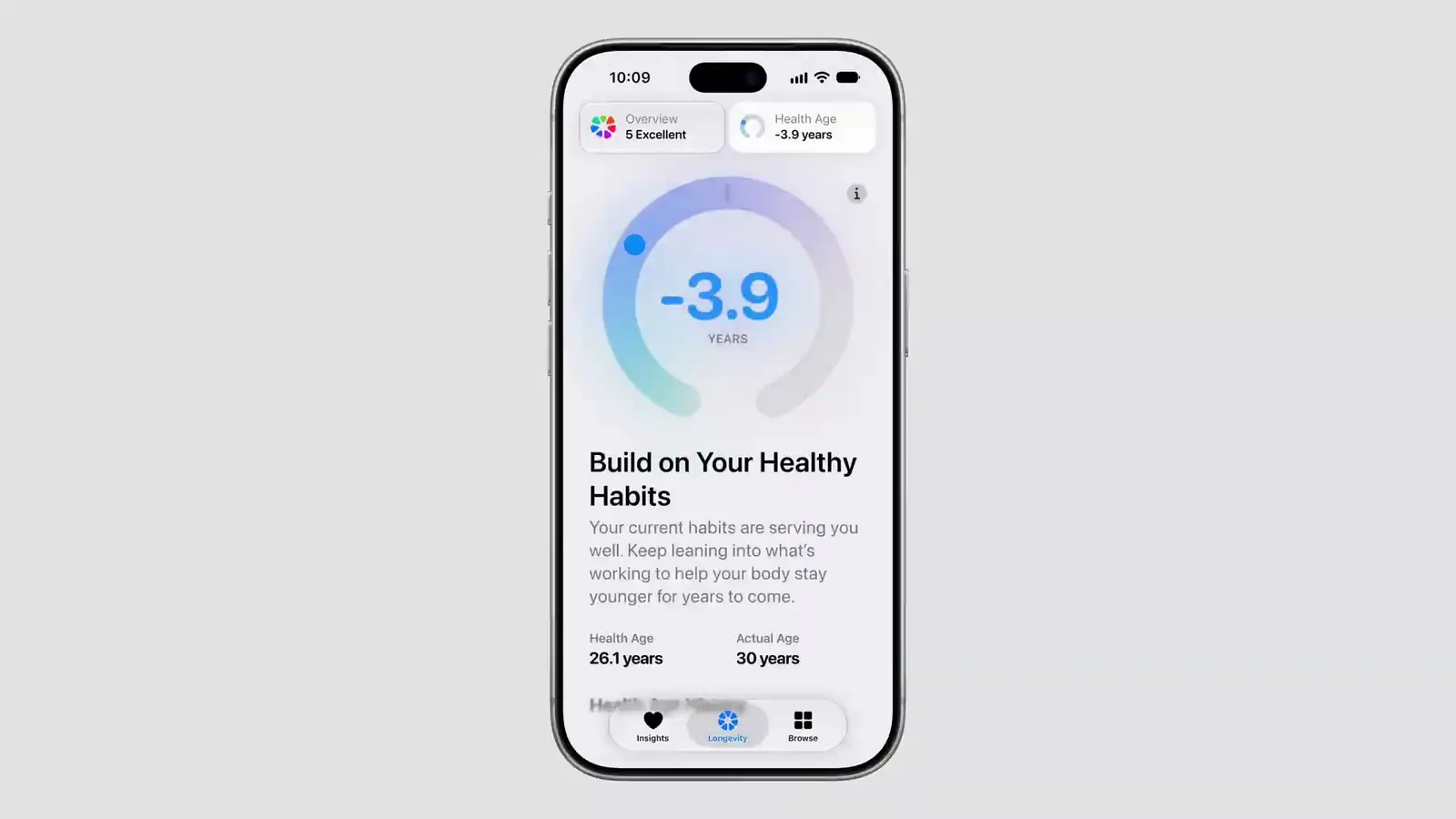
Frame from Apple’s September 9, 2026 event stream, 10:42 a.m. PT.
10:44 a.m. PT: the Health recap, then a title card that read “Audio Intelligence”
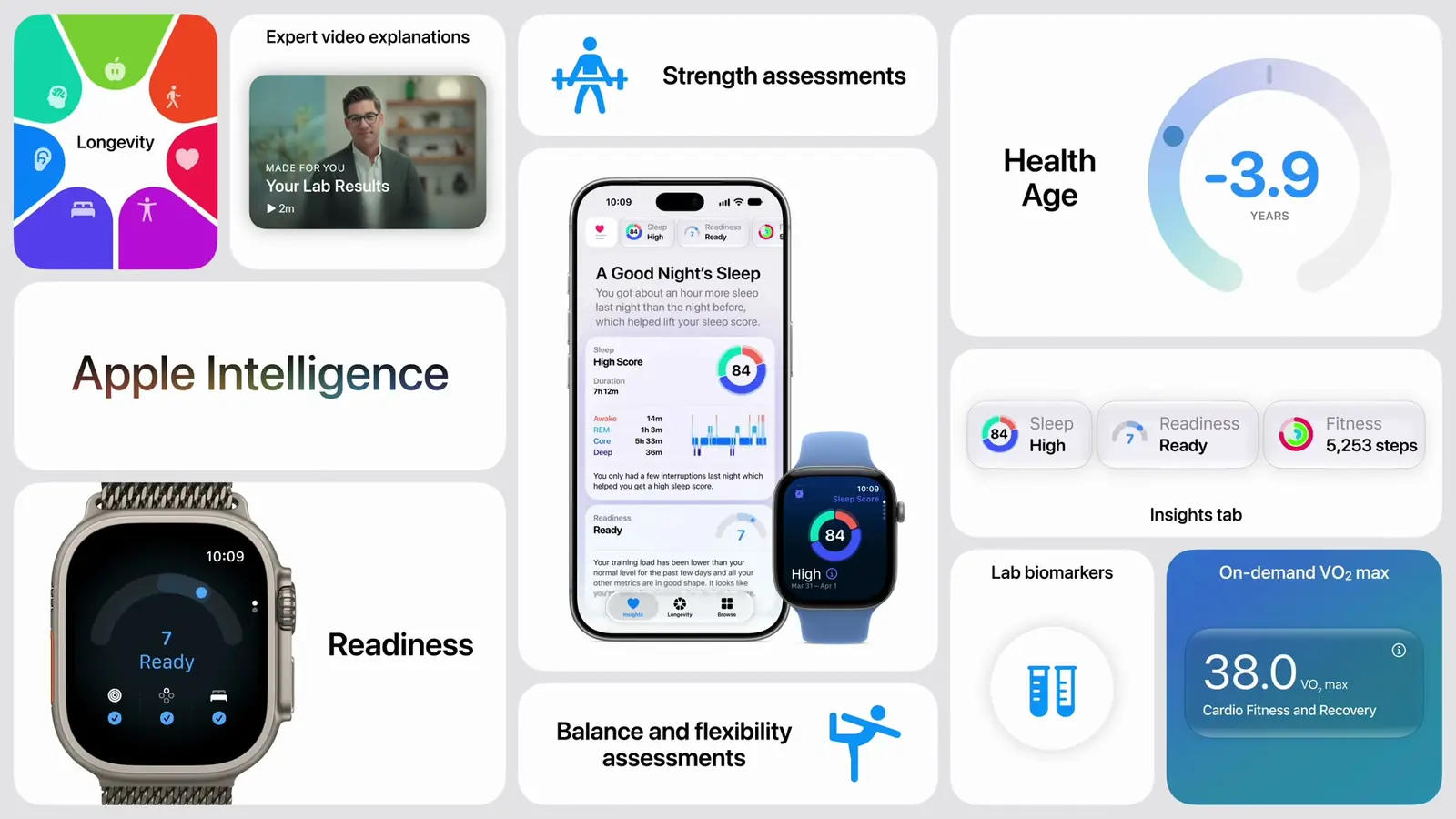
Before the recap, two demos: a Health screen for adding or ordering lab tests under “Your Assessments,” and a strength assessment that used the iPhone’s camera to track a person’s pose through timed rounds. The recap slide listed Longevity, expert video explanations, lab results, strength assessments, balance and flexibility assessments, Health Age, Apple Intelligence, Readiness, an Insights tab, lab biomarkers, and on-demand VO2 max. Ron Huang, captioned as VP of Sensing and Connectivity, then introduced a segment titled “Audio Intelligence” from a cafe patio.
Frame from Apple’s September 9, 2026 event stream, 10:44 a.m. PT.
10:46 a.m. PT: Audio Intelligence, with a four-line privacy slide
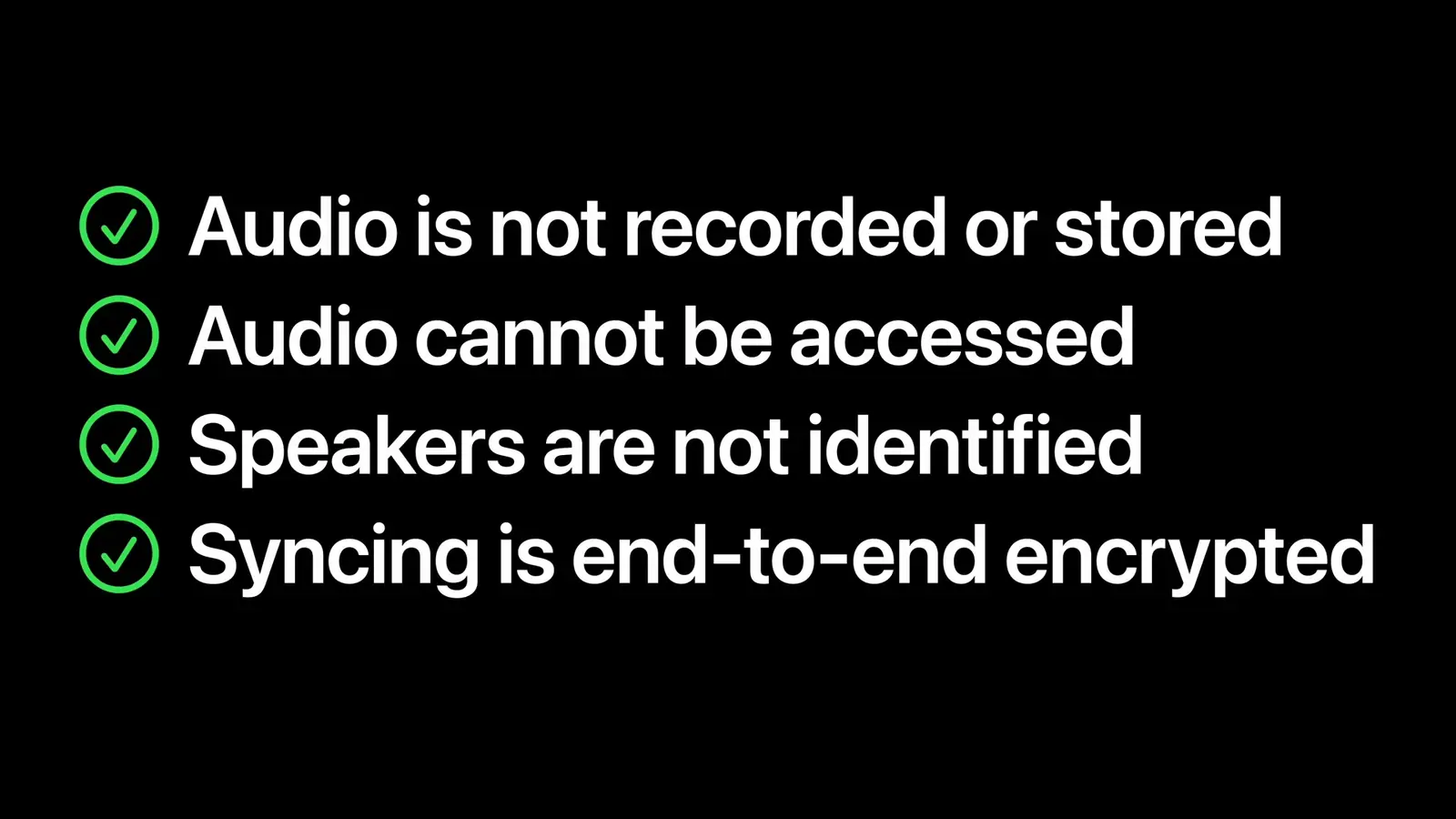
The feature turns conversations into notes. A “Recaps” screen on iPhone and Apple Watch showed a summary titled “Personal Training Routine” with a three-day workout structure and next steps. Watch faces followed: a sound recognition alert for a doorbell, a “Rewind” card that surfaced what a server had just said about the menu with an “Ask Siri” button, a Recaps list, and a Shazam result. The privacy slide had four check marks: audio is not recorded or stored, audio cannot be accessed, speakers are not identified, and syncing is end-to-end encrypted.
Frame from Apple’s September 9, 2026 event stream, 10:47 a.m. PT.
10:49 to 10:57 a.m. PT: eight minutes the capture missed
The stream URL expired and the frame grabber hung on a dead connection, so no frames exist between 10:49 and 10:57. Apple’s Watch and health press releases, posted at 10:58, cover what that stretch announced; their figures are in the verified table above.
10:57 a.m. PT: the foldable
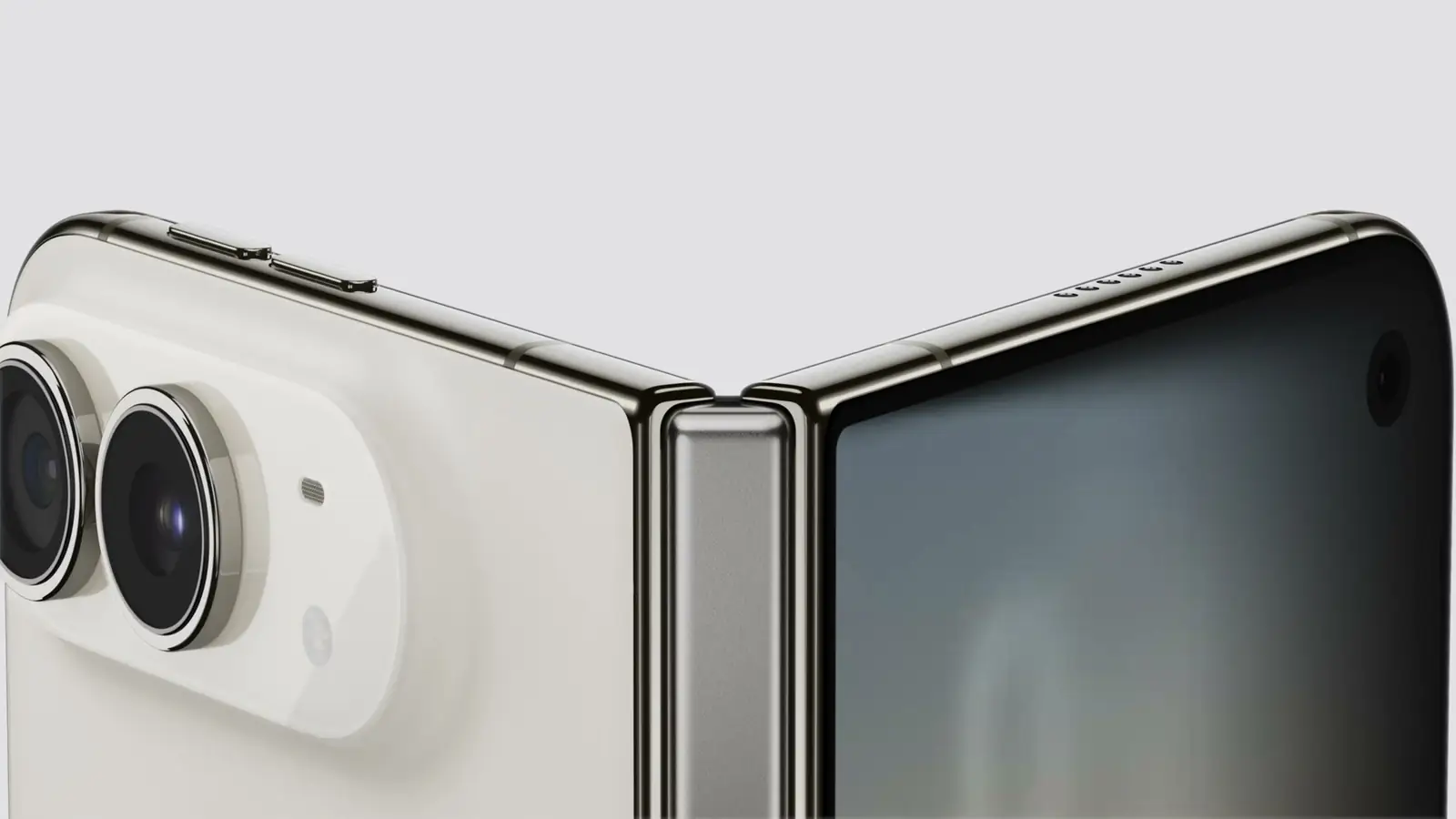
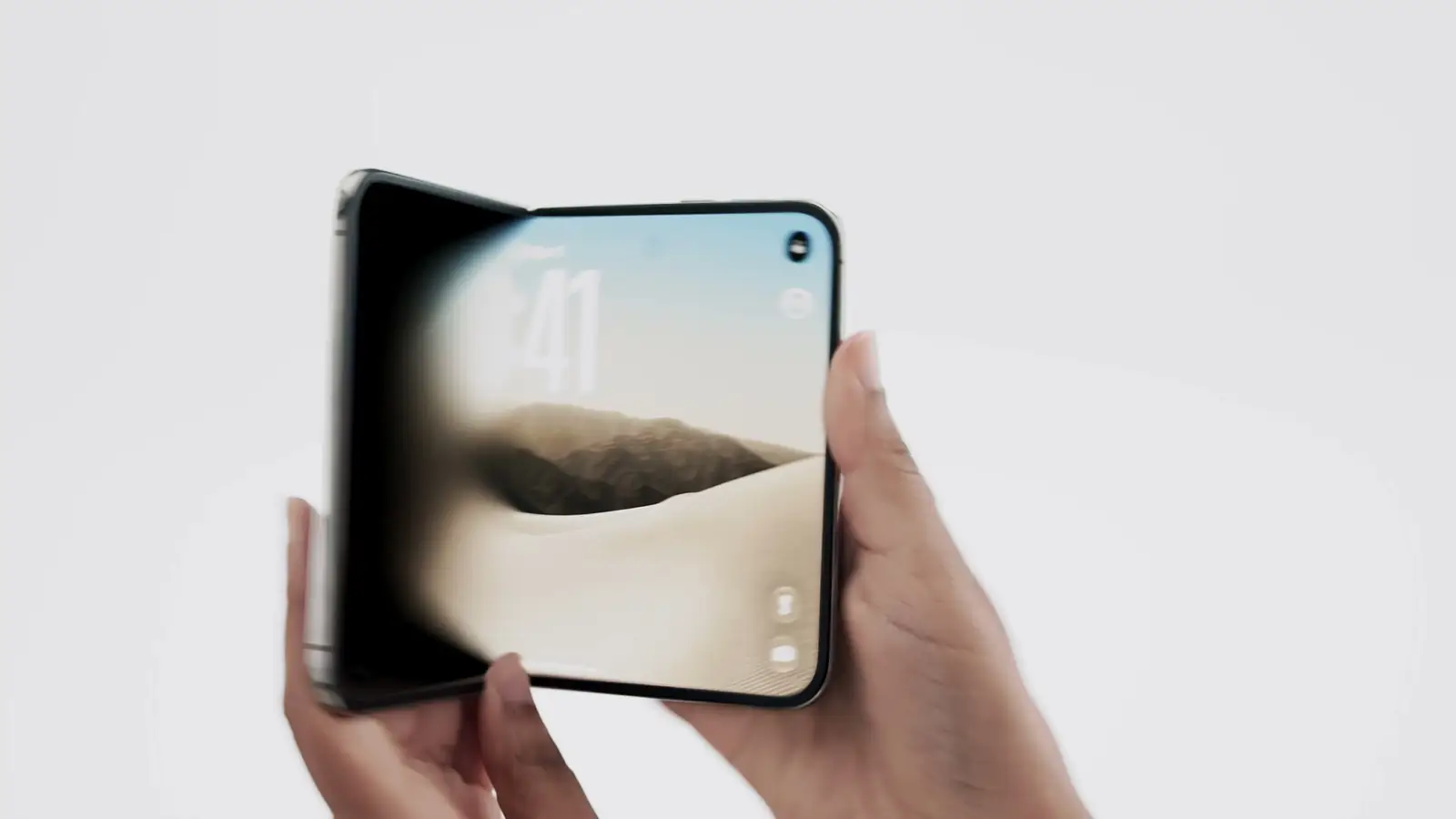
Frames resumed on the device the whole morning had been building toward. The first shot was the closed phone in profile, thin, with a row of speaker holes. Then the hinge from the outside, two rear cameras on the folding body. Open, it ran a two-pane layout: a Messages thread beside a Mail message, a home screen spread wide, an app called WhistleSounds filling the inner display in landscape. One frame showed it half-folded like a small laptop, with a keyboard on the lower half. Closed again, the outer display showed a landscape photo and the number 41. The product name had not appeared on screen in these frames.
Frame from Apple’s September 9, 2026 event stream, 10:58 a.m. PT.
Frame from Apple’s September 9, 2026 event stream, 10:59 a.m. PT.
11:00 a.m. PT: Joswiak takes the foldable, and one number
Greg Joswiak, captioned as SVP of Worldwide Marketing, presented the foldable from a rooftop at dusk under a steel lattice. The one figure on screen so far: “80% larger display than iPhone 18 Pro.” A film clip played full-width on the open device. Name, price, and sizes had not appeared by 11:02.
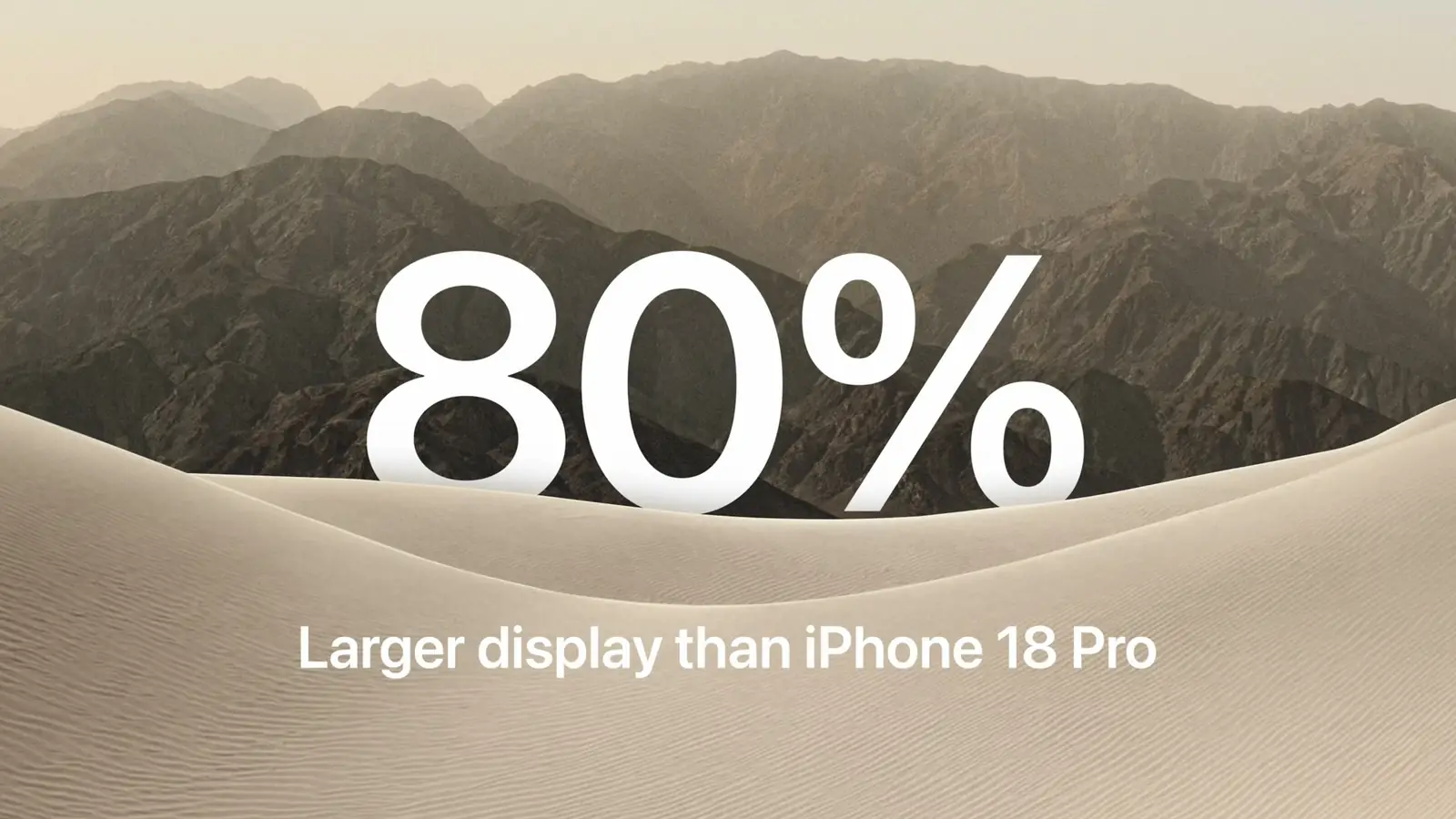
Frame from Apple’s September 9, 2026 event stream, 11:00 a.m. PT.
11:03 a.m. PT: Federighi on the software side of the fold
Craig Federighi took over for the software. The demos were about postures as much as apps: two shopping pages side by side across the fold, a video playing on the top half with a Messages thread on the bottom, and the phone standing half-open on a desk like a small tent, showing a large green clock and, at night, a bedside alarm with stop and snooze buttons. That last one is the StandBy idea moved onto a device that props itself up.
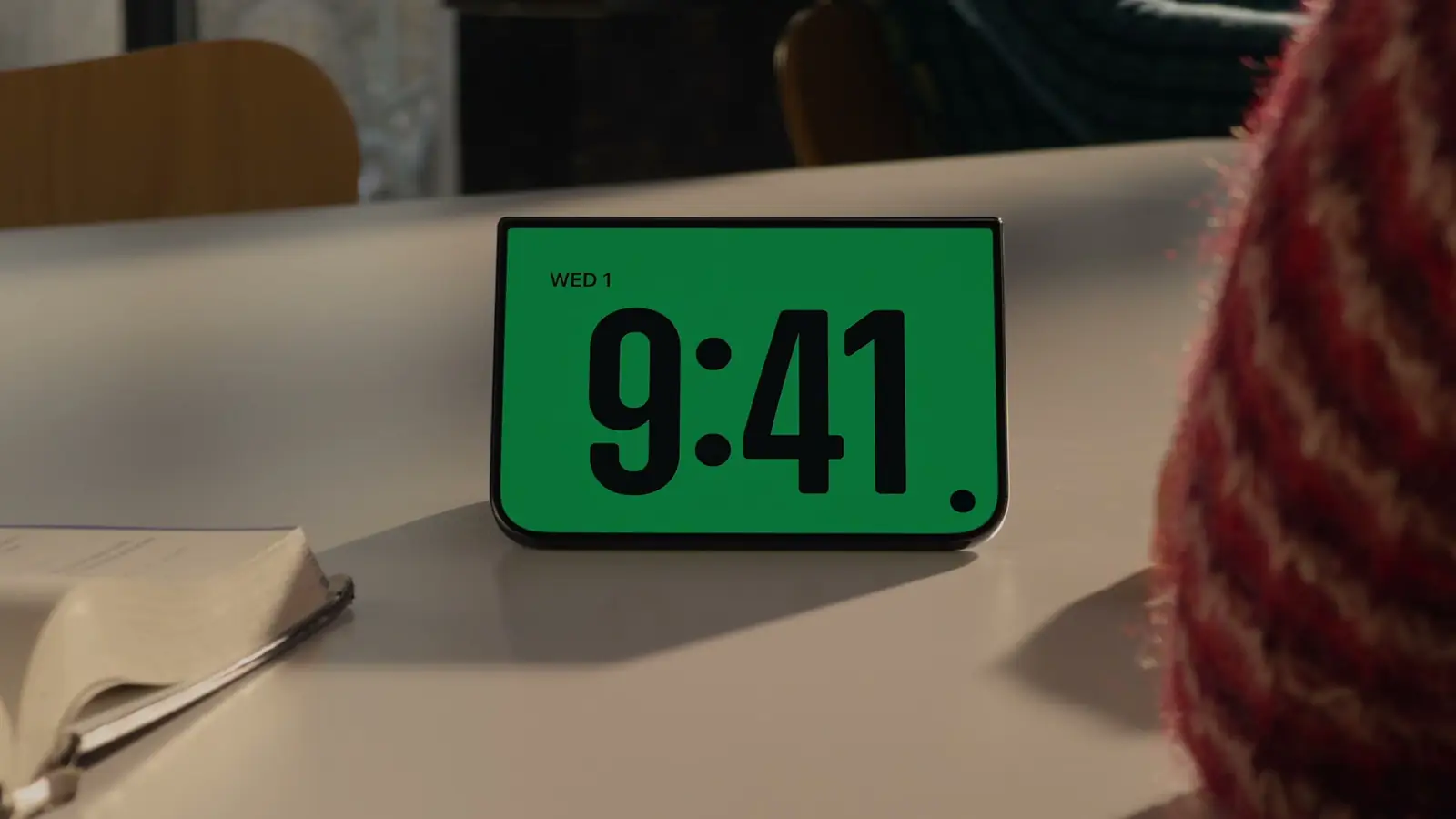
Frame from Apple’s September 9, 2026 event stream, 11:05 a.m. PT.
11:06 a.m. PT: the display, from the lab
After a team-chat app spread across the inner screen and a TV episode playing on the outer one, a “Display” title card handed off to a hardware presenter in an engineering lab. The shots were macro: a textured surface layer at extreme close-up, then the display’s layers fanned out in a stack. No figure for the crease, the glass, or the panel sizes had appeared on screen by 11:08.
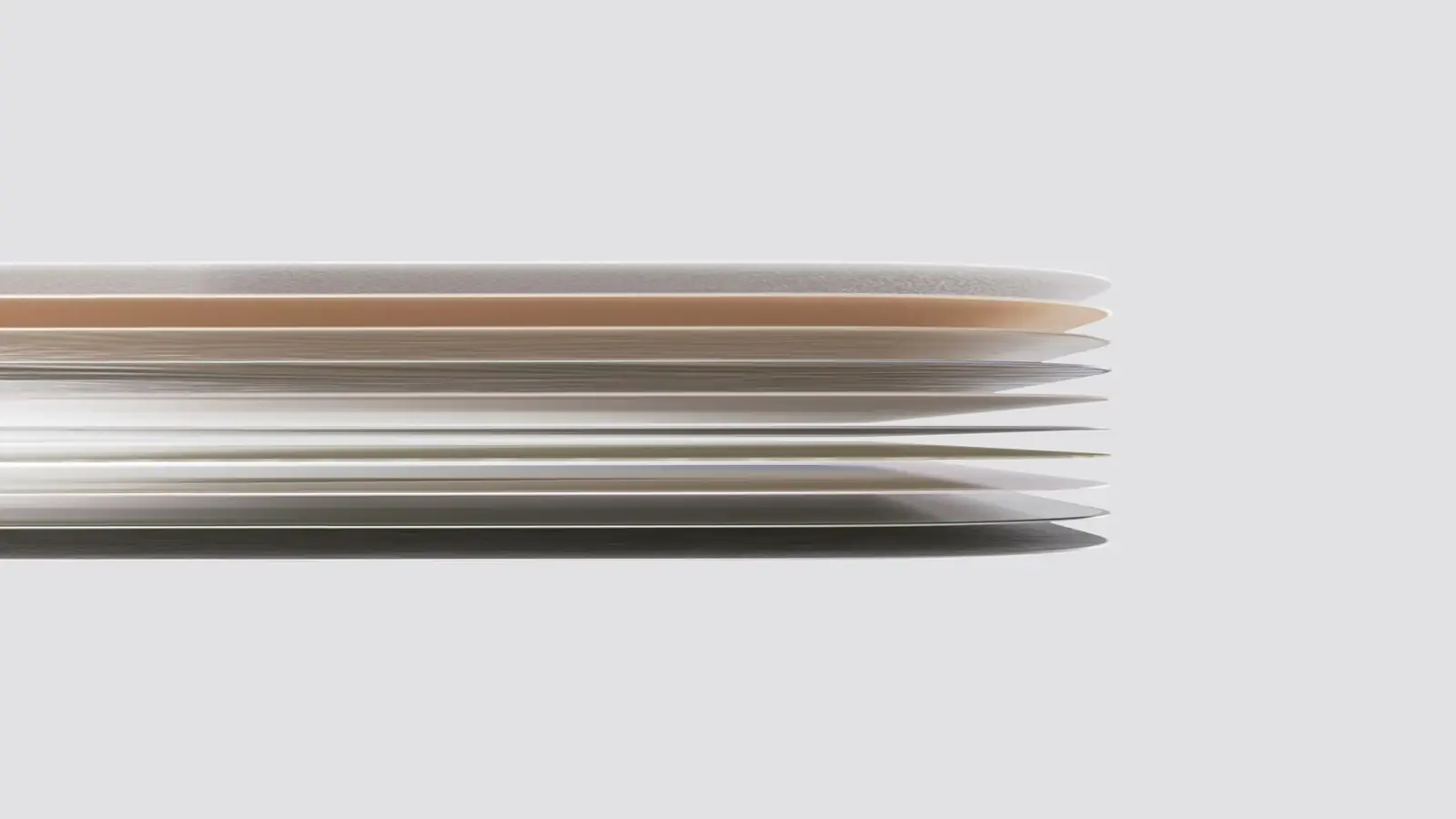
Frame from Apple’s September 9, 2026 event stream, 11:08 a.m. PT.
11:09 a.m. PT: inside the fold, A20 Pro and C2
The internals shot answered the chip question: an x-ray view of the open device showed the logic board along the hinge with an A20 Pro badge on it and a battery cell in each half. The chip badges that followed were A20 Pro and C2, the same modem Apple’s iPhone 18 Pro release credits with faster uploads than C1X. So the foldable shares the Pro’s silicon rather than getting its own.
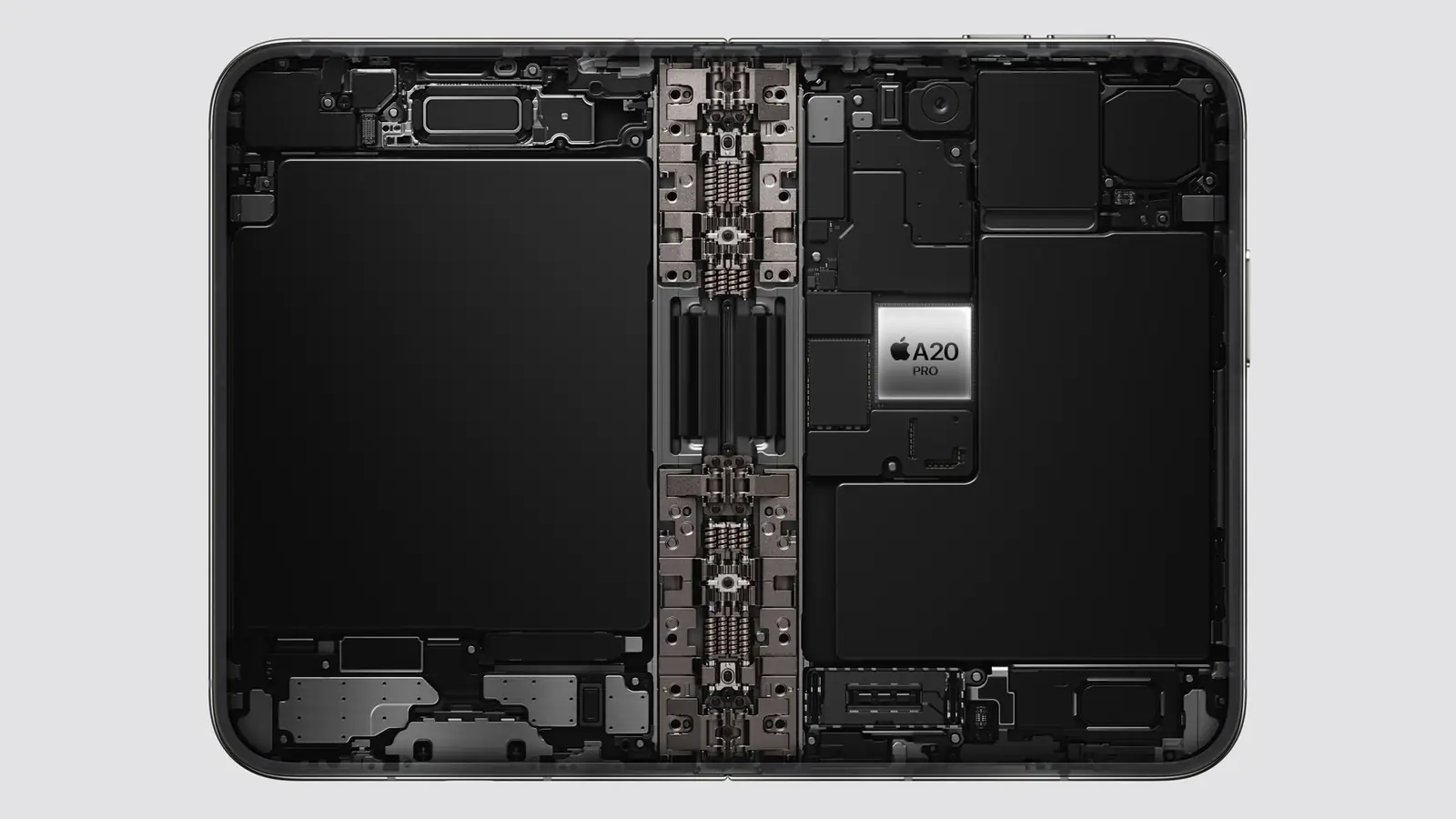
Frame from Apple’s September 9, 2026 event stream, 11:09 a.m. PT.
11:11 a.m. PT: “All-day battery life,” then the foldable’s cameras
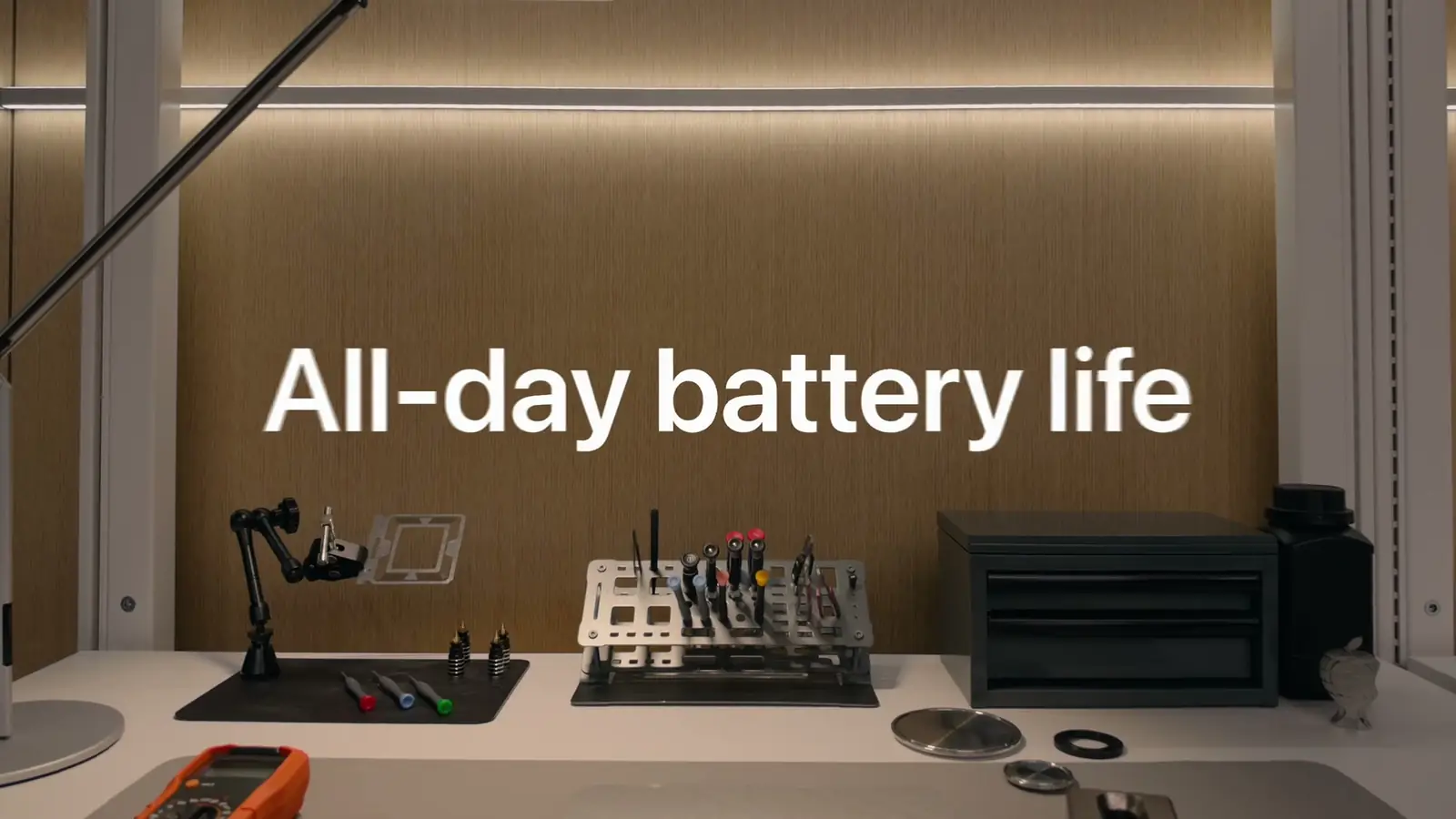
The battery claim came as three words over an engineering bench, “All-day battery life,” with no hour figure on screen, a contrast with the 36 and 45 hours Apple put on the Pro slides. Joswiak returned on the rooftop for the cameras: sample photos with capture-data cards in the corner, a kids-and-crafts video labeled “4K 120 FPS,” and a shot of the hole-punch front camera set into the inner display.
Frame from Apple’s September 9, 2026 event stream, 11:11 a.m. PT.
11:15 a.m. PT: the foldable’s recap slide, with the sizes
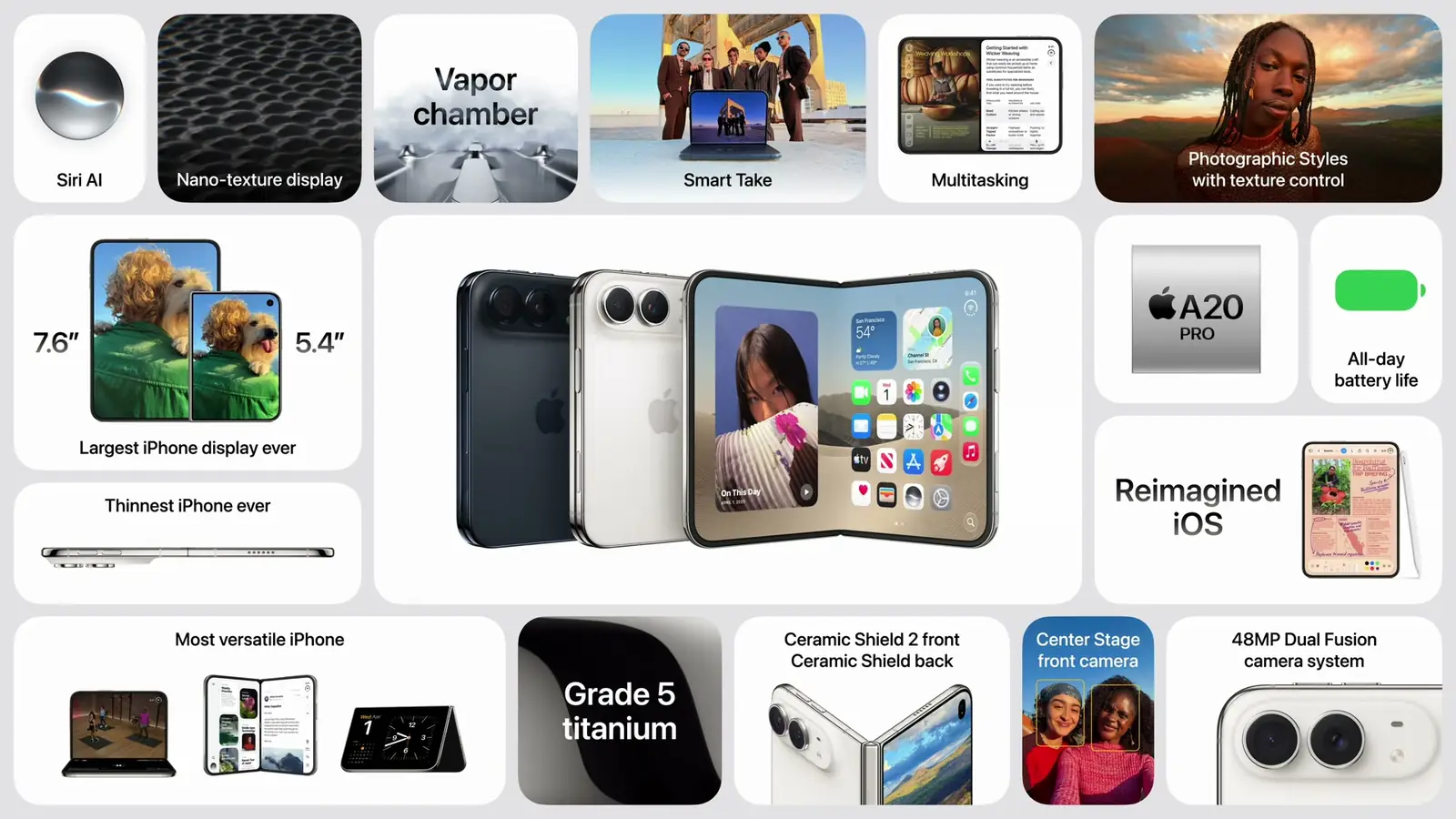
The recap slide finally put numbers on the fold. Read off the tiles: a 7.6-inch inner display and a 5.4-inch outer one, “largest iPhone display ever,” and “thinnest iPhone ever.” Then the build: Grade 5 titanium, Ceramic Shield 2 on the front and Ceramic Shield on the back, a nano-texture display, a vapor chamber. Then the rest: A20 Pro, all-day battery life, a 48MP Dual Fusion camera system, a Center Stage front camera, Smart Take, Multitasking, Photographic Styles with texture control, “Reimagined iOS,” Siri AI, and “most versatile iPhone.” A product shot before it showed two finishes, a pale one and a dark one. The name and price were still not in the captured frames; the next slide is usually the price.
Frame from Apple’s September 9, 2026 event stream, 11:15 a.m. PT.
11:16 a.m. PT: the name is iPhone Duo, and the keynote closes
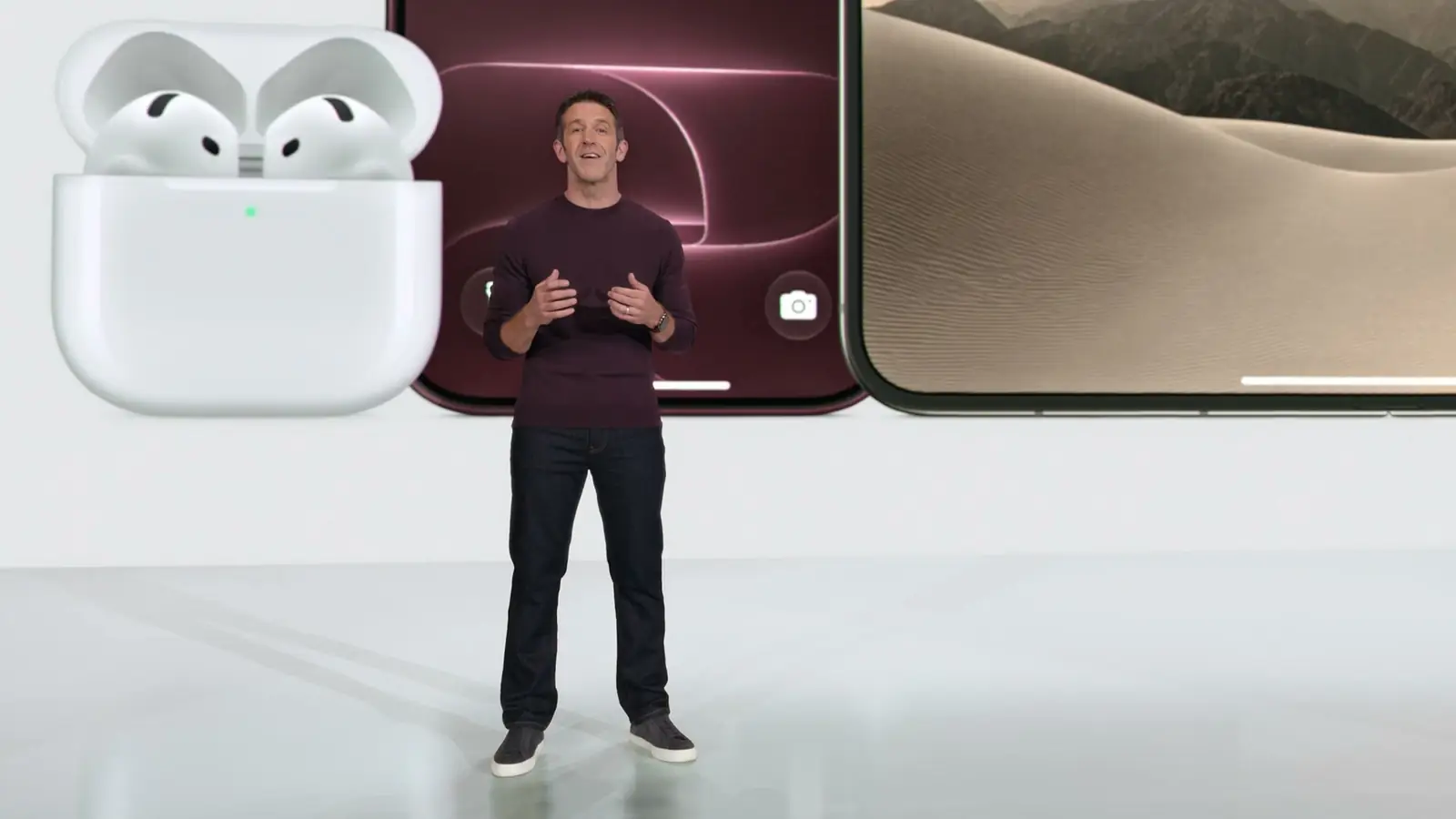
The closing run showed the open device held in two hands with the Home Screen spread across the fold, a magazine layout on the inner display, then the lineup wall: iPhone 18 Pro, AirPods 5, iPhone Duo. The price slide fell between two captured frames, so it is not on this page as a still. Apple’s press release, posted at 11:18, carries it: iPhone Duo starts at $1,999, pre-orders October 16, in stores October 23. The stream ended at 11:19 a.m. PT. This page captured 217 frames over the 79 minutes, minus the eight-minute gap noted above.
Frame from Apple’s September 9, 2026 event stream, 11:18 a.m. PT.
Developer releases and Apple’s product pages usually follow within hours. Anything that lands on developer.apple.com goes into the table above as it appears.
What it means for iOS developers
The clock is Monday. iOS 27 ships as a free update on September 14, five days after the keynote, and Apple Intelligence arrives with it.3 If your app has an App Intents surface, that is the day Siri AI starts reasoning over it in English, in beta, everywhere except the EU.3 The groundwork is in the App Intents and App Schemas posts linked below.
The foldable is a layout problem before it is anything else. iPhone Duo runs Split View with two apps side by side, two windows of the same app, StandBy on either display, and a Lock Screen and Dock that move to the side of the inner screen.8 Apple’s release says developers adapt “using the new and updated APIs in the latest SDKs,” and that Xcode’s Device Hub gains iPhone Duo support in an upcoming release.8 Netflix, Zoom, and Slack were named as already adapted.8 By early afternoon Apple’s Tech Talks had stated the rules: an app runs on the device without recompiling, only the iOS 27.1 SDK reaches the screen edge, the inner display reports regular size classes in both dimensions, and multiple instances work if they work on iPad.9 The device does not ship until October 23 and needs iOS 27.1, so there is a window, and the resizable-iPhone checklist covers the assumptions to remove first.
Photos gain a provenance layer. Apple Reference Image on iPhone 18 Pro signs the sensor data of a photo taken in Reference mode, with Private Cloud Compute developing it into an image whose authenticity can be proven.3 Apps that accept photos as evidence, from insurance to marketplaces, now have something to check for. The release does not describe the verification API, so treat the developer surface as unconfirmed until the documentation lands.
Watch data gets denser. Series 12 and Ultra 4 read heart rate every five seconds all day and add a daily readiness score from 0 to 10.56 For HealthKit apps that means more samples per hour than any prior Apple Watch. Whether readiness itself is exposed to third parties is not in Apple’s releases.
Regional footnotes are product decisions now. Two features carried EU exclusions on their slides, Siri AI and Apple Reference Image, and Apple’s releases confirm Siri AI “will not be available initially in the EU on iOS, iPadOS, and watchOS.”38 Any feature that depends on Siri AI inherits that footnote.
The release candidates landed the same day. Apple’s release-notes pages carried RC titles for every platform by 11:58 a.m. PT and the releases feed listed the builds by 12:24 p.m., all timestamped 10:00 a.m.: iOS 27.0 RC (24A435), iPadOS 27.0 RC (24A435), macOS 27.0 RC (26A428), tvOS 27.0 RC (24J360), visionOS 27.0 RC (24M362), watchOS 27.0 RC (24R363), and Xcode 27 RC (27A266a) with Swift 6.4. At 4 p.m. Apple opened App Store submissions for the iOS 27 releases. The developer table above has each entry with its page.2
Where the openings are for developers and makers
Apple’s releases say more to developers than the keynote did. Each item below pairs a sentence from an Apple page with the opening it creates, and with the post on this site to start from.
iPhone Duo: two apps on one iPhone, and a second screen you do not control
Apple’s words: developers “can easily adapt their apps using the new and updated APIs in the latest SDKs,” with “upcoming support for iPhone Duo in Device Hub in Xcode.”8 By 1 p.m. PT Apple had posted a Get Ready for iPhone Duo developer page with six Tech Talks available now, Group Labs on September 16 and 17, forum Q&As on September 23, and the Xcode 27.1 beta and the app-preparation guide marked “coming later this month”; by 4:10 p.m. PT the design guide, Designing for iPhone Duo, was live in the Human Interface Guidelines with reserved regions, arrangement views, and vertical controls. The UIKit documentation index still has no entry, so the SDK story is the iPad one until that beta lands. The Duo developer post works the numbers and quotes the talks. The talks state what the release did not: “Your app will work on iPhone Duo even if you haven’t built it with the iOS 27 SDK”; with the iOS 27.1 SDK “your app extends to the edge of the screen”; the inner display “has regular horizontal and vertical size classes”; and on multiple instances of an app’s UI, “if your app supports this on iPad, it also will on iPhone Duo.”9 That is workable, because the behaviors Apple lists are iPad behaviors: Split View, two windows of the same app, saved app pairs, and a Dock that moves to the side.8 An app that already handles iPad multitasking and continuous resizing has most of the work done. The resizable-iPhone checklist is the audit, and the iPad resizability post covers the SDK-link rule that decides whether your app gets the new behavior at all.
The outer display is the more interesting surface. Apple’s release puts StandBy on either display without charging, with widget hubs and customizable faces.8 StandBy renders widgets, and a widget is an App Intent with a view. If your app has no widget, iPhone Duo standing on a desk is a screen your app never appears on. The widget surface post explains why one intent feeds every placement.
Duo Preview, Kid Cue, and Duo FaceTime are system features that use the outer display while the rear cameras shoot.8 Third-party camera apps get their own version: the multiple displays and scenes talk introduces a CameraCaptureAccessory that “allows you to pair additional UI on the outer display, while your app’s main UI stays on the inner display,” available when the app is full screen on the inner display with an active camera session, and the camera talk adds a Virtual Front Camera, “a new AV Capture device that automatically switches between the outer and inner physical cameras.”9 Build against the responsive camera pipeline so the capture side is ready for both.
Timing: iPhone Duo ships October 23 on iOS 27.1, six weeks after iOS 27.8 Apple’s developer page dates the Xcode 27.1 beta, the one with the iPhone Duo simulator, to later this month.9
iPhone 18 Pro: provenance you can check, and a bigger Neural Engine
Apple Reference Image signs sensor data in the camera and develops it on Private Cloud Compute into a reference image that sits beside the edited photo like a negative.3 The developer-facing sentence is precise: “APIs are available in iOS, iPadOS, and macOS 27 for third-party apps to enable viewing of these reference images.”3 Viewing, not capturing. So the opening is on the consuming side: a marketplace, an insurance claims flow, a newsroom tool, or a dating app can show a user the reference alongside the upload and let a reviewer compare. Two footnotes shape the product: capture is opt-in, it is off at launch in China, and in the EU only develop-and-view works at launch, not capture.3 SynthID metadata for AI-edited images follows in a later update.3
The A20 Pro’s Dual 16-core Neural Engine has 32 cores and, by Apple’s figure, double the AI throughput of A19 Pro, with Neural Accelerators inside the CPU cores as well.3 That is headroom for on-device models rather than a new API. If you have been holding a feature back because the on-device Foundation Model was too slow on older phones, iPhone 18 Pro is the device to re-test on. Start with tool calling in iOS 27 and the on-device stack comparison, and measure with the Evaluations framework so the gain is a number.
Siri AI on Monday: the App Intents deadline is real
Siri AI ships in beta with iOS 27 on September 14 in English, and AirPods 5 give it a hands-free path, including nod-and-shake replies.34 Apple’s AirPods release names the mechanism for third parties: Siri “works seamlessly with apps from Apple’s vast ecosystem of developers, so users can continue to take action in the apps they already use.”4 That is App Intents. An app without intents is invisible to a user talking to their earbuds. App Schemas is how you describe what your app holds so Siri can reason over it, and background execution is what lets an intent run past 30 seconds without the app in front. The EU exclusion means any feature you build on Siri AI needs a fallback path for European users.3
Apple Watch and Health: denser data in, a bigger Health app to compete with
Series 12 and Ultra 4 read heart rate every five seconds all day.56 HealthKit apps should expect more heart-rate samples per hour than any earlier watch produced, which changes query costs and chart density; the five-second heart rate post works through the query patterns to change, and the iOS 27 HealthKit post covers the new types. Apple’s health release also says the Longevity tab draws on “third-party apps and devices” alongside Apple’s own data,7 so what your app writes to HealthKit now feeds Apple’s summary, not just your screen. Readiness, Health Age, and the $119 lab panels are Apple’s features with no third-party API in the releases.67 For a fitness or wellness app, the bar to clear is that redesigned Health app, so the opening is the thing Apple did not build: coaching for one sport, one condition, or one community.
AirPods 5 and Watch audio: translation and transcription reach the cheap tier
Live Translation comes to $129 AirPods, gated on Apple Intelligence and the latest firmware.4 Apple’s own Translation framework runs on device for free, and that post shows what it can do without the earbuds. Audio Intelligence on the new watches, with Live Rewind and Siri Recap, arrives in beta in late 2026 and needs an iPhone 16 or later.6 Nothing in the releases opens those to third parties.
Housekeeping that ships with iOS 27
Three earlier posts on this site turn into deadlines on Monday: the launch screen rule for new submissions, the canOpenURL deprecation, and the @State macro change that Xcode 27 stops compiling. The App Store’s social media declaration is a September rule as well.
Key Takeaways
For iOS developers:
- Ship for iOS 27 by Monday, September 14; Siri AI in beta reaches English-language users that day, outside the EU.3
- Remove fixed-size assumptions before October 23. iPhone Duo’s Split View and side-mounted Dock are the first iPhone layouts that behave like iPad, and Apple’s Tech Talks say the inner display reports regular size classes both ways while only the iOS 27.1 SDK reaches the screen edge.89
- Expect five-second heart-rate sampling from Series 12 and Ultra 4 in HealthKit, and plan storage and charts for it.5
For indie makers:
- The Health app now carries Health Age, readiness, and lab results at $119 a panel; a fitness or wellness app competes with that surface, not the old one.6
- AirPods 5 at $129 put Live Translation, Conversation Awareness, and hands-free Siri AI in the cheapest AirPods, so audio features reach more users.4
For anyone deciding what to buy:
- iPhone 18 Pro is $1,199, Pro Max $1,299, iPhone Duo $1,999; all three share the A20 Pro and C2 modem.38
- Trade-in credit runs $175 to $885 from Apple for iPhone 13 or later, and up to $1,200 through carriers.3
FAQ
When was the event?
September 9, 2026, at 10 a.m. PT, from Apple Park.1
What did Apple announce?
iPhone 18 Pro and iPhone 18 Pro Max, AirPods 5, Apple Watch Series 12, Apple Watch Ultra 4, and iPhone Duo, the first foldable iPhone, plus a redesigned Health app and the Health Sensing System on the new watches.345678
How much is iPhone Duo and when can I buy it?
It starts at $1,999 in star white and night sky, from 256GB to 2TB. Pre-orders open Friday, October 16, at 5 a.m. PT and it reaches stores Friday, October 23, running iOS 27.1.8
When does iOS 27 ship?
Monday, September 14, as a free update, with Apple Intelligence the same day. Siri AI rolls out in beta in English, with French, Japanese, Korean, Portuguese, and Spanish in October.3
Is Siri AI available in the EU?
Not at launch. Apple’s releases say Siri AI “will not be available initially in the EU on iOS, iPadOS, and watchOS,” and the keynote slide also named China.3
Is there a developer page for iPhone Duo yet?
Yes. Apple posted Get Ready for iPhone Duo by 1 p.m. PT (its developer news post is dated 11:00 a.m. PT) with six Tech Talks available now, Group Labs on September 16 and 17, forum Q&As on September 23, the Xcode 27.1 beta and the app-preparation guide marked coming later this month, and, by 4:10 p.m. PT, the “Designing for iPhone Duo” page in the Human Interface Guidelines.9 The same afternoon Apple added iPhone Duo to App Store Connect’s screenshot and app-preview specifications, and a product-bezel pack to Design Resources; the day-two roundup covers both and what the sizes imply. The device ships October 23 on iOS 27.1.8
Where do the facts in the post come from?
Every entry cites the apple.com or developer.apple.com page it was checked against at the time shown. Press coverage and leaks are not sources for the post.
Sources
-
Apple, Apple Events, fetched September 9, 2026: “Surprise and shine,” “Today at 10 a.m. PT,” streamed on apple.com and the Apple TV app. ↩
-
Apple Developer, Releases, fetched September 9, 2026 at 9:00 a.m. PT (“iOS 27.0 beta 8 (24A5430a)” dated August 31, 2026; “iOS 26.6.2 (23G90)” dated September 8, 2026) and again at 12:24 p.m. and 5:12 p.m. PT (the seven release candidates dated September 9, 2026 at 10:00 a.m. PT, Xcode 27 RC build 27A266a, and the App Store Connect update). Submissions: App Store submissions now open for the latest OS releases, September 9, 2026. ↩
-
Apple Newsroom, Apple debuts iPhone 18 Pro and iPhone 18 Pro Max, September 9, 2026. Prices, storage, finishes, pre-order and availability dates, A20 Pro, camera, battery, iOS 27 date, Siri AI rollout and EU note, Apple Reference Image, trade-in credits. ↩↩↩↩↩↩↩↩↩↩↩↩↩↩↩↩↩↩↩↩
-
Apple Newsroom, Apple introduces AirPods 5 with best-in-class open-ear Active Noise Cancellation, September 9, 2026. Prices, availability, noise cancellation and battery claims. ↩↩↩↩↩↩↩
-
Apple Newsroom, Introducing Apple Watch Series 12, with the all-new Health Sensing System, September 9, 2026. Price, sizes, finishes, battery, five-second heart rate sampling. ↩↩↩↩↩↩
-
Apple Newsroom, Apple unveils Apple Watch Ultra 4, September 9, 2026. Price, battery, readiness score, labs at $119, Audio Intelligence timing, watchOS 27 date. ↩↩↩↩↩↩↩↩
-
Apple Newsroom, Apple advances health and fitness capabilities using Apple Intelligence, September 9, 2026. Health Sensing System, readiness, redesigned Health app. ↩↩↩
-
Apple Newsroom, Apple unveils iPhone Duo, September 9, 2026. Name, price, storage, colors, dates, displays, build, A20 Pro, battery, cameras, Split View and StandBy, developer SDK and Device Hub note, accessories. ↩↩↩↩↩↩↩↩↩↩↩↩↩↩↩↩
-
Apple Developer, Get Ready for iPhone Duo, fetched September 9, 2026 at 1:12 p.m. PT, and the Tech Talks Prepare your app for iPhone Duo, Leverage multiple displays and scenes on iPhone Duo, and Build a great camera experience for iPhone Duo. Quoted sentences are from the talks’ English subtitle tracks: Prepare your app at 0:29, 1:05 to 1:09, and 3:26; Multiple displays and scenes at 3:38 to 3:43 and 4:59 to 5:19; Camera at 1:20. The design guide, Designing for iPhone Duo, was fetched at 4:15 p.m. PT; its change log dates it September 9, 2026. ↩↩↩↩↩↩











