Engineering Philosophy: Grace Hopper, Make the Computer Speak Human

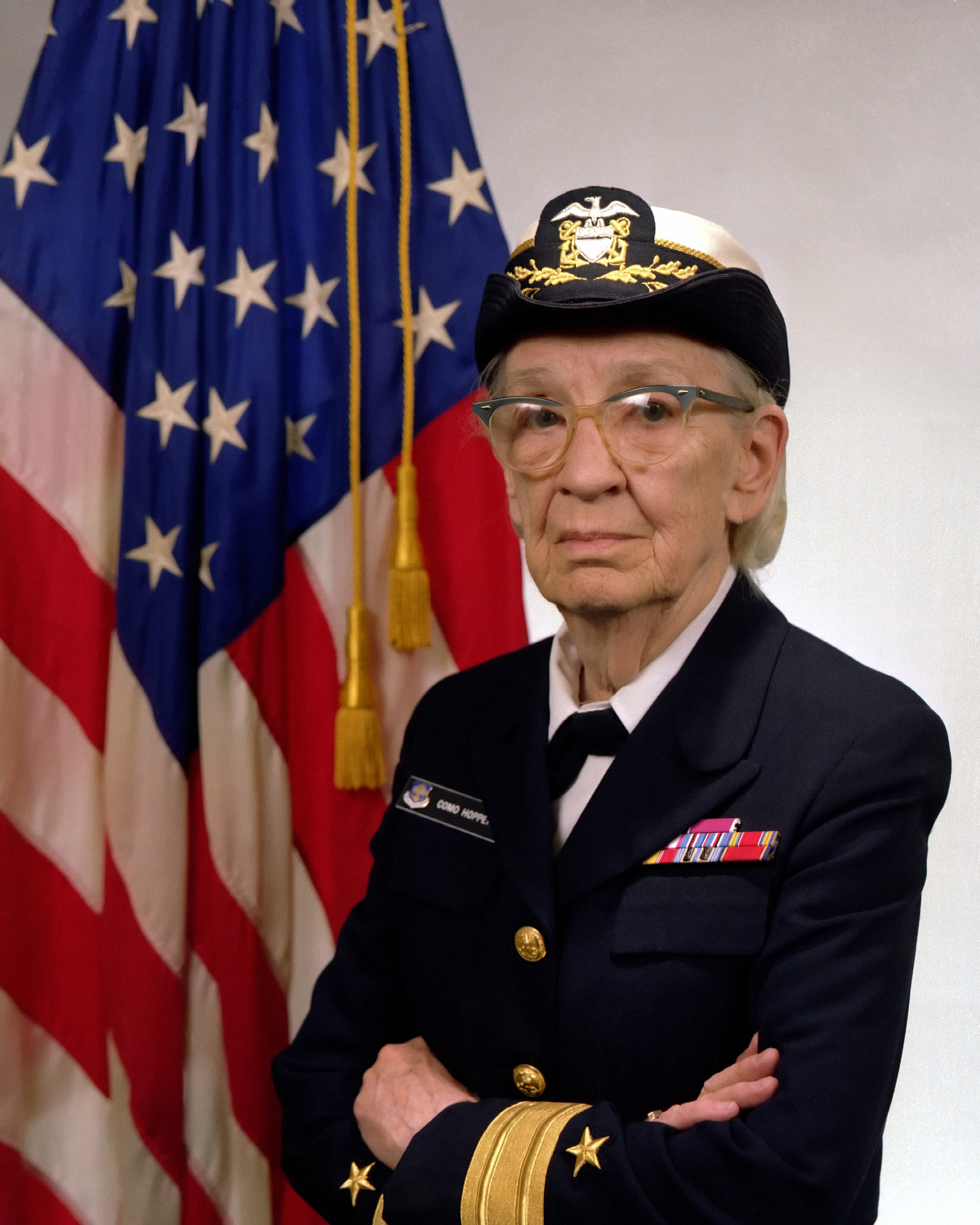
Grace Hopper, US Navy Rear Admiral and computing pioneer

Key Takeaways

  • Hopper’s whole philosophy in one line: make the computer speak the human’s language, never force the human to speak the machine’s.
  • The first compiler, A-0 (1952), put the burden of translation on the machine – automated once in software instead of paid by hand by every programmer forever.
  • The nanosecond wire turned latency into a physical object: 11.8 inches you could hold, so the cost of wasted time stopped being abstract.
  • “We’ve always done it this way” was, to her, the most dangerous sentence in the language – and every one of her inventions was an answer to it.

The Principle

“Humans are allergic to change. They love to say, ‘We’ve always done it this way.’ I try to fight that. That’s why I have a clock on my wall that runs counter-clockwise.” – Grace Hopper1

That temperament is downstream of one conviction: the machine should be made to serve the human, not the other way around. In 1953, when programming meant hand-coding numeric instructions for a specific machine, Hopper proposed that data-processing problems should be stated in English words and let the computer do the translating. Management told her it could not be done – computers did not understand English.2 She was not really claiming that they did. She was claiming that the burden of translation belonged on the machine, where it could be automated once, rather than on every programmer, forever. That is the whole philosophy: make the computer speak the human’s language, not the reverse.

It is easy, seventy years later, to miss how radical that was. The prevailing assumption was that programming was an esoteric craft for people who could think in the machine’s terms, and that this was simply the nature of the work. Hopper’s answer was that the nature of the work was a choice someone had made and never revisited – “we’ve always done it this way” calcified into a law of physics. Her entire career is the refusal of that calcification: the first compiler, the first English-like language, and a lifetime of teaching people that the limits they accepted were not real.

The anti-dogma streak and the accessibility mission are the same instinct seen from two sides. Abstraction – letting a person express intent in their own terms and having a tool translate it down to the metal – is not a convenience layered on top of programming. For Hopper it was the point of programming: the work of opening the machine to people who would otherwise be locked out. When President Obama awarded her the Presidential Medal of Freedom in 2016, the citation put it plainly – she “invented the first compiler, which allowed programs to be written in regular language and then translated for computers to understand.”3 The same conviction sits underneath the argument that good tools should optimize for the human being who uses them, not for the machine that runs them.

Context

Grace Brewster Murray Hopper was born December 9, 1906, in New York City.4 She took a bachelor’s degree in mathematics and physics from Vassar College in 1928, then a master’s (1930) and a PhD in mathematics (1934) from Yale – a doctorate in mathematics that almost no woman of her generation held.4 She taught mathematics at Vassar through the 1930s, and that detail matters: before she was a programmer she was a teacher, and the instinct to make a hard idea graspable never left her.

In December 1943, in the middle of the war, she joined the United States Navy Reserve. The Navy initially balked – she was thirty-six and well under the weight requirement – but she pushed through, and in 1944 was assigned to the Bureau of Ordnance Computation Project at Harvard, where she became one of the first programmers of the Harvard Mark I under Howard H. Aiken.4 The Mark I was a room-sized electromechanical calculator; Hopper co-authored its 561-page manual, A Manual of Operation for the Automatic Sequence Controlled Calculator, which was for years the foundational text on how to program the machine.4

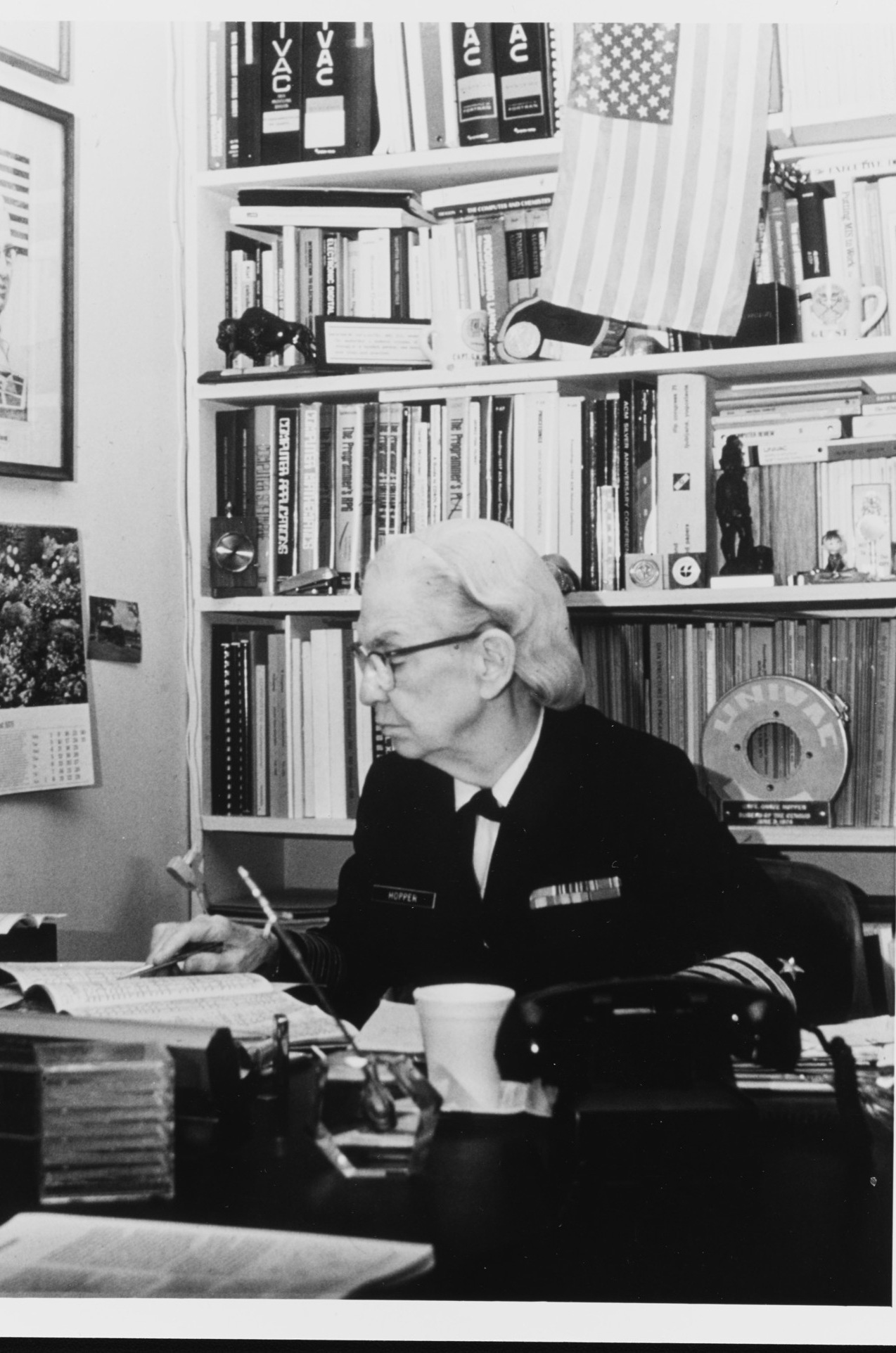
Grace Hopper at work, surrounded by UNIVAC manuals and a magnetic-tape reel

After the war she left active duty but stayed in the Reserve, and in 1949 joined the Eckert-Mauchly Computer Corporation – soon part of Remington Rand – to work on the UNIVAC I, the first commercial computer in the United States.4 It was there, no longer hand-welding code to a one-off research machine but trying to make a product usable by ordinary businesses, that the problem of her life came into focus. Aiken had given her the machine. UNIVAC gave her the customer. The customer could not program, and Hopper decided that was the computer’s problem to solve, not the customer’s.

The Work

The First Compiler: A-0 (1952)

By 1952, Hopper had built the A-0 system, widely credited as the first compiler.5 The idea was almost embarrassingly simple in hindsight and heretical at the time. Programmers had built up libraries of useful subroutines, but to reuse one you copied its instructions by hand into your program and laboriously fixed up every memory address. Hopper’s A-0 let you instead refer to each subroutine by a short call number and supply its arguments; the system then pulled the routines from a tape, resolved the addresses, and assembled a runnable program.5

Purists note, correctly, that A-0 functioned more like what we would now call a loader or linker than a modern optimizing compiler.5 That is true and worth saying. But the conceptual leap is the part that endures: a program could be a specification written in convenient symbols, and a piece of software could translate that specification into machine code automatically. The translation was the machine’s job now. Hopper’s own framing of why she did it survives in her words about the UNIVAC years: “I used to be a mathematics professor. At that time I found there were a certain number of students who could not learn mathematics. I then was charged with the job of making it easy for businessmen to use our computers.”2 Every compiler since – every line of code anyone has written in a language above raw machine instructions – is a descendant of that decision.

FLOW-MATIC and the Road to COBOL

A-0 translated symbols. The next step was to make the symbols English. Between 1955 and 1959, Hopper and her team at Remington Rand built FLOW-MATIC, the first programming language to express operations in English-like statements rather than mathematical notation.6 A FLOW-MATIC program read in commands like INPUT, COMPARE, and MOVE – words a businessperson could read and roughly understand without being a mathematician. It was, in her phrase, the deliberate work of making the computer usable by people who were never going to think in the machine’s terms.

FLOW-MATIC fed directly into COBOL. When the CODASYL committee convened in 1959 to design a common business-oriented language, FLOW-MATIC was the most mature English-like data-processing language in existence and became the primary basis for the new standard.6 Hopper is rightly called the conceptual grandmother of COBOL – not its sole author, but the person whose work and advocacy made an English-like, machine-independent business language thinkable. And machine-independent is the second radical idea bundled in here: she championed the notion that a program should be portable across different computers rather than hand-fitted to one, a direct ancestor of the write-it-once-and-port-it conviction that Unix and C made famous. The same code, the same English, running on machines it was never written for. COBOL outlived nearly everything around it; decades later it still runs the world’s banking and government systems, which is its own quiet argument for the durability of an idea built around the human reader.

The Nanosecond: Making Latency Physical

Hopper’s most famous teaching device was not code at all. It was a piece of wire. Asked once why satellite communication took so long, she set out to make the cost of time something a person could hold. She would hand out lengths of wire cut to 11.8 inches – the maximum distance electricity can travel in one nanosecond, a billionth of a second – so that an abstract unit of delay became a physical object in your hand.7 Then she would produce a coil 984 feet long: that, she explained, was a microsecond. “I sometimes think we ought to hang one over every programmer’s desk,” she said, “so they know what they’re throwing away when they throw away microseconds.”7

Commodore Grace Hopper speaking at a podium, 1985

The wire is the same teacher’s instinct that drove the compiler, aimed at a different lesson. The compiler said: you should not have to think in the machine’s terms to use it. The nanosecond said: but you do have to respect the machine’s physics. Latency stopped being a number on a slide and became a length a signal must physically cross, governed by the speed of light, and every wasted microsecond is wire you made the signal run for no reason. The wires now sit in the Smithsonian’s National Museum of American History.8 They are also, almost exactly, John Carmack’s “the speed of light sucks” – forty years earlier and made of copper. Both made the hard physical floor on latency into something you could not abstract away or wave off, because you could see it, or hold it.

The Bug and the Anti-Dogma Temperament

On September 9, 1947, operators on the Harvard Mark II – Aiken’s successor machine, the team Hopper worked on – traced a fault to a moth caught in Relay #70, Panel F. They removed the insect, taped it into the logbook, and wrote: “First actual case of bug being found.”9 That logbook page, moth still attached, is now held by the Smithsonian.8

The honest version of this story matters, because Hopper told it so well that the facts blurred. The moth was real and the date is documented. But the word “bug” for an engineering fault long predated her – it was in use as far back as Thomas Edison’s era – and the operators were almost certainly making a pun, conflating the engineering term they already knew with the literal insect they had just pried loose.9 Hopper, by most accounts, was not even the person who found it. What she did, with characteristic flair, was popularize the anecdote and the vocabulary of “bug” and “debugging” until they became the field’s native tongue.9 So the precise credit is this: she did not coin “bug,” and she likely did not catch the moth, but she made the story and the word stick. That is its own kind of contribution – the teacher’s contribution, again.

The temperament behind all of it was a standing war on inherited assumption. The clock on her wall ran counter-clockwise, on purpose, to prove that the convention everyone treated as fixed was arbitrary the moment you decided to build a different one.1 “We’ve always done it this way” was, to Hopper, the most dangerous sentence in the language – and the compiler, the English-like language, the portable program, and the wire in your hand were all answers to it.

The Method

The method is consistent across forty years – ordnance computation, commercial computing, language design, and a lifetime of teaching.

Move the burden of translation onto the machine. The recurring move of her career is to take work that every human currently does by hand – resolving addresses, thinking in numeric opcodes, fitting code to one specific computer – and automate it once, in software. The compiler is this idea; FLOW-MATIC is this idea; machine-independence is this idea.56

Let people speak their own language. Programming should meet the user where they are. A businessperson should be able to write MOVE and COMPARE, not memorize an instruction set. Accessibility was never a feature bolted onto the tool; for Hopper it was the whole reason the tool existed.26

Make the abstract physical. When an idea is too abstract to respect – a nanosecond, a wasted microsecond – build a physical object that forces the lesson. The wire is pedagogy as engineering: you cannot argue with a thing you are holding.7

Distrust “we’ve always done it this way.” Treat inherited convention as a hypothesis, not a law. The counter-clockwise clock is the method in object form: prove the constraint is arbitrary by simply doing it differently.1

Ask forgiveness, not permission. “If it’s a good idea, go ahead and do it. It’s much easier to apologize than it is to get permission,” she advised – the operational corollary of fighting dogma. (The sentiment predates her and the exact wording varies across sources, but the line is hers in the form the Navy and the field remember it.)10 You do not get to abstraction by waiting for the people invested in the old way to bless it.

Influence Chain

Who Shaped Her

Howard Aiken and the Harvard Mark I. Aiken handed Hopper her first computer and her first hard problem, and the Mark I manual she co-authored forced her to think rigorously about how a machine is instructed – the question that would become her life’s work. (Direct influence)

The United States Navy. The Navy gave her the institution, the discipline, and ultimately the platform; she stayed in uniform, on and off, for over four decades. The military’s demand for reliable, repeatable, teachable procedure shaped her conviction that programming had to be made systematic and transferable rather than artisanal. (Formative influence)

Her years as a mathematics professor. Before the machines, she taught. The teacher’s question – how do I make this graspable to someone who does not already think like me? – is the seed of the compiler, the English-like language, and the wire. (Formative influence)

Who She Shaped

Every high-level language. The compiler made it possible to program in anything other than raw machine code. FORTRAN, COBOL, and everything since stand on the premise A-0 proved: that a tool can translate human-convenient symbols into machine instructions.5

COBOL and business computing. As the conceptual grandmother of COBOL, Hopper put English-like, machine-independent programming into the hands of enterprises worldwide. The language still runs an enormous share of the world’s financial and government systems.6

Accessibility as the goal of programming. The deepest inheritance is not a language but a stance: that opening the machine to more people is the work, not a side effect of it. Obama’s citation – “we can thank Grace Hopper for opening programming to millions more people” – is exactly this.3

The Throughline

Yukihiro Matsumoto designed Ruby to optimize for programmer happiness – the language should bend to the human, not the human to the language. That is Hopper’s “make it easy for businessmen to use our computers” said again in 1995: the direct philosophical heir to make the computer speak human. John Carmack’s “the speed of light sucks” is her nanosecond wire rendered as a sentence – both insist that latency is physical, a hard floor you respect rather than abstract away; she just got there forty years earlier and made hers out of copper you could hold. And Thompson and Ritchie’s Unix and C, built so that an operating system could be written once and ported rather than welded to a single machine, are the practical fulfillment of the machine-independence Hopper championed for COBOL: the same program, running on hardware it was never written for. (Series bridge)

What I Take From This

The lesson I keep is that abstraction is not a luxury you add when you have time – it is the entire job. Hopper looked at programming in 1952, saw that the hard part was being borne by every human who touched the machine, and moved that burden into software where it could be paid once. That is the move I try to make in everything I build now: find the translation work that humans are doing by hand, over and over, and automate it into the tool. The standard is the same as quality being the only variable – the question is never “can a person be trained to tolerate this interface?” but “why should they have to?”

In the world I build in now – agents, tool loops, AI systems – Hopper’s two halves are both load-bearing, and they pull against each other in exactly the productive way. The accessibility half says: let the human express intent in their own language and make the system translate it down to whatever the machine needs – which is, almost literally, what an LLM tool-calling layer is, a compiler for English seventy years on. The physics half says: but do not let the abstraction lie to you about cost; every model call is a nanosecond of wire, and stacking them because the interface is friendly is how you throw away microseconds you cannot see. And the temperament – the counter-clockwise clock, the refusal of “we’ve always done it this way” – is the part I most need around a field that mistakes its current conventions for laws. That conviction, that taste is a technical system you can examine and change rather than a tradition you inherit, runs straight from a 1952 compiler to a 2026 agent harness.

FAQ

What is Grace Hopper’s engineering philosophy?

Hopper’s core conviction was that the computer should be made to serve the human, not the reverse: the burden of translating human intent into machine instructions belongs in software, automated once, rather than on every programmer forever. That single conviction produced the first compiler (A-0, 1952) and the first English-like programming language (FLOW-MATIC), both aimed at making computers usable by people who could not – and should not have to – think in the machine’s terms.256 Paired with this accessibility mission was a relentless anti-dogma streak, captured in her view that “we’ve always done it this way” is the most dangerous phrase in the language.1

What did Grace Hopper invent?

She built the A-0 system in 1952, widely credited as the first compiler, which translated symbolic program specifications into machine code automatically.5 She then led the development of FLOW-MATIC (1955–1959), the first programming language to use English-like statements, which became the primary basis for COBOL.6 She is called the conceptual grandmother of COBOL and a champion of machine-independent programming. She rose to the rank of Rear Admiral in the US Navy, retired in 1986 as its oldest active-duty officer, and received the Presidential Medal of Freedom posthumously in 2016; a Navy destroyer, the USS Hopper, is named for her.34

What was Grace Hopper’s “nanosecond” wire?

It was her most famous teaching tool: lengths of wire cut to 11.8 inches, the maximum distance electricity can travel in one nanosecond (a billionth of a second). She handed them out so that an abstract unit of delay became a physical object you could hold.7 She contrasted it with a 984-foot coil representing a microsecond, telling programmers it showed “what they’re throwing away when they throw away microseconds.”7 The lesson was that latency is not abstract – it is a physical length a signal must cross. The wires are now in the Smithsonian’s National Museum of American History.8

Did Grace Hopper coin the term “computer bug”?

No, and the honest version is more interesting. On September 9, 1947, operators on Harvard’s Mark II found a moth caught in a relay, taped it into the logbook, and wrote “First actual case of bug being found”; that logbook page is held by the Smithsonian.89 But the word “bug” for an engineering fault predates the moth by decades – it was in use in Thomas Edison’s era – and the operators were almost certainly punning on a term they already knew. Hopper, by most accounts, did not find the moth herself. What she did was popularize the anecdote and the vocabulary of “bug” and “debugging” until they became the field’s standard language.9


Sources


  1. Philip Schieber, “The Wit and Wisdom of Grace Hopper,” OCLC Newsletter, No. 167 (March/April 1987). “Humans are allergic to change. They love to say, ‘We’ve always done it this way.’ I try to fight that. That’s why I have a clock on my wall that runs counter-clockwise.” See also “Grace Hopper,” Wikiquote. 

  2. “FLOW-MATIC,” Wikipedia. Hopper proposed in late 1953 that data-processing problems be expressed in English keywords; management initially dismissed it as unfeasible. “I used to be a mathematics professor. At that time I found there were a certain number of students who could not learn mathematics. I then was charged with the job of making it easy for businessmen to use our computers.” 

  3. President Barack Obama, “Remarks by the President at Presentation of the Presidential Medal of Freedom,” The White House, November 22, 2016. “If Wright is flight and Edison is light, then Hopper is code.” “She invented the first compiler, which allowed programs to be written in regular language and then translated for computers to understand.” 

  4. “Grace Hopper,” Wikipedia. Born December 9, 1906, New York City; died January 1, 1992. BA Vassar (1928); MS (1930) and PhD in mathematics (1934) from Yale. Joined US Navy Reserve 1943; assigned to the Harvard Mark I under Howard Aiken in 1944; co-authored the Mark I manual. Joined Eckert-Mauchly/Remington Rand 1949 to work on UNIVAC I. Rose to Rear Admiral; retired August 1986 as the oldest active-duty officer in the Navy; USS Hopper (DDG-70) named in her honor. 

  5. “A-0 System,” Wikipedia. Written by Grace Hopper in 1951–1952 for the UNIVAC I; widely credited as the first compiler, though it functioned more like a loader/linker than a modern compiler – it accepted subroutines specified by call number with arguments and assembled runnable machine code. Followed by A-1, A-2, and eventually FLOW-MATIC. 

  6. “FLOW-MATIC,” Wikipedia. Developed under Hopper at Remington Rand, 1955–1959; the first programming language to express operations in English-like statements; production-ready 1958–1959; directly shaped COBOL (via the 1959 CODASYL effort), passing along file organization, data qualification, and program-section structure. See also “COBOL,” Wikipedia, on FLOW-MATIC as a primary basis for the language. 

  7. “Grace Hopper Explains the Nanosecond,” ratfactor, transcribing her lecture; and “Grace Hopper to Programmers: Mind Your Nanoseconds!,” High Scalability. A nanosecond is 11.8 inches of wire (the maximum distance electricity travels in a billionth of a second); a microsecond is a 984-foot coil. “I sometimes think we ought to hang one over every programmer’s desk… so they know what they’re throwing away when they throw away microseconds.” 

  8. “Nanoseconds Associated with Grace Hopper,” and “Log Book With Computer Bug,” Smithsonian National Museum of American History. The 11.8-inch nanosecond wires and the 1947 Mark II logbook page with the moth are in the museum’s collection. 

  9. “Bug (engineering),” Wikipedia, and “The First Use of ‘Bug’ in the Context of Computing,” HistoryofInformation.com. On September 9, 1947, operators on the Harvard Mark II found a moth in Relay #70, Panel F and logged “First actual case of bug being found.” The term “bug” for an engineering fault predates this by decades (back to Edison’s era); Hopper was likely not the person who found the moth but helped popularize the anecdote and the terms “bug” and “debug.” See also “The Bug in the Computer Bug Story,” JSTOR Daily. 

  10. “Grace Hopper,” Wikiquote. “If it’s a good idea, go ahead and do it. It’s much easier to apologize than it is to get permission.” Widely attributed to Hopper (and quoted in the US Navy’s Chips magazine, July 1986); Wikiquote notes the underlying sentiment appears in print earlier than Hopper, so the wording is hers as remembered while the idea is older. Attribution discussion: Quote Investigator. 

相關文章

Engineering Philosophy: Barbara Liskov, The Contract Is the Type

Barbara Liskov made data abstraction a programming primitive: a type is the contract it keeps, and a subtype must honor …

20 分鐘閱讀

Engineering Philosophy: Leslie Lamport, Think Before You Code

Leslie Lamport made distributed systems a science: time is not global, causality is what is real, and you specify the de…

19 分鐘閱讀