Engineering Philosophy: Tim Berners-Lee, This Is for Everyone

Key Takeaways
- Berners-Lee’s philosophy is one choice seen from two angles – universality (the web must work for any device, language, and ability) and permissionless decentralization (anyone can publish or link without asking, because no central registry can approve or switch you off).
- The decisive act was not the invention but the terms: in 1993 he pushed CERN to release the web’s source code into the public domain, royalty-free, and refused to patent it – trading a likely personal fortune for universal adoption no one could revoke.
- “This is for everyone,” typed in front of a billion people at the 2012 Olympics, was not sentiment but specification: a web that excludes anyone is, by his standard, unfinished.
- The open web was a deliberate, defensible engineering decision – openness designed in on purpose, before anyone had the power to take it away.
The Principle
“This is for everyone.” – Tim Berners-Lee1
He typed it on a NeXT computer at the center of the 2012 London Olympics opening ceremony, and it was spelled out across the LED panels ringing the stadium.1 Three words, in front of a billion people, summing up a thirty-year argument. The man who invented the World Wide Web did not use his one moment of mass attention to claim it. He used it to give it away again, in public, on purpose.
That sentence is not sentiment. It is a specification. The web Berners-Lee designed is universal by construction: it must work for any device, any language, any ability, anywhere – and it is permissionless by construction: to publish a page or link to another, you ask no one. There is no central registry that can approve you, no gatekeeper who can switch you off. Both properties are deliberate engineering choices, and they are the same choice viewed from two angles. “The power of the Web is in its universality. Access by everyone regardless of disability is an essential aspect,” he wrote when CERN’s successor body launched the Web Accessibility Initiative in 1997.2 Universality is not a feature you add for the marginal user. It is the definition of the thing; a web that excludes anyone is, by his standard, not finished.
The decisive act was not the invention. Plenty of people built hypertext systems. The decisive act was that in 1993 he convinced CERN to release the web’s source code royalty-free, into the public domain, and refused to patent it – so that it would stay universal and permissionless forever.3 An invention you own is a product. An invention you give away under terms no one can revoke is infrastructure. That distinction – ownership traded for ubiquity – is the whole of his philosophy, and it is the same conviction that runs under the idea that the open web is something you protect rather than capture.
Context
Tim Berners-Lee was born in London on 8 June 1955.4 The household was, almost literally, made of computing: both his parents, Conway Berners-Lee and Mary Lee Woods, were mathematicians who worked on the Ferranti Mark 1, the first commercially sold general-purpose computer.5 He read physics at The Queen’s College, Oxford, taking his degree in 1976 – not computer science, but the discipline that trains you to look for the simple law underneath the complicated surface.4
He arrived at CERN, the European particle-physics laboratory near Geneva, first as a contract software engineer in 1980 and then on a fellowship from 1984.4 CERN was the perfect provocation. It was a vast, churning collaboration of thousands of scientists from dozens of institutions, every one of them with their own computers, document formats, and conventions, and the institutional memory was constantly leaking away as people rotated through. The problem Berners-Lee actually set out to solve was mundane: how does a place this complex keep track of what it knows?
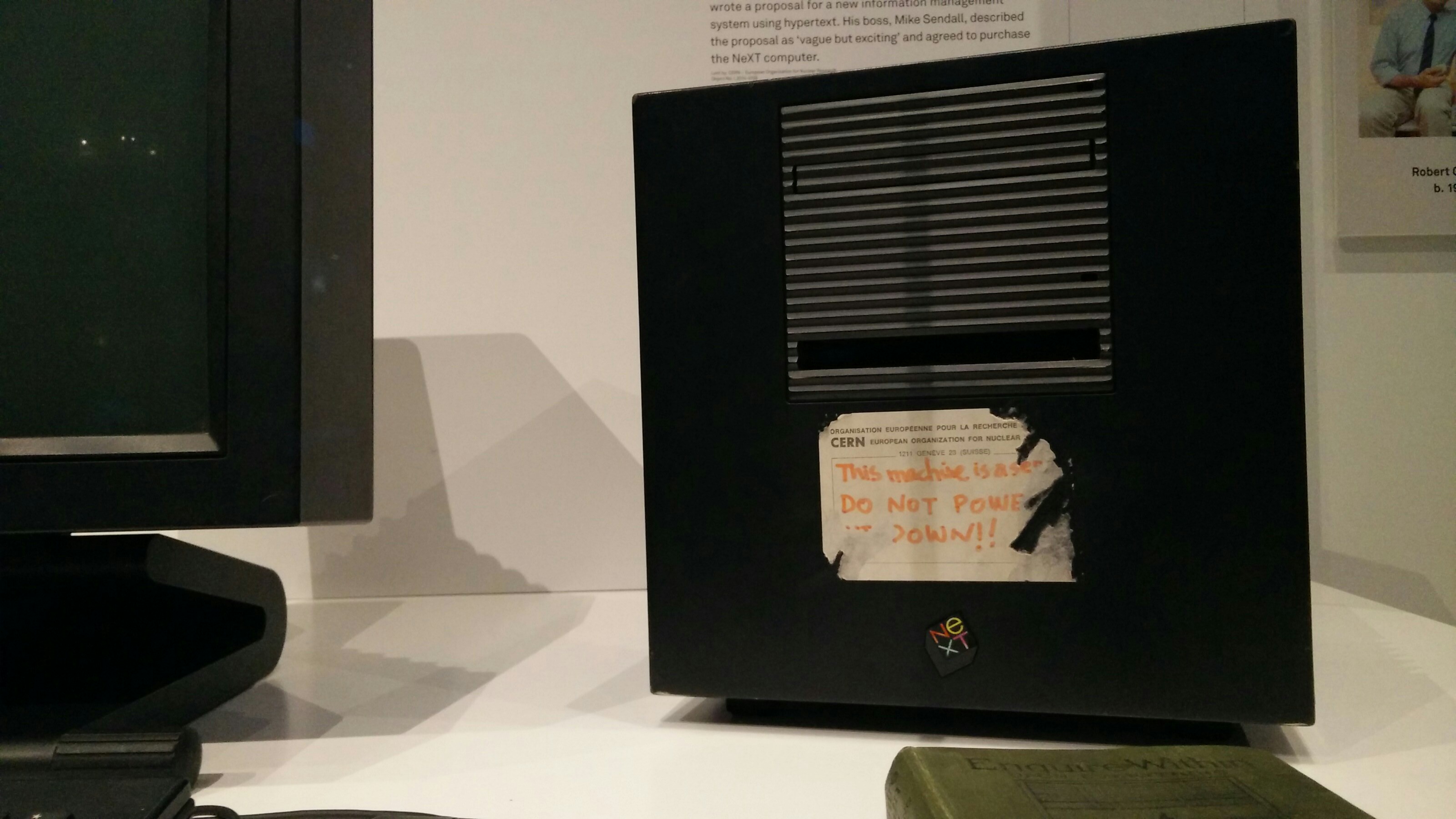
In March 1989 he wrote it up as a memo titled “Information Management: A Proposal,” describing a distributed hypertext system of linked documents.6 His manager, Mike Sendall, scrawled across the top the most famous margin note in computing history – “Vague but exciting” – and, crucially, let him spend time on it.6 Between 1989 and 1991 Berners-Lee turned the vague-but-exciting memo into a working system, and he built the first web server on a NeXT workstation that sat in his office. To keep a colleague from unplugging the machine that was, unbeknownst to most of them, serving the entire web, he taped a label to it in red ink: “This machine is a server. DO NOT POWER IT DOWN!”7 The world’s first website, info.cern.ch, went live in 1991, and in August of that year he announced the software publicly on the alt.hypertext newsgroup.7
The Work
The Three Pillars: URI, HTTP, HTML
The web is not one invention; it is three small ones that compose. Berners-Lee’s genius was not any single piece but the recognition that you needed exactly these three, and no more, and that they had to be simple enough that anyone could implement them.
The first is the URI (the URL is its most common form): a single, universal way to name any resource anywhere, so that one global address space spans every machine on Earth.4 The second is HTTP, the protocol a browser speaks to a server to fetch what a URI names – deliberately stateless and minimal. The third is HTML, a markup language plain enough to write by hand, so the cost of publishing a page was a text editor and nothing else.4 Name it, fetch it, mark it up. That is the entire web, and the radical decision was how little it was. Each piece is the simplest thing that could possibly work, which is precisely why billions of people and machines could implement it without coordinating with anyone – the same “small pieces loosely joined” instinct that the Unix philosophy made famous.
Giving It Away: Royalty-Free and Permissionless
This is the act that mattered most, and it is the one most often forgotten. By the early 1990s rival hypertext and networking systems existed, several of them commercial and licensed. Berners-Lee understood that a web you had to pay to join, or get permission to extend, would never become the web – it would be one walled product among many. So he pushed CERN to do something almost unheard of for a research institution sitting on a valuable invention: give it up entirely.
On 30 April 1993, CERN released the World Wide Web source code into the public domain. The declaration is blunt and total: “CERN relinquishes all intellectual property rights to this code, both source and binary, and permission is given to anyone to use, duplicate, modify and distribute it.”3 He deliberately did not patent the web.38 Had he taken even a modest royalty per server, he would likely have become one of the richest people alive – and the web would almost certainly have died as a niche academic tool, strangled by the licensing friction he was determined to avoid.3
This act of release is the part of engineering most builders never reach. The hard, beautiful work is the protocol; the moral work is choosing terms that keep it open after you no longer control it. Permissionlessness is not an accident of the early web’s chaos – it is a property he engineered in by refusing the only mechanism (a patent) that could have switched it off. Code you give away under irrevocable terms is code that outlives your ownership of it, and that is the only kind of infrastructure worth the name.
Universality, Accessibility, and the W3C
In 1994, having left CERN for MIT, Berners-Lee founded the World Wide Web Consortium (W3C) to steward the web’s standards and keep them open rather than letting any one company fork the web into incompatible proprietary versions.4 He could have run the web as a personal fiefdom. He built a standards body instead – a deliberate dilution of his own authority into a process anyone could participate in.
The W3C is where his commitment to universality became operational. The web had to work regardless of the device, the network, the language, or the user’s abilities – and so accessibility was treated not as a charitable add-on but as a core technical requirement. The Web Accessibility Initiative, launched in 1997, exists because of his flat declaration that access by everyone regardless of disability is essential, not optional.2 A standard that quietly excludes screen-reader users, or low-bandwidth users, or non-English readers, fails the universality test – and failing the universality test means it is not really a web standard at all. This is the same conviction that accessibility is a platform property, not a feature you bolt on later.
Re-decentralizing: Solid and the Fight for the Open Web
Berners-Lee has spent the past decade alarmed by what the web became: not the decentralized commons he designed, but a handful of platforms that pooled the world’s data and attention behind their own walls. His response was characteristic – not a manifesto but a protocol. Solid (from “social linked data”) is a project to re-decentralize the web by giving each person a “pod,” a personal data store they control, so that applications request access to your data on your terms rather than hoarding it on their servers.9 It is the original permissionless principle aimed at the layer the early web never settled: who owns the data.
The through-line from the 1989 memo to Solid is unbroken. The enemy was always the same – a central authority that can switch you off, deny you, or own you – and the answer was always the same: distribute the power so no single party holds the kill switch. In 2016 the ACM recognized the whole arc with the A.M. Turing Award, computing’s highest honor, “for inventing the World Wide Web, the first web browser, and the fundamental protocols and algorithms allowing the Web to scale.”10 (He has also, in a footnote to the story, occasionally let go of artifacts he could have kept: in 2021 he auctioned the original web source code as an NFT.11 The original code, characteristically, remains public.)
The Method
The method is one principle – build it universal, give it away, and keep no kill switch – applied for thirty-five years.
Make it the simplest thing that composes. URI, HTTP, HTML are each minimal on their own; the power is in how they snap together. Berners-Lee resisted the urge to make any one piece clever, because a piece anyone can implement in an afternoon is a piece that spreads to every machine on Earth.4
Universality is the spec, not a feature. The web must work for any device, language, and ability. Accessibility is a correctness criterion, not charity – a standard that excludes anyone is, by definition, unfinished.2
Permissionless by design. To publish or link, you ask no one. There is no registry to approve you and no central authority that can switch you off. This is engineered in, not hoped for, by refusing the mechanisms (patents, licenses, gatekeepers) that would let anyone revoke it.3
Trade ownership for ubiquity. The decisive act was giving the web away royalty-free in 1993 and refusing to patent it. He understood that a thing you own is a product and a thing you irrevocably release is infrastructure – and that the web could only be the latter.38
Dilute your own authority. He founded the W3C rather than ruling the web personally, and built Solid to hand data control back to users. The instinct is consistent: power that sits in one place is a single point of failure, even when that place is you.49
Influence Chain
Who Shaped Him
Vannevar Bush’s Memex. Bush’s 1945 essay “As We May Think” imagined a desk-sized machine that linked documents by association – “trails” the reader could follow – and named the human impulse the web would eventually serve at planetary scale. It is the conceptual ancestor of the hyperlink.12 (Formative influence)
Ted Nelson and hypertext. Nelson coined the word hypertext in the 1960s and spent decades on Project Xanadu, an ambitious linked-document system. Berners-Lee’s web was, in a sense, the deliberately simpler hypertext that actually shipped – where Xanadu chased two-way links and micropayments, the web kept links one-way and free, and that ruthless simplicity is exactly why it spread.13 (Direct influence)
Doug Engelbart. Engelbart’s 1968 “Mother of All Demos” showed live hypertext, the mouse, and collaborative editing decades early – a working proof that documents could be linked and navigated interactively.14 (Formative influence)
The Internet itself – TCP/IP and DNS. Berners-Lee did not build the network; he built on it. The web is an application layer assuming a working packet-switched internet with a name system underneath. He took the hardest infrastructure as given and added the three thin layers that turned a network of machines into a web of documents. (Direct influence)
Who He Shaped
Literally everyone. This is not hyperbole. The web is the substrate of modern commerce, scholarship, journalism, government, and conversation. Few engineers have a blast radius measured in billions of people; he is one.
The open-standards movement. The W3C model – open, royalty-free standards developed in the open – became the template for how the web’s later layers (CSS, the DOM, WebRTC, and more) were built, and a counterweight to every attempt to fork the web into proprietary silos.
The decentralization and data-ownership movement. Solid, the Contract for the Web, and the broader push to give users control of their own data are the direct descendants of his original permissionless design, now aimed at the platform era he helped make possible and came to regret.
The Throughline
Grace Hopper fought to make computing human – to let people address a machine in something closer to their own language rather than its numbers – and Berners-Lee carried that democratizing impulse to its limit, making the machine addressable by everyone, on any device, in any tongue. Where Thompson and Ritchie built Unix from small, sharply scoped pieces that compose – programs that do one thing and pipe into the next – Berners-Lee built the web the same way, from three minimal protocols that snap together, “small pieces loosely joined” at planetary scale. And Alan Kay insisted that the computer is a medium for everyone, a thing to think and create with rather than merely compute on; the web is that conviction made global, a medium anyone can publish into without permission. Four people who refused to let computing stay the property of the few who already had it. (Series bridge)
What I Take From This
The lesson I keep is that the most important engineering decision is often not technical at all – it is the terms. Berners-Lee’s protocols were elegant, but a dozen elegant hypertext systems died in the same decade. The web won because he gave it away under terms no one could revoke, and chose universality over ownership at the exact moment ownership would have made him a fortune. The hard part was not inventing the link. The hard part was refusing to charge for it. That is the same standard as quality being the only variable: the question is never “how do I capture the most value from this?” but “what does the thing actually need to become what it should be?” – and sometimes the honest answer is that it needs you to let go.
In the world I build in now – agents, tools, AI systems – the temptation runs the other way: capture the user’s data, wall off the protocol, become the gatekeeper everyone must route through. Berners-Lee’s discipline is the opposite. Build the universal, permissionless thing; keep no kill switch; dilute your own authority into a standard anyone can implement. When I design how agents discover and link to resources, I keep asking his question – does this require anyone’s permission, and could anyone switch it off? – because taste is a technical system you can interrogate, not a vibe. The throughline from a 1989 CERN memo to a 2026 agent harness is that openness is something you engineer in on purpose, before anyone has the power to take it away.
FAQ
What is Tim Berners-Lee’s engineering philosophy?
Berners-Lee’s conviction is that the web’s power lies in its universality and its permissionlessness: it must work for any device, language, and ability, and anyone must be able to publish and link without asking permission or paying a fee.2 He engineered both properties in by keeping the protocols (URI, HTTP, HTML) as simple as possible so anyone could implement them, and by giving the web away royalty-free in 1993 rather than patenting it – trading personal ownership for universal adoption so that no central authority could ever switch it off.34
Why didn’t Tim Berners-Lee patent the web?
Because a patented web would not have become the web. Berners-Lee understood that any licensing friction – royalties, permissions, gatekeepers – would have driven adopters to rival systems and left the web a niche academic tool. At his urging, CERN released the source code into the public domain on 30 April 1993, declaring that it “relinquishes all intellectual property rights to this code” and granting anyone permission to use, duplicate, modify, and distribute it.3 He explicitly chose not to patent it so the web would stay universal and permissionless forever – a decision that almost certainly cost him a personal fortune and is the reason the web exists as open infrastructure.38
What did Tim Berners-Lee invent, and what are the three pillars of the web?
Between 1989 and 1991 at CERN, Berners-Lee invented the World Wide Web: the first web browser, the first web server (running on a NeXT computer), and the three foundational standards that still run the web today.47 Those three pillars are the URI/URL (a universal way to name any resource), HTTP (the protocol to fetch it), and HTML (a markup language simple enough to write by hand).4 He founded the World Wide Web Consortium (W3C) in 1994 to keep these standards open, and later launched the Solid project to re-decentralize control of personal data.49
Why did Tim Berners-Lee win the Turing Award?
The ACM awarded Berners-Lee the 2016 A.M. Turing Award – computing’s highest honor – “for inventing the World Wide Web, the first web browser, and the fundamental protocols and algorithms allowing the Web to scale.”10 The citation captures the breadth of the achievement: not just the idea of linked documents, but the working browser and server, the URI/HTTP/HTML standards, and the architectural decisions (statelessness, a single global address space, minimal protocols) that let the web grow from one NeXT machine to billions of devices without any central coordinator.
Sources
-
“This is for Everyone: the Tweet Heard Around the World,” W3C News, July 2012. During the 2012 London Olympics opening ceremony (27 July 2012), Berners-Lee tweeted “This is for everyone,” instantly spelled out in LED panels around the stadium. See also the World Wide Web Foundation account and the 2012 Summer Olympics opening ceremony, Wikipedia. ↩↩
-
Tim Berners-Lee, quoted in “World Wide Web Consortium Launches International Program Office for Web Accessibility Initiative,” W3C press release, 22 October 1997. “The power of the Web is in its universality. Access by everyone regardless of disability is an essential aspect.” Collected at Wikiquote, “Tim Berners-Lee.” ↩↩↩↩
-
“Licensing the Web,” CERN. On 30 April 1993 CERN released the World Wide Web software into the public domain; the declaration reads, “CERN relinquishes all intellectual property rights to this code, both source and binary, and permission is given to anyone to use, duplicate, modify and distribute it.” See also “The birth of the Web,” CERN, and “World Wide Web launches in the public domain, April 30, 1993,” History.com. ↩↩↩↩↩↩↩↩↩
-
“Tim Berners-Lee: Longer Biography,” W3C (his own site). Born London, 8 June 1955; BA Hons Physics, The Queen’s College, Oxford, 1976; consultant software engineer at CERN from 1980, fellowship from 1984; proposed the World Wide Web in 1989; wrote the first server (“httpd”) and client (“WorldWideWeb”) in the NeXTStep environment; founded the World Wide Web Consortium in 1994. URI/HTTP/HTML design context: “World Wide Web,” Wikipedia. ↩↩↩↩↩↩↩↩↩↩↩↩
-
“Tim Berners-Lee,” Wikipedia. His parents, Conway Berners-Lee and Mary Lee Woods, were mathematicians who worked on the Ferranti Mark 1, the first commercially available general-purpose electronic computer. ↩
-
Tim Berners-Lee, “Information Management: A Proposal,” CERN, March 1989 (his original proposal, hosted by W3C). His manager Mike Sendall annotated the cover “Vague but exciting.” See the annotated first page at CERN Document Server and “Web at 25: Tim Berners-Lee’s Amazing Proposal Document,” TIME. ↩↩
-
“A short history of the Web,” CERN. The first web server ran on a NeXT computer in Berners-Lee’s office, labeled by hand in red ink “This machine is a server. DO NOT POWER IT DOWN!”; the world’s first website was info.cern.ch; the WWW software was announced on the alt.hypertext newsgroup in August 1991. See also “The world’s first browser/editor, website and server go live at CERN,” CERN timeline. ↩↩↩
-
“World Wide Web,” Wikipedia. Berners-Lee considered the GNU GPL but, after concerns that companies would balk at any licensing terms, ultimately released the web into the public domain without patent restrictions – the decision credited with enabling its rapid, frictionless adoption. ↩↩↩
-
“Solid (web decentralization project),” Wikipedia. Berners-Lee’s project to re-decentralize the web by storing each user’s data in personal “pods” under their own control, with applications requesting access on the user’s terms. Context: “Web inventor Tim Berners-Lee’s Solid data-privacy project enters the real world,” Fortune, November 2020. ↩↩↩
-
“Sir Tim Berners-Lee, Inventor of the World Wide Web, Receives ACM A.M. Turing Award,” ACM, April 2017. 2016 Turing citation: “for inventing the World Wide Web, the first web browser, and the fundamental protocols and algorithms allowing the Web to scale.” See also the ACM Turing Award laureate page. ↩↩
-
“This NFT of the World Wide Web’s source code sold for $5.4 million,” as documented in the Tim Berners-Lee Wikipedia entry: in June 2021 Berners-Lee auctioned an NFT representing the original web source code through Sotheby’s. The underlying source code remains publicly available. ↩
-
Vannevar Bush, “As We May Think,” The Atlantic, July 1945 (as documented at Wikipedia). Bush imagined the “memex,” a desk-sized device that stored documents on microfilm and let a user link them by association into named “trails” the reader could follow – the conceptual ancestor of the hyperlink. ↩
-
“Ted Nelson,” Wikipedia. Nelson coined the terms hypertext and hypermedia in 1963 and published them in 1965 (in “Complex Information Processing: A File Structure for the Complex, the Changing, and the Indeterminate,” ACM National Conference). He spent decades on Project Xanadu, an ambitious linked-document system. ↩
-
“The Mother of All Demos,” Wikipedia. Douglas Engelbart’s 9 December 1968 demonstration of the oN-Line System (NLS) at the Fall Joint Computer Conference introduced hypertext, the computer mouse, dynamic file linking, and a collaborative real-time editor. ↩