Loom: Friendly Professionalism Through Rounded Warmth
How Loom's custom Charlie typeface and bubble motif create approachable B2B design that makes async video feel human.
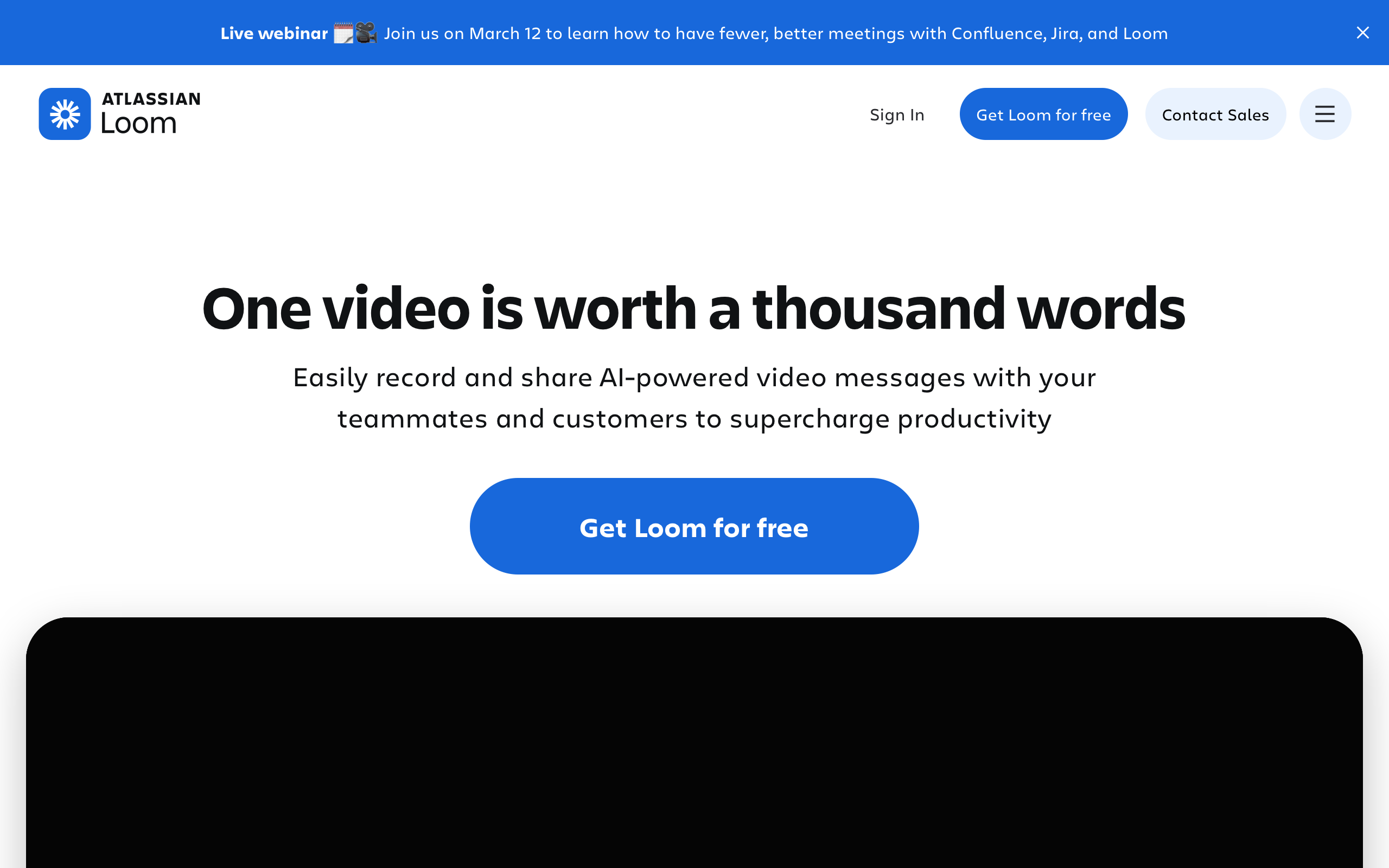
Loom: Friendly Professionalism Through Rounded Warmth
“Video is faster than meetings and clearer than text.” — Joe Thomas, Loom Co-founder
Loom was built on a simple conviction: most workplace meetings exist because text communication lacks nuance. Tone, facial expression, screen context — all lost in a Slack message. The solution was to make recording a screen video as frictionless as typing, then sharing it as a link. Click record, talk through it, share. The recipient watches on their own time. Atlassian validated this category with a $975M acquisition in 2023, and Loom has since leaned into AI features — automatic transcripts, summaries, chapters — that reinforce the async philosophy. You don’t even need to watch the full video if the AI summary captures the key points.
Key Takeaways
- Custom typography defines brand personality - Loom’s commissioned Charlie typeface family creates a warmth that no system font or popular open-source face can replicate
- Rounded geometry signals approachability - Generous border-radius values, pill-shaped buttons, and circular motifs soften what could be cold enterprise software
- A single accent color maintains clarity - Brand purple appears exclusively on interactive elements, creating an unambiguous “this is clickable” signal
- Eating your own dog food builds credibility - The marketing site uses embedded Looms to demonstrate the product, proving the tool’s value through its own medium
- Restraint in the recorder builds adoption - No timeline, no transitions, no effects panel. The recording UI is intentionally simple because complexity would undermine the “faster than a meeting” promise
Why Loom Matters
Loom proved that a communication tool could carve out a category between text and meetings. Where Slack is text-first and Zoom is synchronous, Loom occupies the async video space — rich enough to convey nuance, lightweight enough to replace a quick call. The design challenge was making video recording feel as natural as typing, and the visual identity plays a critical role in that perception.
Key achievements:
- Made async video a mainstream workplace communication pattern
- Created a brand identity that feels human in the enterprise B2B space
- Commissioned a custom typeface family that became the product’s most distinctive design asset
- Built a visual language around the circular webcam bubble that carries through the entire brand
- Demonstrated that friendly aesthetics and enterprise credibility are not mutually exclusive
Core Design Principles
1. The Charlie Typeface: Personality Before Content
Loom’s most distinctive design decision is the custom Charlie typeface family — Charlie Display for headlines, Charlie Text for body. The rounded terminals and generous x-height create a softness that sets Loom apart from the sharp geometric sans-serifs (Inter, Geist, SF Pro) that dominate B2B SaaS.
CHARLIE vs. GEOMETRIC SANS:

Charlie Display (Loom):     Inter / SF Pro (typical SaaS):
┌───────────────────────┐   ┌───────────────────────┐
│  Rounded terminals    │   │  Sharp terminals       │
│  Generous x-height    │   │  Standard x-height     │
│  Friendly, warm feel  │   │  Precise, neutral feel │
│  Brand-exclusive      │   │  Used by everyone      │
└───────────────────────┘   └───────────────────────┘
The typographic hierarchy reinforces this warmth with density. H1 headlines at 56.5px/700 weight use an extremely tight line-height of 1.03 — the lines nearly touch, creating impactful poster-like headline blocks. Negative letter-spacing scales with size: -0.5px at H1, -0.3px at H2, -0.2px at H3. Larger text gets tighter, maintaining optical consistency. After the distinctive headlines, body text at a standard 16px/24px returns to convention. The personality lives in the headings; the body stays readable.
2. The Bubble Metaphor: Circles Everywhere
The circular webcam overlay from Loom’s recording UI — the small face bubble that sits in the corner of every Loom video — became the brand’s central motif. This circle carries through every surface: rounded avatars, circular progress indicators, pill-shaped buttons, and generous border-radius on cards (8-16px).
THE BUBBLE AS BRAND:

Recording UI:                  Brand Language:
┌──────────────────────┐      ┌──────────────────────┐
│                      │      │  ● Circular avatars   │
│    Screen content    │      │  ◉ Progress rings     │
│                      │      │  ╭──────────────────╮ │
│              ┌────┐  │      │  │  Pill-shaped CTA │ │
│              │ 😊 │  │      │  ╰──────────────────╯ │
│              └────┘  │      │  ╭─────────────────╮  │
└──────────────────────┘      │  │  Rounded cards   │  │
                              │  ╰─────────────────╯  │
The webcam bubble              └──────────────────────┘
says "there's a                  Circles everywhere
human behind this"
Where Linear and Stripe use sharp corners to signal precision, Loom uses curves to signal accessibility. No sharp corners exist in the brand language. This creates a tactile, approachable feel that lowers the barrier to adoption — important for a tool that asks people to record themselves on camera.
3. Purple as Action, Not Decoration
Loom’s brand purple (#625DF5) threads through CTAs, hover states, and interactive elements — but never appears as decoration. This restraint maintains a clear semantic signal: purple means clickable. The darker variant (#4E49D7) provides hover feedback, and the playback progress bar uses the same brand purple, connecting the marketing experience to the product experience.
4. Light and Bright, Always
The marketing site is predominantly white backgrounds with dark text (#292A2E) and restrained purple accents. Even the video player uses a white page surround rather than the YouTube-style dark treatment. This is a deliberate departure from the dark-mode trend in SaaS. Loom’s brightness signals openness and simplicity — the visual equivalent of saying “anyone can use this.”
The shadow system follows the same restraint: cards at 0 2px 8px rgba(0,0,0,0.08), dropdowns at 0 4px 16px rgba(0,0,0,0.12), and hero video previews at 0 8px 24px rgba(0,0,0,0.15). Moderate depth, never dramatic.
Transferable Patterns
The most transferable element from Loom’s design is the strategy of using a single visual motif as brand identity. The circle that began as a functional UI element (the webcam bubble) became the organizing principle for the entire visual language. Any product can identify its signature interaction and extend it into a design language.
A CSS implementation of Loom’s friendly professional system demonstrates how few variables create the entire personality:
:root {
  /* Loom's friendly professional palette */
  --color-background: rgb(255, 255, 255);
  --color-text: rgb(41, 42, 46);
  --color-text-secondary: rgb(107, 111, 118);
  --color-purple: rgb(98, 93, 245);
  --color-purple-dark: rgb(78, 73, 215);
  --color-surface: rgb(247, 248, 250);
  --color-border: rgb(228, 230, 235);

  /* Shadows — moderate depth */
  --shadow-card: 0 2px 8px rgba(0, 0, 0, 0.08);
  --shadow-dropdown: 0 4px 16px rgba(0, 0, 0, 0.12);

  /* Typography — custom rounded face */
  --font-display: "Charlie Display", -apple-system, sans-serif;
  --font-body: "Charlie Text", -apple-system, sans-serif;

  /* Border radius — generous rounding */
  --radius-sm: 8px;
  --radius-md: 12px;
  --radius-lg: 16px;
  --radius-pill: 999px;
}
The pill-shaped CTA is the pattern most directly associated with Loom’s rounded aesthetic. The full border-radius combined with the brand purple creates a button that feels inviting rather than demanding:
.button-primary {
  background-color: var(--color-purple);
  color: white;
  border-radius: var(--radius-pill);
  padding: 12px 24px;
  font-family: var(--font-body);
  font-weight: 600;
  transition: background-color 0.15s ease;
}
.button-primary:hover {
  background-color: var(--color-purple-dark);
}
In SwiftUI, the bubble overlay — Loom’s signature element — translates naturally with a white stroke circle and a subtle shadow that lifts it from the content beneath:
// Video bubble overlay — Loom's signature element
Circle()
    .fill(Color(red: 98/255, green: 93/255, blue: 245/255))
    .frame(width: 48, height: 48)
    .overlay(
        Circle().stroke(.white, lineWidth: 3)
    )
    .shadow(color: .black.opacity(0.15), radius: 8, y: 4)
The card pattern extends the rounded philosophy with generous corner radius and light shadows:
struct FriendlyCard<Content: View>: View {
    let content: () -> Content

    var body: some View {
        content()
            .padding()
            .background(.white)
            .clipShape(RoundedRectangle(cornerRadius: 16))
            .shadow(color: .black.opacity(0.08), radius: 8, y: 2)
    }
}
Design Lessons
Use a custom typeface as a brand moat. Charlie is exclusive to Loom. No competitor can replicate the typographic feel without creating their own commissioned face. For products that can afford it, a custom typeface is a more durable brand differentiator than a color palette or logo.
Let a functional element become the brand motif. The webcam bubble wasn’t designed as a brand element — it was a product necessity. Loom recognized its distinctiveness and extended it. Look for the functional elements in your product that are already recognizable and amplify them.
Rounded does not mean unserious. Loom serves enterprise customers (Atlassian-owned, used by large organizations) with a design language that is deliberately soft and warm. The rounded typography and curves lower adoption barriers without sacrificing credibility.
Restrain your accent color. Purple appears only on interactive elements. This discipline means every purple element communicates “you can click this” without any additional affordance needed.
Avoid complexity in recording tools. Loom has no timeline, no transitions, no effects. This is not a limitation but a design decision — complexity would undermine the “faster than a meeting” promise that drives adoption.
Frequently Asked Questions
What makes Loom’s design distinctive compared to other B2B SaaS products?
The custom Charlie typeface family is Loom’s strongest differentiator. Where most B2B products use Inter, SF Pro, or another geometric sans-serif, Charlie’s rounded terminals and generous x-height create immediate visual warmth. Combined with the circular bubble motif and pill-shaped buttons, the design feels approachable in a space that typically defaults to sharp, precise aesthetics.
How does Loom balance friendliness with enterprise credibility?
Loom uses warmth in visual elements (rounded typography, soft shadows, generous border-radius) while maintaining restraint in structure (clean layout, minimal navigation, white backgrounds). The brand purple appears only on interactive elements, never as decoration. This combination reads as professional but not cold — serious enough for an Atlassian acquisition, friendly enough for anyone to record their first video.
Why did Loom choose a light theme instead of following the dark-mode trend?
The light, bright aesthetic signals openness and simplicity. Loom’s core challenge is convincing people to record themselves on camera — a vulnerable act for many. A dark, developer-oriented aesthetic would raise the perceived barrier to entry. The white backgrounds and soft shadows communicate “this is easy, anyone can do it.”
What can designers learn from Loom’s recording interface?
The recording UI demonstrates radical simplicity: a record button, a camera toggle, and done. No timeline, no transitions, no editing tools. This restraint is the design lesson — every feature added to a creation tool raises the perceived effort required to use it. Loom optimized for the 3-minute “quick Loom” use case, not the 30-minute produced video.
References
- Loom Homepage — Product overview and marketing design
- Loom Product Page — Feature details and embedded Loom demonstrations
- Loom Blog — Product updates and design evolution
- Atlassian Acquisition Announcement — Context on Loom’s enterprise validation
- Loom on Product Hunt — Launch history and community reception
- Charlie Typeface — Custom commissioned for Loom (not publicly available)











