Balatro: Juicy Feedback in a Poker Roguelike
How Balatro won Apple Design Award 2025 with CRT scanlines, card physics, score animation, and feedback loops that make poker math feel electric on screen.
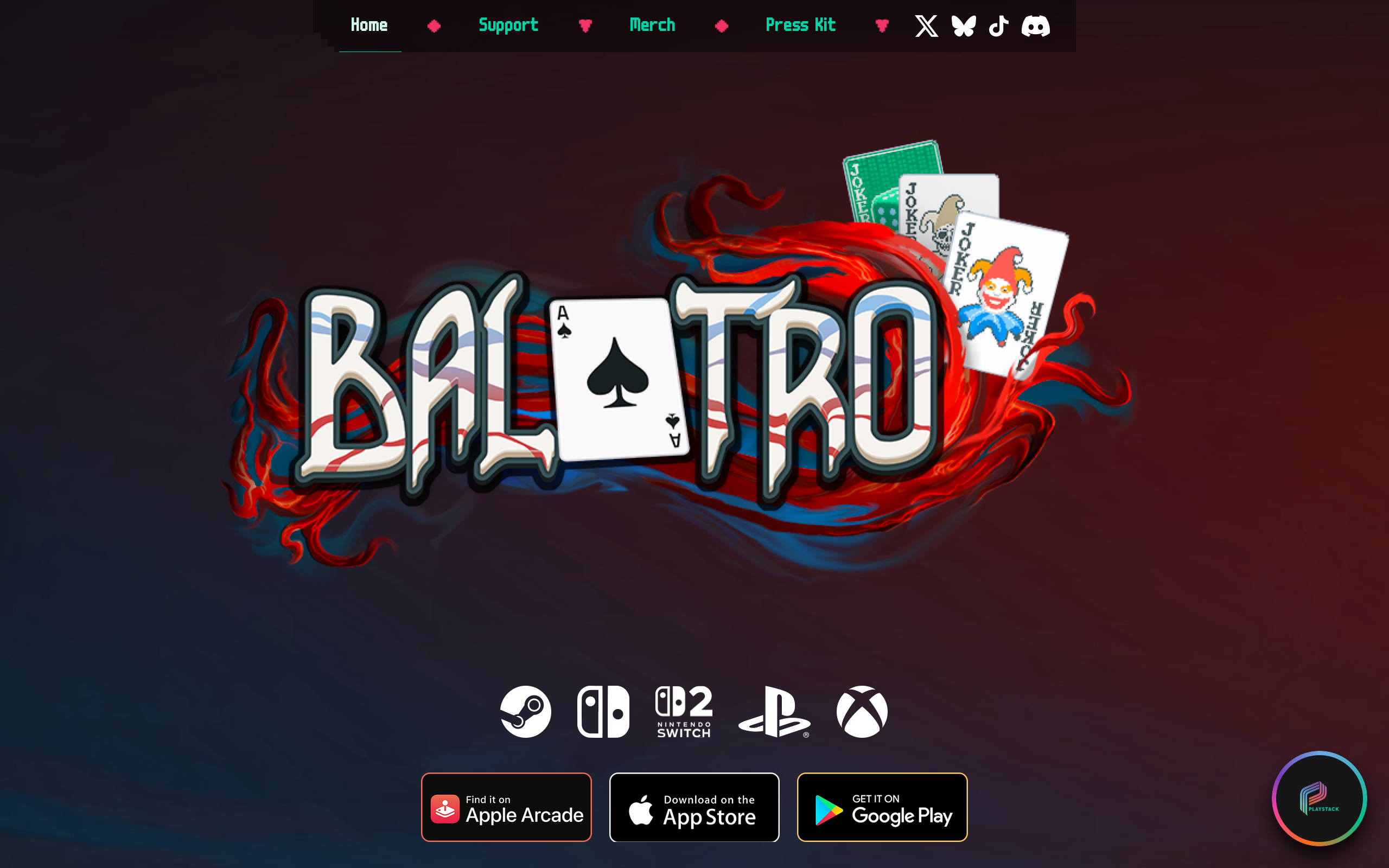
Balatro: Juicy Feedback in a Poker Roguelike
Every interaction should feel rewarding. When players repeat thousands of hands, the feedback loop itself becomes the game. — Design philosophy behind Balatro
Balatro is a poker-themed roguelike deckbuilder that won an Apple Design Award in 2025 after major 2024 awards recognition. Created by LocalThunk, a solo developer working under a pseudonym, it transforms the dry mathematics of poker hand evaluation into a visceral, screen-shaking experience. The game proves that visual feedback design is not decoration — it is the core product. Every chip scored, every multiplier triggered, every Joker synergy discovered is communicated through layered animation, particle effects, and audio cues that make arithmetic feel like fireworks.
What makes Balatro remarkable for designers is that the underlying system is just math. Poker hands have point values, Jokers add multipliers, and you try to hit score thresholds. The entire experience gap between “spreadsheet” and “dopamine machine” is bridged by feedback design.
Why Balatro Matters
A solo developer created one of the most recognized indie games of 2024 with a visual identity shaped by constraint. The CRT aesthetic was born from limitation, not a big art pipeline.
Key achievements:
- Apple Design Award 2025 winner
- Multiple major 2024 awards and Game of the Year nominations
- 2 million+ copies sold within six months of launch
- Crafted by LocalThunk, described by Apple as a solo developer working under a pseudonym
- Nominated for Best Art Direction despite deliberately lo-fi visuals
Key Takeaways
- Feedback is the product, not the polish - Strip Balatro’s animations and sounds and you have a calculator; the juice IS the game, not a layer on top of it
- Constraint breeds identity - The CRT scanline aesthetic emerged from a solo dev working within limitations, and it became the most recognizable visual identity in indie games
- Synergy visualization builds mastery - Showing players exactly which cards triggered which bonuses turns opaque math into learnable systems
- Layered feedback creates perceived depth - Screen shake + particle burst + number animation + sound effect = one moment that feels three-dimensional
- Retro aesthetics earn trust through consistency - Every element commits to the CRT fiction — menus, cards, backgrounds, even the pause screen warps like a tube monitor
Core Design Principles
1. The Juice Stack
Balatro layers multiple feedback channels on every scoring event. No single channel carries the experience alone — they stack multiplicatively, just like the game’s scoring.
SCORING A FLUSH (5 cards, base 175 chips)

LAYER 1: Card Animation
  Cards slide from hand → scoring area
  Each card flips with a spring bounce
  Slight rotation randomness (±3deg) for organic feel

LAYER 2: Chip Counter
  Numbers don't just appear — they ROLL
  Each digit spins like a slot machine reel
  Blue chip count rolls up, then red multiplier kicks in

LAYER 3: Screen Effects
  Screen shake intensity scales with score magnitude
  CRT scanlines intensify momentarily
  Background color pulses toward the hand's color

LAYER 4: Particle System
  Chips burst from scored cards
  Trail particles follow the score as it flies to the total
  Color matches the poker hand type

LAYER 5: Audio
  Each card plays a rising pitch note (C, D, E, F, G for 5 cards)
  Multiplier trigger has a distinct "ka-ching" layer
  Score threshold reached = bass drop + screen flash
CSS implementation of the score roll effect:
.score-digit {
  display: inline-block;
  overflow: hidden;
  height: 1.2em;
}

.score-digit-inner {
  transition: transform 0.4s cubic-bezier(0.34, 1.56, 0.64, 1);
}

/* Each digit rolls independently with staggered timing */
.score-digit:nth-child(1) .score-digit-inner { transition-delay: 0ms; }
.score-digit:nth-child(2) .score-digit-inner { transition-delay: 50ms; }
.score-digit:nth-child(3) .score-digit-inner { transition-delay: 100ms; }
.score-digit:nth-child(4) .score-digit-inner { transition-delay: 150ms; }

/* The roll: translate Y to show the target digit */
.score-digit-inner[data-value="7"] {
  transform: translateY(-840%); /* 7 * 120% per digit height */
}
2. CRT Scanline Aesthetic as Brand Identity
Balatro’s entire visual language is built on the fiction of a CRT monitor. This is not a filter applied on top — it is the foundational design decision that every other visual choice flows from.
/* Balatro-style CRT overlay */
.crt-container {
  position: relative;
  background: #1a1a2e;
  border-radius: 12px;
  overflow: hidden;
}

/* Scanline overlay */
.crt-container::before {
  content: "";
  position: absolute;
  inset: 0;
  background: repeating-linear-gradient(
    to bottom,
    transparent 0px,
    transparent 2px,
    rgba(0, 0, 0, 0.15) 2px,
    rgba(0, 0, 0, 0.15) 4px
  );
  pointer-events: none;
  z-index: 10;
}

/* Subtle screen curvature via vignette */
.crt-container::after {
  content: "";
  position: absolute;
  inset: 0;
  background: radial-gradient(
    ellipse at center,
    transparent 60%,
    rgba(0, 0, 0, 0.4) 100%
  );
  pointer-events: none;
  z-index: 11;
}

/* Phosphor glow on text/elements */
.crt-text {
  color: #e8e8e8;
  text-shadow:
    0 0 2px rgba(255, 255, 255, 0.5),
    0 0 8px rgba(100, 200, 255, 0.15);
}
What makes this work as identity, not gimmick:
- Scanlines are always present, not toggled — they are the world, not a filter
- The curvature vignette is subtle enough to not distort gameplay
- Card art is designed FOR the scanlines — pixel art at the right resolution to alias cleanly
- Menu screens, shop screens, and pause screens all maintain the CRT fiction
- Even the game’s logo warps as if displayed on a curved tube
3. Synergy Visualization as Teaching Tool
The most important design innovation in Balatro is how it shows players WHY their score happened. When a hand is played, each scoring element activates sequentially with visual callouts.
HAND PLAYED: 4 Kings

Step 1: Base hand evaluated
  "Four of a Kind" label appears
  Base: 60 chips × 7 mult

Step 2: Each Joker triggers in order (left to right)
  ┌─────────┐  ┌─────────┐  ┌─────────┐
  │ Joker 1 │→ │ Joker 2 │→ │ Joker 3 │
  │ +4 mult │  │ ×1.5    │  │ +30chips│
  │ (pulse) │  │ (pulse) │  │ (pulse) │
  └─────────┘  └─────────┘  └─────────┘
  Each Joker physically bounces when it activates
  Running total updates after each trigger

Step 3: Final score animation
  90 chips × 15.0 mult = 1,350
  Score flies to the chip total with trail particles

THE CRITICAL INSIGHT:
  By showing each Joker trigger individually,
  players learn which combinations matter.
  This replaces a 10-page tutorial with
  300ms of sequential animation.
Design Patterns Worth Stealing
Screen Shake as Information Design
Balatro uses screen shake not just for “feel” but as a data channel. Shake intensity communicates score magnitude before the number even appears. Players develop an instinctive sense of “that was a big hand” from the shake alone.
/* Score-proportional screen shake */
@keyframes shake-small {
  0%, 100% { transform: translate(0, 0); }
  25% { transform: translate(-2px, 1px); }
  50% { transform: translate(1px, -2px); }
  75% { transform: translate(-1px, 2px); }
}

@keyframes shake-medium {
  0%, 100% { transform: translate(0, 0); }
  20% { transform: translate(-4px, 3px); }
  40% { transform: translate(3px, -4px); }
  60% { transform: translate(-3px, 2px); }
  80% { transform: translate(4px, -3px); }
}

@keyframes shake-large {
  0%, 100% { transform: translate(0, 0); }
  10% { transform: translate(-8px, 6px) rotate(-1deg); }
  30% { transform: translate(6px, -8px) rotate(0.5deg); }
  50% { transform: translate(-6px, 4px) rotate(-0.5deg); }
  70% { transform: translate(8px, -6px) rotate(1deg); }
  90% { transform: translate(-4px, 8px) rotate(-0.5deg); }
}

/* Apply based on score magnitude */
.game-container.shake-small { animation: shake-small 0.2s ease-out; }
.game-container.shake-medium { animation: shake-medium 0.3s ease-out; }
.game-container.shake-large { animation: shake-large 0.5s ease-out; }
function triggerScoreShake(score) {
  const container = document.querySelector('.game-container');
  let shakeClass;

  if (score > 10000) shakeClass = 'shake-large';
  else if (score > 1000) shakeClass = 'shake-medium';
  else shakeClass = 'shake-small';

  container.classList.add(shakeClass);
  container.addEventListener('animationend', () => {
    container.classList.remove(shakeClass);
  }, { once: true });
}
Card Physics That Communicate State
Cards in Balatro are never static. They hover, tilt toward the cursor, and have subtle parallax on their foil layers. This constant micro-motion makes the hand feel alive and the cards feel like physical objects.
/* Card hover with parallax tilt */
.card {
  transition: transform 0.15s ease-out, box-shadow 0.15s ease-out;
  transform-style: preserve-3d;
  cursor: pointer;
}

.card:hover {
  transform: translateY(-12px) scale(1.05);
  box-shadow:
    0 12px 24px rgba(0, 0, 0, 0.4),
    0 0 20px rgba(100, 150, 255, 0.15);
}

/* Selected card lifts higher */
.card.selected {
  transform: translateY(-24px) scale(1.08);
  box-shadow:
    0 20px 40px rgba(0, 0, 0, 0.5),
    0 0 30px rgba(255, 200, 50, 0.3);
}

/* Foil/holographic shimmer on special cards */
.card.foil::after {
  content: "";
  position: absolute;
  inset: 0;
  background: linear-gradient(
    135deg,
    transparent 20%,
    rgba(255, 255, 255, 0.1) 40%,
    rgba(200, 220, 255, 0.2) 50%,
    rgba(255, 255, 255, 0.1) 60%,
    transparent 80%
  );
  background-size: 200% 200%;
  animation: foil-shimmer 3s ease-in-out infinite;
  border-radius: inherit;
  pointer-events: none;
}

@keyframes foil-shimmer {
  0% { background-position: 200% 200%; }
  50% { background-position: 0% 0%; }
  100% { background-position: 200% 200%; }
}
Color as Scoring Language
Balatro assigns distinct colors to chips (blue) and multipliers (red). This two-color system means players can instantly parse any scoring display without reading labels.
BALATRO'S SCORING COLOR SYSTEM

  Blue (#009dff)  = Chips (base value)
  Red  (#fe5f55)  = Multiplier
  Gold (#f0c040)  = Money/economy
  Green (#50c878) = Hand remaining
  Purple (#9b59b6)= Planet cards (hand upgrades)

Every number in the game uses this palette.
No labels needed — color IS the label.
The Verdict
Balatro is the definitive case study in feedback design. It proves that “game feel” is not subjective polish — it is a designable, layerable system. Every interaction in Balatro passes through the juice stack: animation, particles, screen effects, audio, and haptics. Remove any one layer and the game still works. Remove all of them and you have a spreadsheet. The gap between those two experiences is the entire value proposition, and it came from a creator who understood that how something feels is how it IS.
Best for learning: Layered feedback systems, score visualization, constraint-driven aesthetic identity, and how to make mathematics feel like magic through animation timing and screen effects.
Frequently Asked Questions
What makes Balatro’s visual feedback different from other games?
Most games add feedback as polish at the end of development. Balatro’s feedback IS the design — the sequential Joker activation, score rolling, and screen shake were built alongside the scoring system, not layered on after. Each feedback channel (visual, audio, haptic, motion) carries independent information, so they stack multiplicatively rather than redundantly.
Why does the CRT aesthetic work when retro filters usually feel gimmicky?
Balatro commits totally to the CRT fiction. Scanlines are not a toggle or a filter — they are the world. Card art is pixel-crafted to alias cleanly with the scanline resolution. Menus, shops, and even the pause screen maintain the curvature and phosphor glow. When an aesthetic is the foundation rather than a coat of paint, it reads as identity rather than nostalgia bait.
How does Balatro teach its complex scoring system without tutorials?
Sequential Joker activation is the key. When a hand is scored, each Joker visually pulses in order (left to right) with its contribution displayed. Players see the running total update after each trigger. This 300ms animation replaces pages of documentation by showing causality directly. After a few hands, players intuitively understand which Jokers synergize without reading tooltip text.
What can web designers learn from Balatro’s approach?
The score digit roll, screen shake as data channel, and color-as-label system all translate directly to web interfaces. Dashboard numbers that roll to their target value, subtle container shake on error states, and consistent color coding for data types are all patterns Balatro executes at the highest level. The core lesson: feedback should be proportional to significance.
How did a solo developer achieve award-winning art direction?
Constraint. LocalThunk chose a CRT aesthetic partly because pixel art at low resolution is feasible for one person. The scanline overlay, vignette, and phosphor glow add perceived fidelity without requiring high-resolution assets. The lesson for small teams: choose an aesthetic that your constraints make possible, then commit to it completely.











