Still Rooms: AI Composition, Not AI Generation

This post has not been translated yet, so you are reading the English original. Read it at the English URL
Still Rooms is a ten-piece ambient album that plays inside Return, my meditation timer, and sits on Apple Music under the name Dream of Electric.1 No one played it, and no model generated its audio. Claude wrote the score, note by note, as code, under twelve rules taken from a study of Hiroshi Yoshimura’s records, with every rule either tested or built into the code that writes the notes, and every place the code bends one named. The score is ten Standard MIDI files that Logic Pro opens with their tempo, key and section markers. The sound came from a sampled 1977 Rhodes and three instruments written for the album, through a renderer whose output is reproducible to the sample. That is the difference between AI generation and AI composition. It is why the surround bed is a real 7.1.4 mix rather than an upmix, and why the whole record can be criticized, revised and credited the way written music can.
This is the case study: what was asked for, what the research found, how a piece is written, what Logic sees, what went wrong in the first revision, what the instruments are, how the files were mastered and spatialized, and how the album got into the app and onto the stores.
The difference in one table
Suno makes ambient music I like. I have written a guide to its tags and I still use it.2 For a room that people sit in for forty minutes it was the wrong tool, and the reasons have nothing to do with how it sounds.
| Generation (Suno, Udio and the audio models) | Composition (this album) | |
|---|---|---|
| What goes in | a text prompt, a style field, optional lyrics or audio, and a person choosing takes | a brief, a study of one composer, twelve rules, and a person listening |
| What comes out | a waveform | a score, then a waveform rendered from it |
| The notes | not in a generated song; transcribing it to notes is a model’s reading of the sound, and the MIDI clips Suno’s Studio writes from the chat bar and plays on its own synth are a score, the same kind of thing this piece argues for, offered inside a generation tool3 | 3,990 notes in ten readable files |
| Change one note | regenerate the span, and the new take can change more than the one note; in a Studio MIDI clip, move the note | change one number and re-render; every other note stays as written |
| Stems | split out on request after generation, twelve categories or picks from nearly a hundred instruments on Suno’s top tier,3 and never written as separate parts | one bus per instrument from the source |
| The instruments | implied by the audio | named: a Rhodes Mark I sample set, a glass pad, an FM bell, an FM mallet |
| Reproducible | not from a hosted service; seed-dependent at best for an open model | seeded, to the sample |
| What is in the file | whatever the model learned to produce | the score, rendered through four named instruments over a tape-hiss bed written in code, and nothing else |
| What the stores’ AI tags were written for | this | a question the release section takes up |
The note count is every note-on across the instrument tracks of the ten MIDI files. The pieces range from 75 notes (Snow Street, three minutes and fifty-two seconds) to 634 (Paper Boat and Night Train). An album where one piece holds seventy-five notes is an album where each note can be found and answered for.
The obvious objection is that a model wrote every note, so this is AI-made music by any ordinary meaning, in a file format that happens to be editable. That is right, and the title does not argue with it. Composition here is not a claim of less AI. It is a claim of more disclosure. The model’s output is a score, and a score can be read, so whoever holds the files and the kept first revision can see exactly what the model wrote and what changed afterward. A generated waveform hides both. The difference is not how much of the work was a machine’s. It is whether the work can be audited.
The brief: a room, not a track
Return is a timer with five rooms. You pick a length, a room and a bell, and the app gets out of the way. Three of the rooms are loops (water, fire and forest), and one is silence. The fifth needed music, and the music had a job description that most music fails: it has to sit under a person who is trying not to listen to it, for as long as they sit, and then let a bell through.
Hiroshi Yoshimura spent his life writing for exactly that condition. His first album was made for, and first played in, a museum in Shinagawa,4 and he went on to design sound for show homes, for shopping malls, for a subway line, for an airport in Osaka, and for a funicular whose written score climbs at the same incline as the mountainside,5 and he described what he wanted from his own records in terms no pop composer would use. Surround, his 1986 record for Misawa Homes, was meant to be “as close to air itself”. Its “volume should not become a hindrance to a conversation”, and it belonged in the same family of sounds “as the vibration of footsteps, the hum of an air conditioner, or the clanging of a spoon inside a coffee cup.”6 His pieces for Nine Post Cards came from “the movement of clouds, the shade of a tree in summer time, the sound of rain, the snow in a town”, and in that music “a short refrain is played over and over while it changes its form gradually just like clouds or waves.”4 Satoshi Ashikawa, whose Still Way sat beside Nine Post Cards in the Wave Notation series, composed music “intended to be listened to in a casual manner, as a musical landscape or a sound object”, music that “should drift like smoke and become part of the environment.”7
That was the brief. Ten pieces after Yoshimura, written for the room a person sits in when they open the app. Listenable in order as a record. Usable one at a time under a session. Quiet enough that a guide’s voice, or the bell, is never fought. And every piece ends by thinning to nothing, so one piece hands to the next without a cut, and a sit that ends mid-piece ends on the bell’s fade.
The word “after” is doing honest work. The album samples nothing of his. The rules below come from published descriptions of his method and from his own liner notes, and then from listening.
The research came before the notes
The first thing Claude produced was not music. It was a study: who Yoshimura was, what he believed, what each record is, what the sources establish about his musical language, and, separately labeled, what is the study’s own analysis rather than a sourced fact. The study runs to about forty references, from the Light in the Attic reissue notes to the review of the 2023 retrospective at The Museum of Modern Art, Kamakura & Hayama,5 and it keeps those two kinds of claim apart on purpose. “Home recorded on a minimal setup of keyboard and Fender Rhodes” is a sourced fact.4 Harmony that lives in a major key or its relative minor and moves among two to four diatonic chords with seventh and ninth color is analysis, and the document says so.
What the sources establish is specific enough to build on:
- Instruments. A Fender Rhodes with “long, pure tones on an unspecified synth” in 1982.8 Yamaha DX7, TX7 and FB-01 synthesizers on Green, recorded over the winter of 1985 to 1986, FM instruments “known for their crisp digital tones”,9 with marimba notes opening Surround.6
- Form. One figure per piece, “with its own distinct rhythmic signature, alternating between two or more harmonic iterations” or “passing through a recognizable harmonic sequence”.8 In his own words, “a short refrain is played over and over while it changes its form gradually”.4
- Nature. None on Green as he preferred it. The stream and birdsong that open the American CD of Green were added for that edition, which Light in the Attic describes as “a limited edition remixed version of the album, with added sound effects”. The 2020 reissue restores “the original mix preferred by Yoshimura himself”.9
- Titles. One or two plain words of weather, light, time or a view.
The study lists density among its sourced findings, from a review of Green: he “rarely employs more than three synthesizers at one time”, “often eschews chords for the simplicity of a single note”, and “the patches being played never compete for sonic space”.10
The study then became rules, and the rules became tests. That order is the whole method.
Twelve rules, and the tests that hold them
| Rule | What it says | How it is checked |
|---|---|---|
| Parts | at most three pitched voices, counting a low struck tone as a voice; no drum kit; no bass line | by construction: one figure, one melody, and one or two sustains that never overlap, except Night Train’s, below; the test holds two to four tracks, none on the drum channel |
| Registers | figure G3 to G5, melody D5 to A6, sustain D2 to A4 | every note of every track inside its role’s range |
| The figure | one cell per piece with a fixed velocity contour, changing only by subtraction, addition or transposition, on four-bar boundaries, with the exceptions named below | by construction, and by the velocity bands |
| Harmony | two to four diatonic chords every four or eight bars; no dominant chains | by construction |
| Melody | long tones only; at most twenty melody notes in any sixteen bars | every melody note about a beat or longer, with 0.95 of a beat as the floor; a sixteen-bar window checked every four bars |
| Tempo and length | 50 to 80 BPM; three and a half to seven minutes | asserted per piece |
| Time | the grid, a fixed lean, a hand’s roll, or a fixed timing curve that repeats every cell; nothing random | every onset within 45 ms after or 12 ms before a sixteenth; Night Train’s deviations drawn only from its curve |
| Velocity | figure 40 to 60, melody 48 to 66, sustain 34 to 50 | asserted per note |
| Effects | reverb two to four seconds; echo on a quarter, a dotted eighth or a dotted quarter with feedback under 0.4; no distortion, no nature sounds | by construction |
| Silence | at least two consecutive bars with the sustain alone or nothing | computed from the score |
| Loudness | -18 to -16 LUFS by the renderer’s meter, peaks at or below -3 dBFS | measured on the render |
| Titles | one or two plain words | asserted |
One piece bends the first rule. Night Train carries its low struck tone under the cell, the melody and the pad through its Sky sections, which is four voices by the study’s own count, and the test admits the fourth track. It stayed because the low tone is the piece’s device, and the rule exists to keep pieces thin, which Night Train is. Five more places bend. Cloud Copy’s harmony moves every two bars with its two-bar figure, and its copy enters one bar behind the figure by design. Paper Boat and Returning each hold the cell back two bars into a Thin section before it returns. Low Tide’s bell cell is re-voiced to follow each chord rather than transposed. The melody’s echo, and Snow Street’s dyads, sit on a dotted quarter where the study asked for a quarter or a dotted eighth. The table says what the rule is and what the code allows, and in those six places the two are not quite the same thing.
Three of the tests are worth reading, because they are the kind of thing you can only write against a score.
The first refuses a sustained note a half step from a figure or melody note in the same octave, and any figure or melody note a flat ninth above the bass. A seventh an octave below the root is allowed, and it is the Rhodes color, but a pad holding F sharp directly under an accented G, a half step in the same octave, is a mistake, and the test names the bar it happens in.
def test_no_half_step_against_the_sustain(songs):
    """A figure or melody note never sits a half step from a sustained note in the same
    octave, and never a flat ninth above the lowest sustained note. A seventh an octave
    below the root is allowed: that is the Rhodes colour."""
    for title, s in songs:
        sus = [t for t in s.tracks if ROLE_OF[t.name] == "sustain"]
        for t in s.tracks:
            if ROLE_OF[t.name] == "sustain":
                continue
            for n in t.notes:
                chord = _sounding(sus, n.start + 0.05)
                if not chord:
                    continue
                assert all(abs(n.pitch - p) != 1 for p in chord), (title, t.name, n.start / s.beats_per_bar, n.pitch, chord)
                assert (n.pitch - min(chord)) % 12 != 1, (title, t.name, n.start / s.beats_per_bar, n.pitch, min(chord))
The second refuses a melody phrase that is another piece’s phrase transposed, or that shares another piece’s rhythm. It exists because the first revision had one tune in five keys.
def test_each_piece_has_its_own_melody(songs):
    """No melody phrase is another piece's phrase transposed, and no phrase rhythm
    belongs to two pieces (revision 1 had one tune in five keys)."""
    shapes, rhythms = {}, {}
    for title, s in songs:
        for t in s.tracks:
            if ROLE_OF[t.name] != "melody":
                continue
            for p in _phrases(t):
                t0 = p[0].start
                rhythm = tuple((round(n.start - t0, 2), round(n.dur, 1)) for n in p)
                shape = (tuple(b.pitch - a.pitch for a, b in zip(p, p[1:])), rhythm)
                assert shapes.setdefault(shape, title) == title, (title, "transposes", shapes[shape])
                assert rhythms.setdefault(rhythm, title) == title, (title, "shares a rhythm with", rhythms[rhythm], rhythm)
The helper that cuts a melody into phrases keeps only phrases of four notes or more, so the three pieces whose melodies are shorter gestures, Low Tide, Snow Street and Blue Hour, are outside the second test’s reach.
The third holds the running order: adjacent keys never a tritone or a half step apart, and no key used twice. The order the album settled on moves G, D, A, E by fifths, then A minor, D minor, G minor by fifths, then E flat, A flat, and a major third up into C.
None of these tests make a piece good. They keep it from being wrong by the album’s own standard, and they keep it from drifting when a piece is revised. The taste came from somewhere else.
What a piece is, in code
Here is the opening of Paper Boat, the first piece, as it exists in the source, with the other three phrases and the section loop elided.
# melody signature: a step down, a step down, a leap up, then down again (the opener's own)
P1 = [(0.0, 83, 2.5), (3.0, 81, 1.0), (4.0, 79, 3.0), (8.0, 86, 2.0), (10.0, 83, 2.0), (12.0, 81, 4.0)]
# ... P2, P3 and P3_END


def paper_boat(seed=63):
    rng = random.Random(seed)
    bpm = 63
    cell, melody, pad = rhodes("Cell", 0), rhodes("Melody", 1, "rhodes_lead"), Track("Pad", 2, 89, "glass_pad")
    C, V = [67, 71, 74, 76, 74], [54, 46, 48, 50, 44]
    # the seventh sits a major seventh above the root, never a half step under the cell's G
    PAD, PAD9 = {"G": [43, 54, 62], "C": [48, 59, 64]}, {"G": [43, 50, 57, 62], "C": [48, 59, 62, 64]}
    secs = [("Water", 8), ("Sky", 16), ("Thin", 8), ("Sky 2", 16), ("Thin 2", 8), ("Sky 3", 12), ("Still", 4)]
    # ... the loop over secs that writes each section
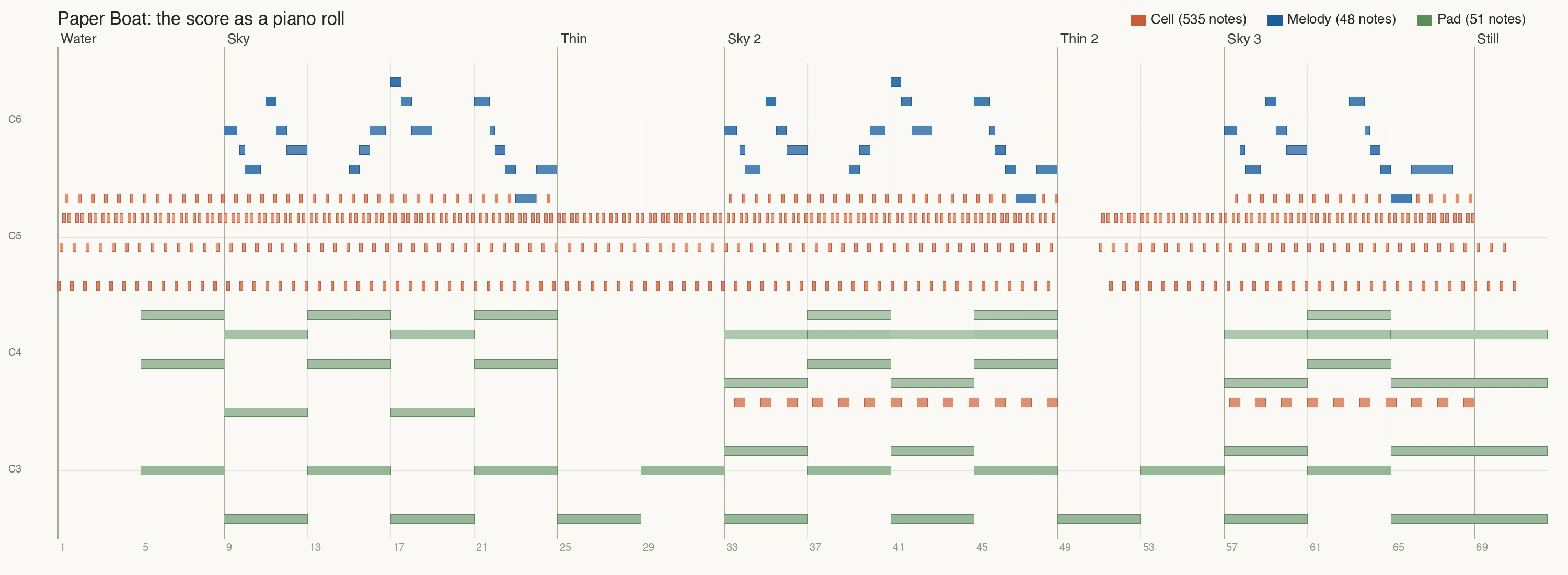
Read it as a musician would. The cell is five notes, G B D E D, played as eighth notes at 63 beats per minute, with a velocity contour that puts the weight on the first note and lets the fourth rise. Five eighth notes against a bar of eight means the cell realigns with the bar every five bars, which is the “distinct rhythmic signature” the sources describe: the figure drifts against the meter and comes back, and the ear hears weather rather than a loop. The pad holds two chords, G and C, and where a chord carries a seventh it sits a major seventh above the root and never a half step under the cell’s G. The melody is six long tones with a shape of its own: down a step, down a step, up a leap, down again. The sections are named for what happens in them, Water, Sky, Thin, Still, and the piece changes state at their boundaries, with one exception: in Thin 2 the cell waits two bars. In Thin the cell loses its fourth note and the pad drops to roots. In Still the cell plays only the first two notes of each cycle for two bars, then stops, and the pad rings for fourteen beats.
There is one seeded random generator in the whole piece, and it does one thing: a velocity jitter of plus or minus two on the cell and the melody. Nothing about timing is random anywhere on the album, because random timing does not sound human. It sounds drunk. Where a piece leans off the grid, it leans the same way every time. Night Train’s cell carries a timing curve, in milliseconds, that repeats every seven notes: [0, 10, 18, 22, 14, 4, -6]. That is a fixed, repeating deviation, and the timing test admits only those seven values.
Nearly every piece on the record is built this way: a device, a cell with its own contour, two to four chords, a melody signature that no other piece shares, and sections that add and subtract. Cloud Copy’s copy stands in for its melody, and Blue Hour’s one Rhodes note per bar stands in for its cell.
| # | Title | Key | BPM | Length | Device |
|---|---|---|---|---|---|
| 1 | Paper Boat | G | 63 | 4:36 | a five-note Rhodes cell cycling against the bar; a glass pad on two chords; long melody tones |
| 2 | Morning Glass | D | 66 | 4:24 | a seven-note cell over three chords, realigning every seven bars; a melody of repeated notes and a leap |
| 3 | Low Tide | A | 66 | 4:35 | a lilting bell figure in three over Rhodes dyads that follow each chord |
| 4 | Cloud Copy | E | 54 | 4:11 | a two-bar figure and its copy a fifth higher, one bar behind; no separate melody |
| 5 | Snow Street | A minor | 50 | 3:52 | Rhodes dyads with long rests; the pad arrives late; ends in silence |
| 6 | Night Train | D minor | 72 | 4:29 | a seven-note cell on a repeating timing curve; a low struck tone every two bars; a melody whose phrases open on a falling fifth |
| 7 | Blue Hour | G minor | 56 | 4:19 | a pad chorale on four chords with one Rhodes note per bar |
| 8 | Afternoon Shade | E flat | 60 | 4:18 | a seven-step mallet cell with two rests, phasing against the bar, the cell coming forward and back every four bars |
| 9 | Rain Window | A flat | 58 | 4:27 | single Rhodes notes in a fixed irregular pattern, like rain on glass, over open pads |
| 10 | Returning | C | 63 | 3:51 | the first piece’s cell again, transposed home, under a melody of dotted pairs on one note |
Tempo falls to its stillest at the fifth piece, Snow Street at 50, jumps to its fastest at Night Train, settles between 56 and 60, and the closer returns to the opener’s 63. The total is 43:06 from the exact lengths. Each length is shown rounded down to the second, so the column adds to 43:02.
What Logic Pro opens
The score is exported as a Type 1 Standard MIDI File at 480 ticks per quarter note. Track zero carries the tempo, the meter, the key signature and the section markers. Each instrument is its own track with a General MIDI program number that is the right instrument: Electric Piano 1 for the Rhodes parts, Pad 2 for the glass pad, Tubular Bells for Low Tide’s bells, Marimba for the mallet and the low tone.
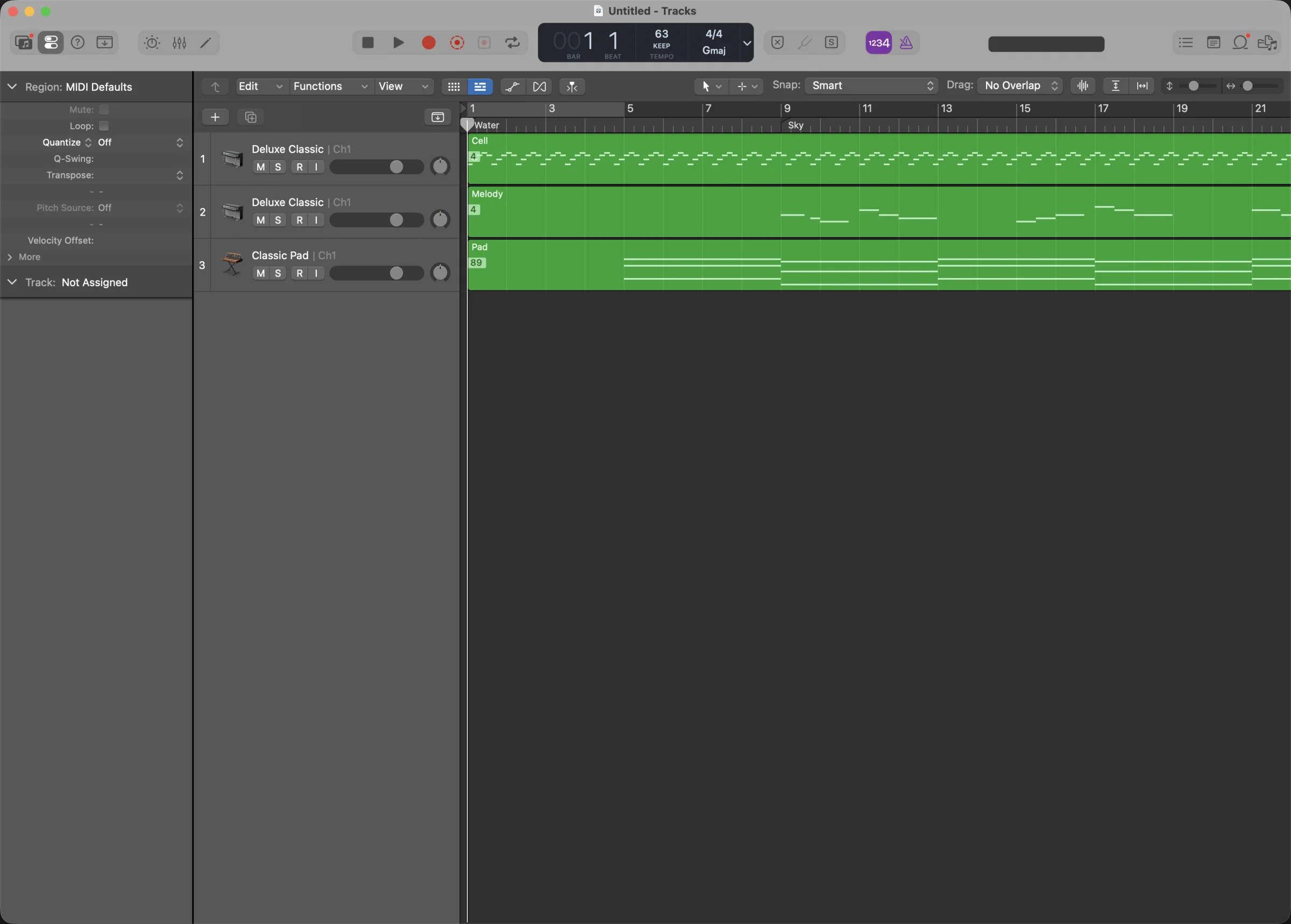
Open Paper Boat in Logic Pro and this is what arrives: the tempo set to 63, the key to G major, seven markers in the marker lane reading Water, Sky, Thin, Sky 2, Thin 2, Sky 3 and Still, and three tracks whose regions are named Cell, Melody and Pad, holding 535, 48 and 51 notes. Logic reads the program numbers, picks instruments without being asked, and names the tracks after them: Deluxe Classic, an electric piano, for the two Rhodes tracks, and Classic Pad for the pad. The Cell track is a staircase of eighth notes between G3 and E5 with velocities between 42 and 56. The Melody track is sparse enough that you can count it from across the room. The Pad is long chords of three or four notes, roots alone in the Thin sections, changing every four bars.
| Piece | Markers in Logic | Tracks in the file | Notes per track |
|---|---|---|---|
| Paper Boat | Water, Sky, Thin, Sky 2, Thin 2, Sky 3, Still | Cell, Melody, Pad | 535, 48, 51 |
| Low Tide | Bells, Dyads, Line, Alone, Line 2, Still | Bells, Dyad Pad, Melody | 512, 104, 15 |
| Snow Street | Dyads, Pad, Alone | Dyads, Melody, Pad | 60, 6, 9 |
| Night Train | Cell, Pad, Sky, Alone, Sky 2, Thin, Still | Cell, Melody, Pad, Low Tone | 552, 20, 30, 32 |
| Rain Window | Pad, Rain, Rain 2, Pad 2, Rain 3, Thin | Rain, Melody, Pad | 288, 10, 23 |
This is the point of the exercise. A generated track gives you a waveform, and every edit it allows, a trimmed span, a regenerated section, a separated stem, is an edit to a waveform. A composed one gives you a file you can open, read, count, and argue with. Which is what happened next.
Revision 2: the score could be criticized
The first revision was rendered, and before anyone had listened closely I asked for an evaluation “from a musical standpoint”. The analysis was done on the scores and the renders, not on a feeling, and it found five things wrong by the album’s own standard, none of them yet a written rule. Four of them became rules with tests. The fifth became a better device.
- One melody in five keys. Night Train’s first phrase was Paper Boat’s a whole step down, note for note. Returning’s was one pitch off. Morning Glass and Afternoon Shade used the same template. Every piece now has a melodic signature of its own, named in the source beside each piece, and the test refuses a phrase that is another piece’s transposed or that shares its rhythm. Cloud Copy has no separate melody at all: its copy is the melody.
- Half steps in one octave. Paper Boat’s pad held F sharp directly under the cell’s accented G forty-three times. Cloud Copy held E under F for three and a half beats on every F chord. Blue Hour dropped a B flat over an A bass. Sevenths now sit a major seventh above the root, or are left to the figure, and the test above holds it.
- No presence. The velocity rule chose the two darkest of the Rhodes’ five sample layers, so the 2 to 5 kHz band sat 28 to 35 dB under the body of the sound. The Rhodes parts now ask for the timbre of the layer sixty velocity steps higher at the written loudness, with a broad 4 dB lift at 3 kHz. The gap is 21 to 27 dB now in the eight pieces the Rhodes leads, and a test checks that the brighter layer arrives with the loudness within 2 dB of where it was.
- Two devices he would not have used. Afternoon Shade ran sixteenth notes for four minutes and barely moved, a loudness range of 7 LU on the EBU meter against 10 in revision 2. It is now a seven-step cell with two rests, phasing against the bar. Cloud Copy’s rolled triad with answering notes became a figure and its diatonic copy a fifth above, one bar behind.
- The running order. Low Tide in A was followed by Afternoon Shade in E flat, a tritone, and the last two pieces were both in C. The order now has no tritone, no half step and no repeated key, and a test holds it.
Revision 1 is kept, in a separate file, with its own renders. The decision to keep it was mine. The analysis, the fixes and the tests were Claude’s. I listened to both.
That exchange is not available with a generated track. You cannot tell an audio model that bar 23 has a flat ninth over the bass. You can ask Suno’s Song Editor to regenerate a few seconds around it and keep the rest,2 but what comes back is a fresh generation of that span, not bar 23 with one note moved.
The instruments
Four sounds, and a bed of tape.
- The Rhodes is jRhodes3c, Jeffrey Learman’s sample set of a 1977 Rhodes Mark I Stage 73, with up to five velocity layers and the set’s own stereo doubling.11 It plays the figures, the melodies and Low Tide’s dyad pad, on two separate buses so a melody gets its own echo and room. Its license says you “can use the sounds in any way in your works as an artist, just as you could with a real instrument”. What it restricts is redistributing the samples themselves. It is the one sound on the record not made for the record, and it is credited here.
- The glass pad is a sine with a whisper of second and third partials, a slow swell, a long release, three copies a few cents apart spread across the field, and a drift under a tenth of a percent so it breathes. It stands in for the “long, pure tones” a critic heard on the 1982 record,8 and it has nothing above 2 kHz by design.
- The FM bell is two-operator phase modulation with a 3.5 to 1 ratio, the classic inharmonic bell, with a second copy four cents sharp for shimmer, panned by pitch. Low Tide is built on it.
- The FM mallet is the same idea at a 4 to 1 ratio, the marimba’s tuned partial, with a short wooden decay. Afternoon Shade’s cell and Night Train’s low tone use it. The marimba notes that open Surround are the ancestor.6
- The tape is a bed of pink hiss under 6 kHz with a slow swell, 24 to 31 dB under the music across a piece, measured as the tape bus against the sum of the others, and alone in Snow Street’s rests. It is deliberate. On AirPods in the quiet stretches you can hear it as a soft warm hiss, a nod to the cassette tape he carried Nine Post Cards to the Hara Museum on.4
No drums, no bass guitar, no field recordings. The study says why for the last two, and the records themselves answer the first.
Rendering and the masters
The renderer and its instrument code are about twelve hundred lines of Python on NumPy and SciPy. Each track is rendered by its voice into a bus, each bus gets its own lowpass and reverb, the keys, lead and bell buses get their own delay, and the buses sum into a master that is leveled to -16 LUFS integrated by the renderer’s own ITU-R BS.1770-4 meter, with a look-ahead ceiling holding sample peaks at or below -3 dBFS.12 An independent meter, ffmpeg’s EBU R128 filter, reads the ten finished masters at -16.0 to -15.8 LUFS. Reverb is two and a half to three and a half seconds. The delays sit on a quarter, a dotted eighth or a dotted quarter, with feedback under 0.4. There is no compression in the musical sense, because the parts are quiet and sparse and the ceiling only catches the rare peak. Each master runs two and a half seconds past the end of the final bar, so the reverb tail is kept rather than cut.
The masters are written from the floating-point render, never from a 16-bit intermediate: 24-bit 44.1 kHz WAV at the native rate, nothing upsampled, with true peak measured by four-times oversampling at or below -1 dBTP. That is what Apple’s Digital Masters brief asks for: 24-bit sources at their native rate, no upsampling, and “at least 1 dB of headroom” against the clipping that oversampling on playback can cause.13 The same audio is written as 24-bit Apple Lossless with the cover embedded, and Apple uses one master for both its lossless and AAC encodes. With Sound Check on, Apple Music plays every song “at approximately the same loudness”, so a quiet record is not punished for being quiet.13 Here is the packager’s measured table, with each length taken from the released file:
| # | Title | Length | LUFS | Peak dBFS | True peak dBTP |
|---|---|---|---|---|---|
| 1 | Paper Boat | 4:36 | -16.0 | -3.0 | -2.9 |
| 2 | Morning Glass | 4:24 | -16.0 | -3.0 | -3.0 |
| 3 | Low Tide | 4:35 | -16.0 | -3.0 | -3.0 |
| 4 | Cloud Copy | 4:11 | -16.0 | -3.0 | -3.0 |
| 5 | Snow Street | 3:52 | -16.0 | -3.0 | -3.0 |
| 6 | Night Train | 4:29 | -16.0 | -3.0 | -3.0 |
| 7 | Blue Hour | 4:19 | -16.0 | -3.0 | -3.0 |
| 8 | Afternoon Shade | 4:18 | -16.0 | -3.0 | -3.0 |
| 9 | Rain Window | 4:27 | -16.0 | -3.0 | -3.0 |
| 10 | Returning | 3:51 | -16.0 | -3.0 | -3.0 |
Lossless is not special to composition. Any float render can be written at 24 bits, and a generator’s export can be too. What composition adds is that the chain is known end to end, score, instrument, bus, master, file, and every link in it can be opened.
The surround bed and the app
Because every instrument is on its own bus, with its dry signal and its wet signal available separately, the album could be mixed for a room rather than upmixed into one. The packager builds a 7.1.4 bed per piece: the dry signal of each instrument stays mostly in front, and its delay and reverb open into the sides, the backs and the four height channels, with pads and bells highest. Small delays, 7 to 23 milliseconds, decorrelate the copies so they spread rather than fuse into one image. The bed is written at 48 kHz, 24-bit, in the ITU channel order, wrapped as ADM Broadcast Wave with the standard’s own bed definition, and leveled to -18 LUFS by the packager’s own meter.14 That meter builds its filters for 44.1 kHz and gives the rear pair the 1.41 weight the standard reserves for side surrounds. A meter with the standard’s weights and 48 kHz filters reads the ten beds at about -18.0 to -17.8 LUFS. Every file then passes the EBU’s reference ADM renderer in strict mode, a second render of the file to 7.1.4 returns the bed to the bit, and the EBU renderer’s stereo render lands 2 to 5 LU under the stereo master, which is a different mix and meant to be.15
Those beds conform to the ITU’s model as far as the EBU reference renderer checks them in strict mode. They are not Dolby Atmos masters, which need Dolby’s own profile and metadata, and the store release is stereo. Spatial lives in the app instead.
Return plays one file per piece and never branches. The app’s files are 5.1 AAC at 320 kbps, folded from the 7.1.4 beds and leveled so the stereo fold sits at -16 LUFS by the packager’s meter, like the stereo masters. Why 5.1 and not 7.1.4: Apple Lossless stops at eight channels, and its one eight-channel layout puts the extra pair at front left-center and right-center rather than behind the listener. Apple’s AAC layout tags top out at eight as well. The default eight-channel tag is that same front-wide layout, and the side-and-rear variant that AAC does have has no counterpart in Apple Lossless. AAC also defines a 5.1 layout with two heights, which was not tried. 5.1 has one layout in both codecs, center, left, right, two surrounds and the low channel, so nothing lands in the wrong speaker, and it is the layout the app was tested with,16 and the heights fold into the fronts and surrounds.
In the app, the player is an AVPlayer. When the Music room starts, the audio session declares that the app offers multichannel content, which is what lets iOS offer the spatial treatment, and the player reads the current route to show a small headphones mark when the output reports Spatial Audio. On AirPods with Spatial Audio on, iOS renders the six channels around the listener, with head tracking if that mode is chosen. On a speaker, on most wired headphones, or with Spatial Audio off, it folds them to stereo. The app does nothing different in either case.
The rest of the room follows the brief. The pieces play in order and wrap, so a sit longer than the album starts it again. Each piece ends as written, so the album moves on by itself and never loops a piece seamlessly. The piece you were on is remembered for the next sit. The album sits at 0.6 of full volume under the bells, which ring at full level, and the final bell fades it out over a second and a half. On the sit screen, the previous and next buttons sit on either side of pause, a small label names the piece for four seconds when it changes and then fades, and nothing covers the scene. On Apple Watch the same ten pieces play as stereo copies through paired headphones. The app’s icon is a crop of the album’s cover, a glass cube in a bank of cloud, and the Music room’s scene is that cube turning over the cloud in a ten-second loop.
The release
The album went out through DistroKid on October 15, 2026, stereo only, with the 24-bit WAV masters and a 3000-pixel cover, and was on Apple Music the same day with ten tracks and Blake Crosley credited as composer on every one.1 The credits also carry a performer line, because the form requires a performer credit for Apple Music, and Keyboard was the role entered. Nobody played a keyboard on this record. The line is the form’s requirement, not a claim. The Dolby Atmos add-on, at $26.99 a track, was declined.17 The surround mix is in the app, where the people who sit with it are. The listing went in as Electronic with Electronica / Downtempo as its subgenre and New Age second, the closest fit the upload form offered, and Apple shows it as Electronica. The form’s own help page says to pick the genre “that most closely represents your music” when the exact one is not there.18
Two things about the credits matter more than the genre.
The cover is a Midjourney image. The art is generated, and the music is composed, and the difference is the subject of this piece. A prompt and a seed gave me a glass cube in cloud that I chose from a grid, and that was the right tool for one picture. It was the wrong tool for forty-three minutes of music that has to be revised at the level of a single note.
The stores are now asking what AI did. DistroKid’s help page says to add AI credits for “AI-generated audio”, “AI-generated lyrics” and “AI-generated compositions (melody or arrangement not composed by a human)”, and not when “you just used AI as a tool”, its examples being pitch correction, “AI-assisted mixing or mastering” and “AI-assisted workflows”. The upload form asks whether any of a track “was generated by AI”, with four answers: the lyrics, the music (“AI composed the melody”), all of the audio, or part of it, and the credits can be added or updated after upload.19 Spotify said in September 2025 that it would help develop and support the DDEX standard for AI disclosures in credits, and in its own words the use of AI tools “is increasingly a spectrum, not a binary” and the industry should not be “forced to classify every song as either ‘is AI’ or ‘not AI’”.20 By August 2026 it reported “tens of thousands of AI credits submitted daily”.21 Apple’s delivery specification added AI transparency tags in March 2026, and as of version 5.3.27 the tag has four values, Artwork, Track, Composition and Music Video, each for when AI “is used to generate a material portion of the content”, and “If omitted, none is assumed”. Track means “AI was used to generate a material portion of a sound recording”. Composition means “AI was used to generate a material portion of any music compositions embodied in a track”, which the specification glosses as “a material portion of the lyrics or other components of a composition”.22 This record went out with the question answered no. Track, and DistroKid’s part of the audio, are for sound a model generated, and no model generated any sound here. The audio came from a renderer playing a sampled Rhodes and three synthesizer voices written as code, the way a sample player or a softsynth plays a score. Claude wrote that code too, but code that makes a sine wave is an instrument, not a recording. The composition answers are the close ones. A model wrote the notes, and on a plain reading DistroKid’s “melody or arrangement not composed by a human” and Apple’s Composition value reach them. My reading is that those lines were written for generated songs, and that a score written as code, tested like code, revised under a person’s ear and rendered through instruments is an AI-assisted workflow, the exception DistroKid’s own page names, the way a sequencer’s output is. That reading is mine, and this piece is the disclosure, in more detail than any tag carries.
What this is not
- It is not a performance. Nobody played these pieces. The “hand’s roll” on a chord is about eleven or twelve milliseconds per note, written into the score, the same every time. If you want the thing a pianist’s left hand does with a slow Satie, this is not it, and it does not pretend to be.
- It is not Yoshimura. It is after him, by published descriptions of his method and his own notes, with no sample of his records and no transcription of his pieces. His records are better than this one. The reissues are on Light in the Attic.9
- It is not autonomous. I chose the composer. I heard Paper Boat and said it was nice and asked for an album. I asked for the evaluation that produced revision 2 and kept both. I said the first loop of the cover scene felt like a pause at the join, and the hiss in the quiet stretches was a question before it was a decision. The taste on this record is a person’s; the notes are a model’s; the rules are the handshake between them.
- The tests do not make it good. They keep it from being wrong by its own standard. A piece can pass all twelve rules and be dull. Two did, in revision 1, and the fix was a better device, not a tighter test.
What transfers
If you are going to put a model to work on music, make it write a score. Everything downstream of that choice gets better: you can read what it wrote, you can test what it wrote against the rules you gave it, you can change one note, you can name the instruments and credit them, you can follow the chain from score to master and open every step, you can mix for a room because every voice is on its own bus, and you can show a distributor exactly what was made and how. The alternative hands you a waveform. You can trim it, swap a span, split it into stems, even transcribe it to notes and move one, but the notes are a guess about a score that never existed, and the edit is an edit to the guess. Suno’s own Studio now writes MIDI clips from a chat request and plays them on its synth, which is this argument arriving inside a generation tool.
The ten MIDI files are the album’s score. They open in Logic, and in anything else that reads a Standard MIDI File.
-
Still Rooms by Dream of Electric on Apple Music, released October 15, 2026, ten tracks: https://music.apple.com/us/album/still-rooms/6824145686 ↩↩
-
Suno, “Introducing Suno Studio 2.0” (MIDI clips, audio dragged onto a MIDI track to transcribe it, the chat bar generating MIDI clips, 32-bit WAV export): https://help.suno.com/en/articles/13670529 ; Suno release notes (Stem Separation, June 11, 2026; Studio MIDI, September 17, 2026): https://suno.com/release-notes ↩↩
-
Yoshimura’s own account of Music for Nine Post Cards, reproduced in Diego Olivas, “Hiroshi Yoshimura: Music for Nine Post Cards (1982)”, FOND/SOUND, September 28, 2016: https://fondsound.com/hiroshi-yoshimura-music-for-nine-post-cards-1982 ; the home recording and the Hara Museum are in Light in the Attic’s notes for the reissue: https://lightintheattic.net/products/music-for-nine-post-cards ↩↩↩↩↩
-
Sam Thorne, “Hiroshi Yoshimura’s ‘Ambience of Sound, Sound of Ambience’”, e-flux Criticism, on the 2023 retrospective at the Museum of Modern Art, Kamakura & Hayama: https://www.e-flux.com/criticism/558398/hiroshi-yoshimura-s-ambience-of-sound-sound-of-ambience ↩↩
-
Hiroshi Yoshimura’s notes for Surround, as quoted on the album’s Bandcamp page (https://hiroshi-yoshimura.bandcamp.com/album/surround) and in Patrick St. Michel, “Everyday Ambient: The Legacy of Hiroshi Yoshimura’s Surround”, Bandcamp Daily, November 16, 2023, which also describes the marimba notes that open the record: https://daily.bandcamp.com/features/hiroshi-yoshimura-surround-feature ↩↩↩
-
Satoshi Ashikawa on Still Way (Wave Notation 2), as quoted in The Vinyl Factory, July 3, 2019: https://thevinylfactory.com/news/satoshi-ashikawa-still-way-wave-notation-2-vinyl/ ↩
-
Eric D. Bernasek, “Hiroshi Yoshimura: Music for Nine Post Cards”, Spectrum Culture, November 16, 2017: https://spectrumculture.com/2017/11/16/hiroshi-yoshimura-music-nine-post-cards-review/ ↩↩↩
-
Light in the Attic’s notes for the Green reissue (the FM synthesizers, the original mix, the American CD): https://lightintheattic.net/products/green ; the gear list from the American edition’s liner notes and the stream and birdsong that open it, in Diego Olivas, “Hiroshi Yoshimura: Green (1986)”, FOND/SOUND, October 14, 2016: https://www.fondsound.com/hiroshi-yoshimura-green-1986 ↩↩↩
-
Smack Media, “REVIEW: Hiroshi Yoshimura - Green”: https://www.smackmedia.ca/deep-cuts/green ↩
-
jRhodes3c by Jeffrey Learman, on sfzinstruments, with its README and license: https://github.com/sfzinstruments/jlearman.jRhodes3c ↩
-
ITU-R BS.1770-4, Algorithms to measure audio programme loudness and true-peak audio level: https://www.itu.int/rec/R-REC-BS.1770 ↩
-
Apple, “Apple Digital Masters: Music as the Artist and Sound Engineer Intended”, technology brief, April 2021: https://www.apple.com/itunes/docs/apple-digital-masters.pdf ↩↩
-
ITU-R BS.2051 (advanced sound system layouts, including 4+7+0) and ITU-R BS.2076 (the Audio Definition Model): https://www.itu.int/rec/R-REC-BS.2051 and https://www.itu.int/rec/R-REC-BS.2076 ; ITU-R BS.2094 (common definitions for the ADM, whose 4+7+0 bed the files use): https://www.itu.int/rec/R-REC-BS.2094 ↩
-
The EBU ADM Renderer, the reference implementation of ITU-R BS.2127: https://pypi.org/project/ear/ and EBU Tech 3388: https://tech.ebu.ch/docs/tech/tech3388v1.pdf ↩
-
Apple’s open-source ALAC codec, ALACAudioTypes.h (eight channels at most; the eight-channel layout is MPEG_7_1_B, C Lc Rc L R Ls Rs LFE; the six-channel layout is MPEG_5_1_D): https://github.com/macosforge/alac/blob/master/codec/ALACAudioTypes.h ; the AAC layout tags in Apple’s CoreAudioTypes, where AAC_7_1 is MPEG_7_1_B, AAC_7_1_B is the side-and-rear eight-channel tag (C L R Ls Rs Rls Rrs LFE) that ALAC does not define, and AAC_5_1 is MPEG_5_1_D: https://developer.apple.com/documentation/coreaudiotypes/audiochannellayouttag ↩
-
DistroKid Help Center, “Uploading a Dolby Atmos Mix of Your Music” (“Adding a Dolby Atmos file to a release costs $26.99 per track”): https://support.distrokid.com/hc/en-us/articles/4403029574675-Uploading-a-Dolby-Atmos-Mix-of-Your-Music ↩
-
DistroKid Help Center, “Genre Selection on the Upload Form”: https://support.distrokid.com/hc/en-us/articles/360021512113-Genre-Selection-on-the-Upload-Form ↩
-
DistroKid Help Center, “What Are AI Credits?”: https://support.distrokid.com/hc/en-us/articles/50784235803411-What-Are-AI-Credits and “How to Fill Out AI Credits”: https://support.distrokid.com/hc/en-us/articles/50784709021971-How-to-Fill-Out-AI-Credits ; the rollout as reported by Digital Music News, May 14, 2026: https://www.digitalmusicnews.com/2026/05/14/distrokid-ai-credit-disclosure-what-it-looks-like/ ↩
-
Spotify, “Spotify Strengthens AI Protections for Artists, Songwriters, and Producers”, September 25, 2025: https://newsroom.spotify.com/2025-09-25/spotify-strengthens-ai-protections/ ↩
-
Spotify, “Introducing a New Label for AI-Generated Artist Identities on Spotify”, August 11, 2026: https://newsroom.spotify.com/2026-08-11/ai-persona-badges-transparency/ ↩
-
Apple Music Specification 5.3.27, the ai_transparencies tag (added in 5.3.25, March 2026): https://help.apple.com/itc/musicspec/en.lproj/static.html ↩